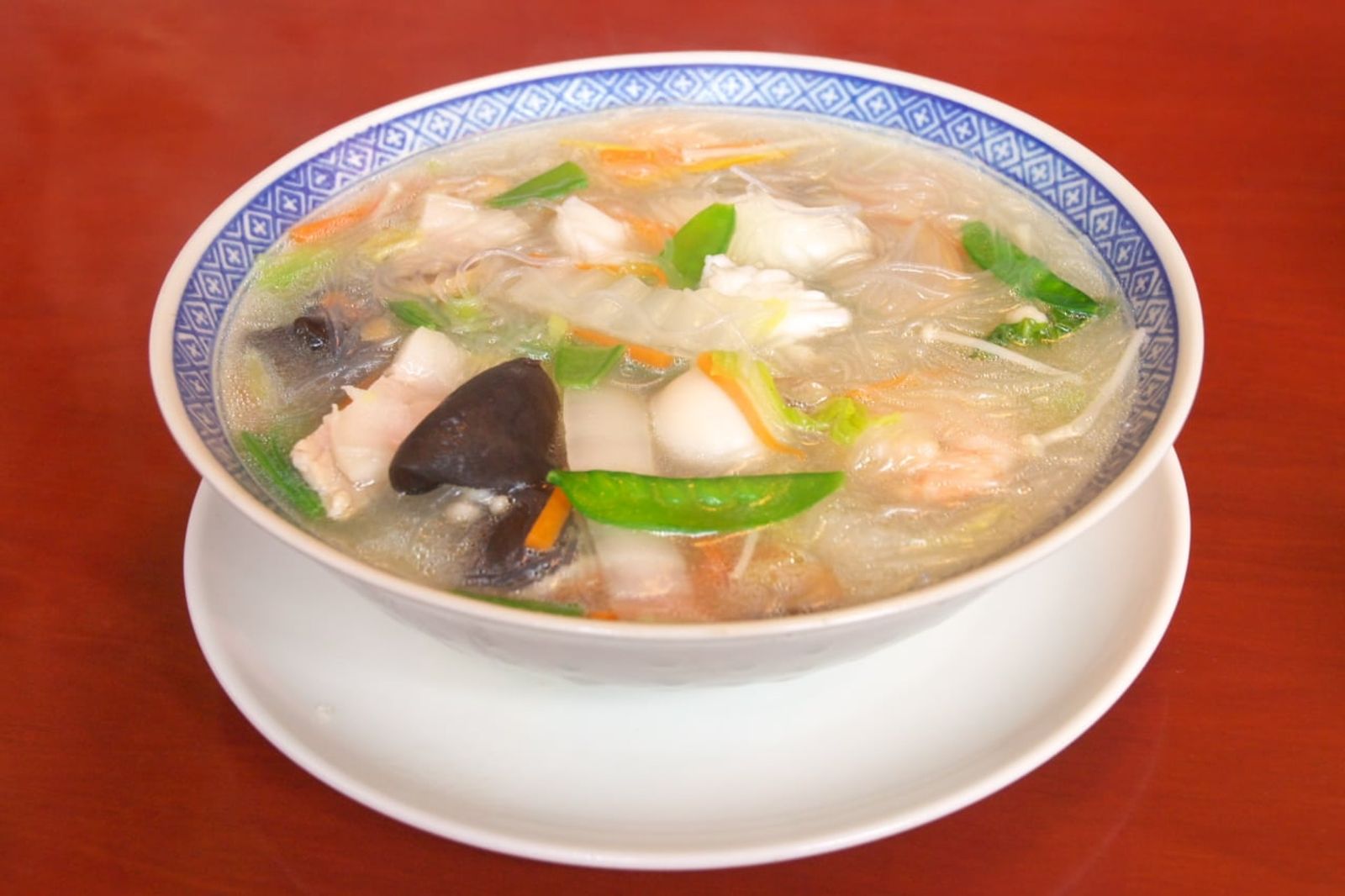
Taipien in Kumamoto · Photo: woinary / CC BY-SA 2.0 (Wikimedia Commons)
 JapanKumamoto
Taipien: How a Fuzhou Banquet Dish Became a Kumamoto School Lunch Favourite
It looks like ramen, but the noodles are glass noodles and there is a fried egg on top. Taipien, which Kumamoto kids grow up eating at school, came from Fuzhou in China. Here is what the name means, how it changed in Japan and how to order it.
It Looks Like Ramen, but the Noodles Are Glass Noodles
Taipien (太平燕) is a soup dish found in almost every Chinese restaurant in Kumamoto. In a big bowl it looks like champon or tanmen, but the key difference is that it uses harusame, glass noodles usually made from mung beans, instead of wheat noodles. On top go stir-fried seafood and vegetables such as shrimp, squid, pork, napa cabbage, bamboo shoots and wood ear mushrooms, finished with an egg that is boiled and then deep-fried. That egg is called kohitan (虎皮蛋), "tiger-skin egg", because its wrinkled fried surface looks like a tiger's hide. The broth varies by restaurant, from soy sauce to salt to tonkotsu pork bone, and some places use a boiled or quail egg instead. Since it is built on glass noodles and vegetables, many restaurants promote it as a lighter option than ramen.
Its Home Is Fuzhou: A Name That Means Peace
Taipien's roots lie in a local dish of Fuzhou in Fujian Province, China. According to Japanese Wikipedia, the Fuzhou version is a soup of wonton-like dumplings, wrapped in thin skins made from pork and sweet potato starch, together with duck eggs. In the Fuzhou dialect the word for duck egg sounds like a phrase meaning "to quell unrest", so the dish became a wish for peace, and under the name 太平宴, "peaceful banquet", it was served at weddings and other celebrations. In Japan the name is written with 燕, "swallow", instead of 宴, "banquet"; the two characters are pronounced the same in Chinese. The characters may make you think of bird's nest soup, but there is no bird's nest in it. The Fuzhou dish and Kumamoto's taipien look so different that you could almost call them two dishes sharing one name.
Brought by Chinese Immigrants in the Meiji Era, Then Reinvented
Taipien is said to have been brought to Japan by Chinese immigrants in the Meiji era (1868–1912). Duck eggs were hard to find in Japan at the time, so cooks switched to fried chicken eggs, and replaced the labour-intensive dumpling skins with glass noodles, which turned the soup into something close to a noodle dish. Exactly when it first appeared in Kumamoto is unclear. A Chinese restaurant that opened inside a city department store around 1933 is often named as the originator, but other Chinese restaurants that opened around 1933–34 are also put forward. One writer who studied the dish argues that no single restaurant can be crowned, because Chinese restaurants at the time shared information closely. Rather than settling the debate, it makes more sense to see taipien as something Kumamoto's Chinese community developed together in the 1930s.
An Everyday Kumamoto Dish, Even at School
Taipien is eaten mainly in central Kumamoto Prefecture and is said to appear on school lunch menus in Kumamoto City as well as Uto, Uki and Nankan. For people from Kumamoto, then, it is less a special meal out than a familiar taste from childhood, a Chinese dish woven into local life much like champon in neighbouring Nagasaki. From the 2000s it was increasingly described as a healthy noodle dish, thanks to its low-calorie glass noodles and generous vegetables. In 2005 several food companies released cup versions, and in 2008 a Tokyo-area Chinese restaurant chain added it to its menu, spreading the name in the Kanto region. Even so, it remains unfamiliar outside Kumamoto, which is why it counts as a speciality worth trying on the spot.
Where to Eat It and How to Order
You will find taipien at Chinese restaurants and casual diners around the Shimotori and Kamitori arcades in central Kumamoto City and near Kumamoto Station. It is written 太平燕 on menus; some places let you choose the broth or offer a smaller bowl. Portions are generous, so if you are ordering other dishes, pick the small size or share. Glass noodles soak up broth quickly and go soft, so eat it as soon as it arrives. Eat the fried egg while its skin is still crisp, or let it soak up the broth first; either way works. It is a good choice if you want to avoid wheat noodles, but ingredients and broths differ, so ask the restaurant if you have allergies.