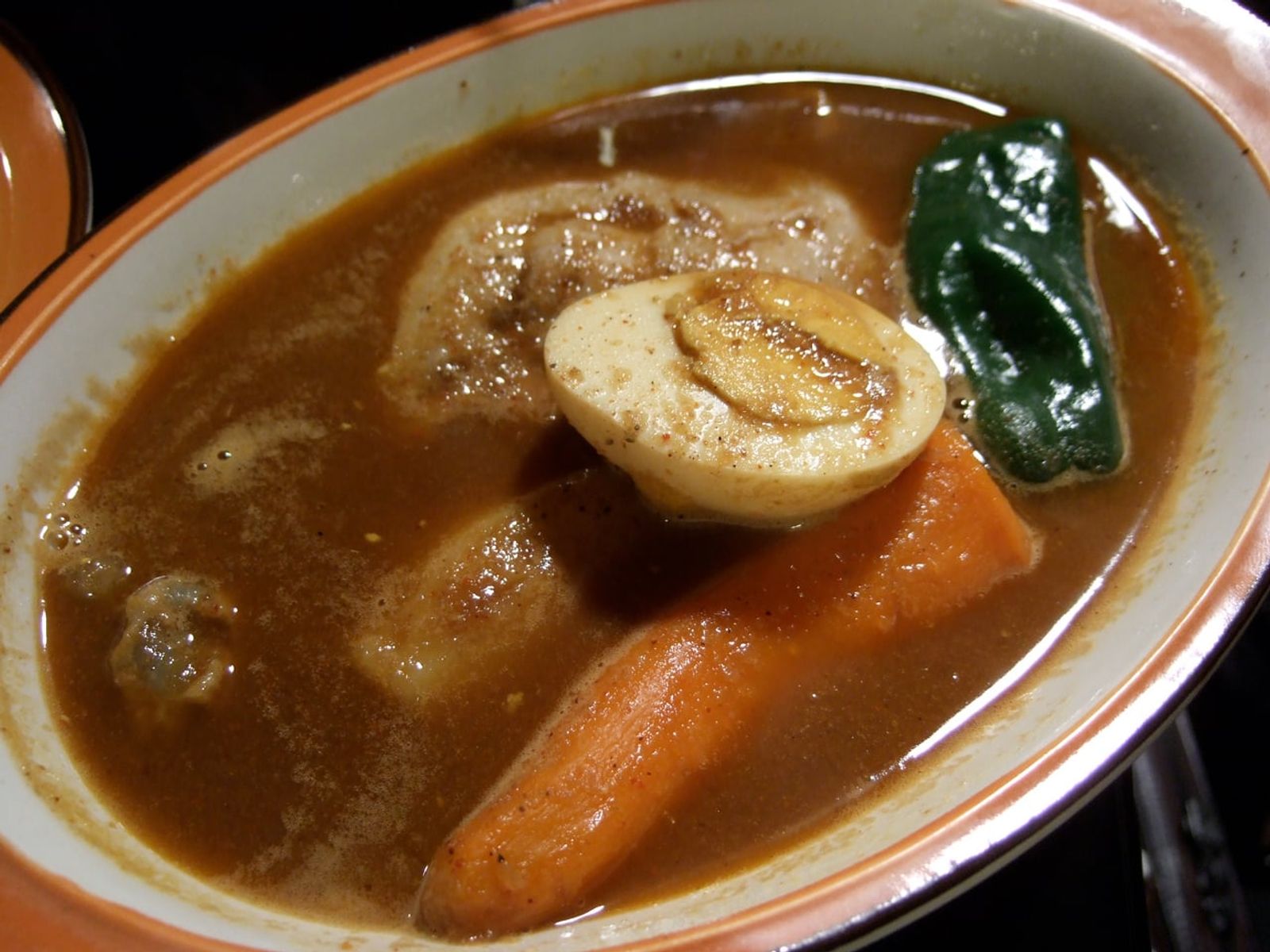
Chicken and vegetable soup curry in Sapporo · Photo: pelican from Tokyo, Japan / CC BY-SA 2.0 (Wikimedia Commons)
 JapanSapporo
Soup Curry: Sapporo's Brothy Curry, From a 1970s Café to Your Order Sheet
Unlike thick Japanese curry, soup curry is a thin, spice-forward broth loaded with a chicken leg and big chunks of vegetables, and Sapporo is its home. Here is how it began, why it boomed in the 2000s, and how to handle the ordering and eating that puzzle first-timers.
It Began as "Medicinal Curry" at a Café
The most commonly cited origin of soup curry is the "yakuzen curry" served at a Sapporo café in 1971, a thin curry made with medicinal herbs and spices. Around 1975 a customer asked for a whole chicken leg to be added, and chunky carrots and green peppers followed, giving the dish the basic shape it still has today. In the 1980s, a few Sapporo restaurants began serving Sri Lankan-style or unusual spice-led curries. But the name "soup curry" did not exist yet. Each shop was simply serving its own kind of curry.
The Name "Soup Curry" and the 2000s Boom
The first shop to use "soup curry" as a product name opened in Shiroishi Ward, Sapporo, in 1993, and it calls itself the originator. So when people argue over who invented it, some point to the 1971 café curry and others to the 1993 name. Shops multiplied from around 1999. A 2002 guidebook covering about 100 Sapporo curry shops sold 33,000 copies, and in 2003 a Sapporo shop opened at a curry-themed attraction in Yokohama, taking the dish national. A popular Hokkaido-born actor's enthusiasm for soup curry also helped. By around 2012, Sapporo had more than 200 soup curry shops.
A Dish Where Soup and Toppings Are Cooked Separately
What sets soup curry apart is how it is made. Regular Japanese curry simmers everything together and thickens it with roux. Soup curry cooks the broth and the toppings separately and brings them together in the bowl, so the vegetables keep their shape and texture. Chicken leg was the original star, but pork, lamb and seafood are now common too. Grilled or fried vegetables such as potato, eggplant, okra and lotus root go in whole or in big pieces, so one bowl is a tour of Hokkaido produce. Broths vary widely by shop, from tomato-based soups to ones made with veal stock and finished with basil oil.
The Ordering System That Confuses First-Timers
At many soup curry shops, ordering means more than picking one dish. You typically choose (1) the main ingredient, such as chicken leg, vegetables or pork, (2) the broth, (3) the spice level, (4) the amount of rice and (5) extra toppings. The spice level is the one to watch. Many shops use numbered levels, but the scale varies completely from shop to shop, so a "3" in one place is not a "3" in another. Even if you love heat, pick a middle or lower level at a new shop and add spice from the table if needed. Toppings include cheese, egg, natto and seasonal vegetables, and many shops serve the rice with a slice of lemon.
How to Eat It, and Where
Soup curry arrives with the rice and soup served separately. There is no fixed rule, but a common local way is to scoop some rice onto your spoon and dip it in the broth. Tipping all the rice in at once makes it soggy, so dipping a little at a time keeps it good to the last bite. The chicken leg is usually cooked so tender it comes off the bone with a spoon and fork. Soup curry shops are scattered all over Sapporo, so you will find them easily around Sapporo Station, Odori and Susukino. Popular places get queues at lunchtime, so go a little early or later in the afternoon. Thanks to the spices, it is everyday food in Sapporo not just in the cold winter but in summer too.