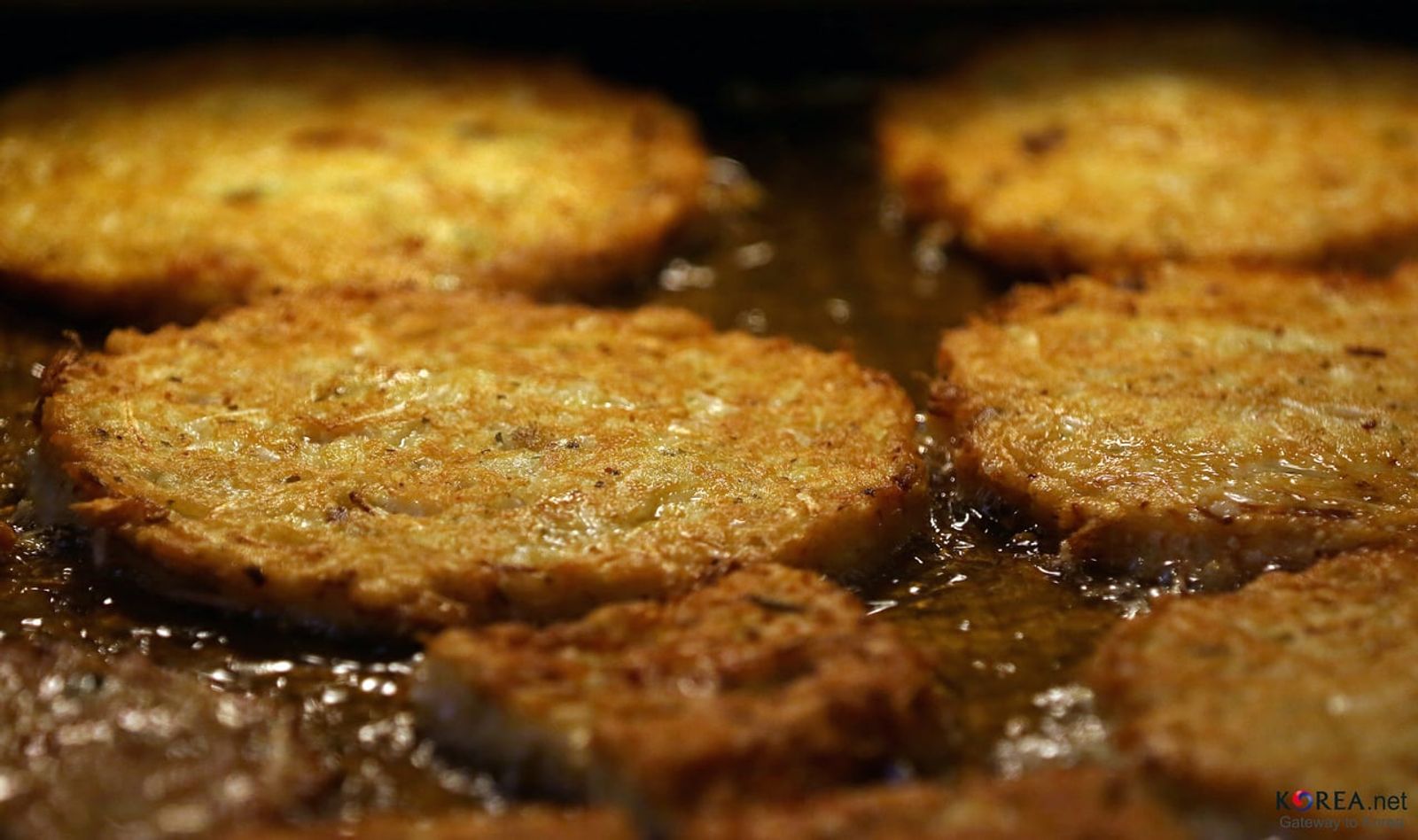
Bindaetteok at Gwangjang Market · Photo: Korea.net / Korean Culture and Information Service / CC BY-SA 2.0 (Wikimedia Commons)
 KoreaSeoul
Bindaetteok at Gwangjang Market: Mung Bean Pancakes in a 120-Year-Old Market
Step into Gwangjang Market in Jongno and the first thing you hear is mung bean batter sizzling in oil. Here is the history of what is often called Korea's first permanent market, the theories behind the name bindaetteok, and how to enjoy it there.
Gwangjang Market, Opened in 1905
Gwangjang Market was founded in 1905 when merchants set up the Gwangjang Company, and it is often described as Korea's first permanent market. The plan was to build it between the Gwanggyo and Janggyo bridges over Cheonggyecheon, hence the name 廣長, "wide and long". When it ended up at Baeogae, today's Jongno 4-ga and 5-ga area, the characters changed to 廣藏, meaning "to gather widely and keep". Its 1907 permit used the name Dongdaemun Market, and only after other large markets appeared nearby in the 1960s did people start calling it Gwangjang Market. It began as a general market for silk, hanbok fabric and textiles, but the food alleys that fed merchants and shoppers kept growing, and today it is better known to travellers as one of Seoul's signature places to eat.
Why Is It Called Bindaetteok?
Bindaetteok is a pan-fried pancake made from soaked, ground mung beans mixed with bean sprouts, bracken, kimchi and pork, and it is also called nokdujeon or mung bean pancake. It tastes nuttier and heartier than a flour-based green onion pancake, and a good one is crisp outside and moist inside. No one is sure where the name comes from, and several stories circulate. One links it to the word "bingja" found in a Joseon-era Chinese phrasebook. Another says it was "binjatteok", a cake for the poor. A third claims a neighbourhood around Jeong-dong in Seoul was nicknamed for its bedbugs (bindae) and was full of binjatteok sellers. Sources disagree, so treat these as good stories rather than settled fact.
From Royal Mung Bean Cakes to Post-Liberation Street Food
Ground mung bean pancakes have a long history. The 17th-century cookbook Eumsik Dimibang includes a recipe called "binja-beop", though it looked quite different from today's version, with sweet red bean filling between layers of batter. Later texts show it gradually taking on meat and vegetables. Some see it as a palace and aristocratic mung bean cake that spread to ordinary households. Bindaetteok was especially popular in the northwest, in Hwanghae and Pyongan provinces, where the Pyongan version is known for being much larger and thicker than the Seoul style. Right after Korea's liberation in 1945 it was among Seoul's most common street foods, and the 1943 song "Bindaetteok Gentleman" joked that if you had no money, you should go home and fry yourself some bindaetteok. It was that much of an everyday dish.
How to Enjoy It at Gwangjang Market
In the bindaetteok alley at Gwangjang Market, you can watch vendors grind mung beans in stone mills right at the stall, then fry thick rounds of batter on big oiled griddles. Some vendors say beans ground in a stone mill rather than a machine give a better texture, and market bindaetteok is generally much crispier outside than the home-made kind. It is usually dipped in soy sauce with sliced onion, and many people pair it with makgeolli to cut through the richness. One pancake is quite big, so it works well for two people to share one and try other dishes too. The market is also known as the birthplace of kkoma gimbap (mini gimbap, nicknamed "mayak gimbap"), and its yukhoe (beef tartare), sundae and jokbal are famous as well, so sample a little of everything.
Getting There and Travel Tips
Gwangjang Market is close to Exit 8 of Jongno 5-ga Station on Line 1 and Exit 4 of Euljiro 4-ga Station on Lines 2 and 5. According to Seoul city information, the market shops are generally open Monday to Saturday from 9 a.m. to 6 p.m., the food alleys open daily from 9 a.m. to 11 p.m., and regular shops close on Sundays. The food stalls cluster around the East Gate, North Gate 2 and South Gate 1 on the Cheonggyecheon side. Weekend evenings are packed shoulder to shoulder, so weekday afternoons are your best bet for a seat. Stalls have long shared benches, so travel light. Afterwards, it is natural to stroll along Cheonggyecheon right next door or walk on toward the shopping streets of Dongdaemun.