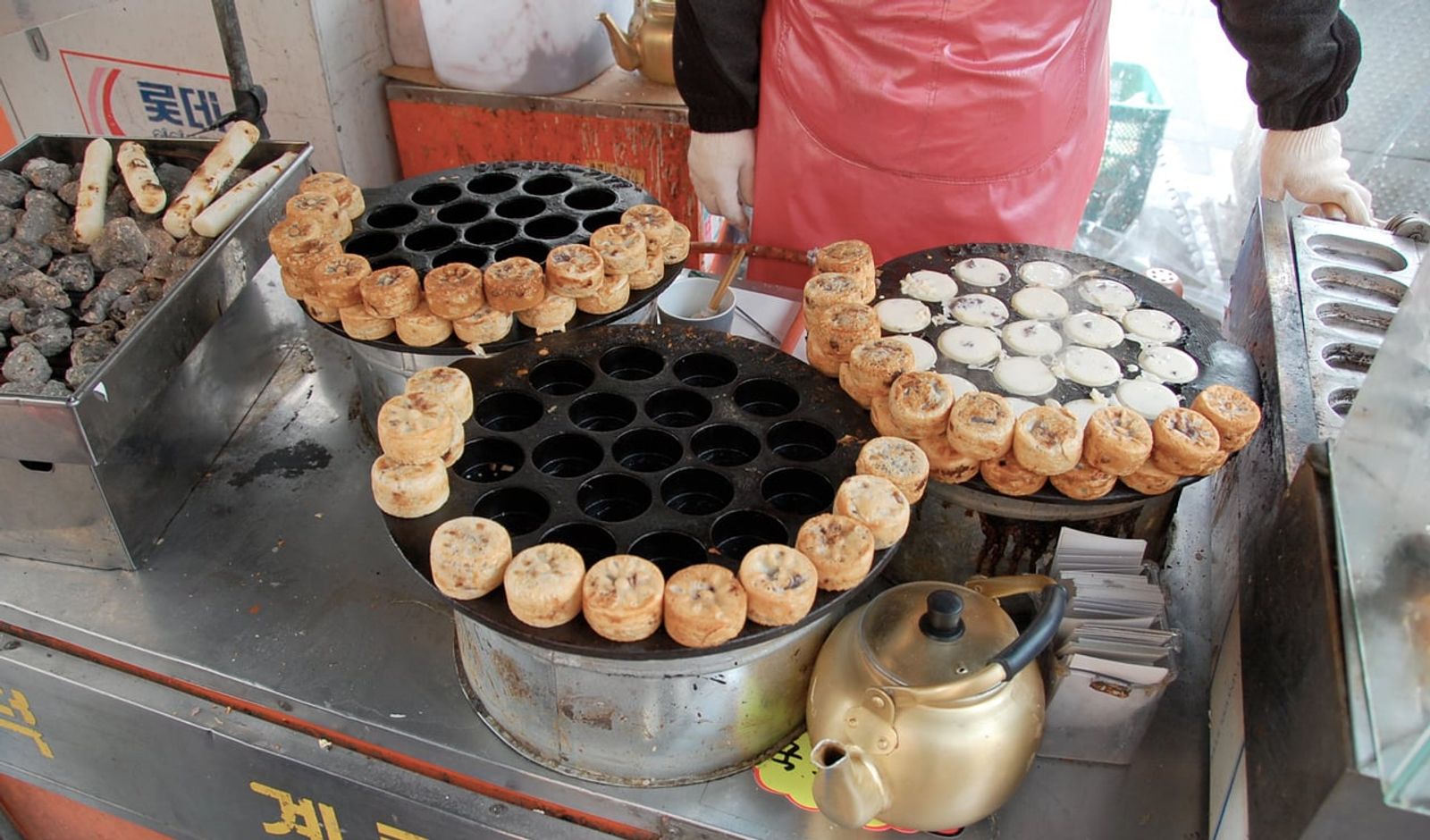
Freshly baked gukhwappang · Photo: by LWY / CC BY 2.0 (Wikimedia Commons)
 KoreaSejong
Jochiwon's Five-Day Market (Sejong Traditional Market): Mung Bean Pancakes, Gukhwappang and Seasonal Fruit on Market Days
Sejong is known as a neat, planned city, but it also has a market that has been holding market days for more than 90 years. Here is the story of Sejong Traditional Market in Jochiwon-eup, the legend behind the name Jochiwon, what to eat on market days ending in 4 and 9, and tips for a visit.
A Market Held on the 4th and 9th Since 1931
In the Joseon era, Jochiwon belonged to Cheongju-mok and was already a crossroads of transport and trade where markets were held. In 1931 an official five-day market was set up across the Won-ri and Jeong-ri area, opening on every date ending in 4 or 9 (the 4th, 9th, 14th, 19th, 24th and 29th). People came from nearby Cheonan, Gongju and Daejeon, shops took root, and it grew into a proper traditional market. Long called Jochiwon Traditional Market, it was renamed Sejong Market, now Sejong Traditional Market, when Sejong Special Self-Governing City was launched on 1 July 2012. Unlike the new town of government complexes and apartment blocks, this market in old Jochiwon still has the classic market-day scene, with long rows of stalls selling vegetables, fruit, fish and side dishes.
The Story of "Choe Chiwon's Market" Becoming "Jochiwon"
An entertaining story lies behind the name Jochiwon. Choe Chiwon, a scholar of late Silla, is said to have opened a market here and encouraged trade, so people called it "Choe Chiwon's market", and over time the pronunciation shifted to "Jochiwon". The tale has not been verified, but it is widely told locally as a place-name legend showing that the area has long been known for its market. The name does appear in 18th-century records. The Donguk Munheon Bigo, compiled in 1770, and Seo Yu-gu's encyclopedia Imwon Gyeongjeji are said to mention Jochiwon-ri. In earlier times, goods passed through on the road linking Hanyang (Seoul) with the Honam region and on boats along the nearby Geum River, and once the railways arrived, Jochiwon Station, where the Gyeongbu and Chungbuk lines meet, took over that role.
Market-Day Food to Try
Sejong Traditional Market is packed with food, from the local specialty padak to dumplings, sundae, jokbal, jeon (savoury pancakes) and fried snacks. A report from a September 2026 visit described buying mung bean pancakes, whole fried chicken, pressed pork head meat, tteokgalbi (grilled short rib patties) and hotteok to make a feast, and noted that gukhwappang cost 2,000 won for five. Snacks such as peanut-shaped cakes, seed-filled hotteok, dasik, yakgwa and gangjeong are part of the market-day fun too. Gukhwappang are small cakes baked in chrysanthemum-shaped moulds from a thin batter with red bean filling; eaten hot, they are crisp outside and sweet inside. Ssiat hotteok are pan-fried pancakes stuffed with nuts and seeds, and the mung bean pancakes are fried to order from freshly ground batter. Some items sell out quickly on busy market days, so go in the morning.
Jochiwon Peaches and Seasonal Fruit
The fruit stalls at Sejong Traditional Market change with the seasons. Alongside the local specialty, Jochiwon peaches, they fill up with seasonal fruit such as Korean melons, plums, apples and pears. In midsummer Jochiwon peaches take centre stage, and the market is crowded with people carrying them home by the box. Many vendors offer tastings, so try a slice before you choose. The old market custom of throwing in an extra piece when you buy several is still alive here too. Autumn is apple and pear season, so if you visit around now it is a good time to pick firm, fragrant fruit. If carrying a lot is a burden while travelling, it is perfectly fine to buy just a few pieces for the day.
Getting There and Market Tips
Sejong Traditional Market is in old downtown Jochiwon, close to Jochiwon Station. Trains on the Gyeongbu and Chungbuk lines stop at the station, making it easy to reach by rail from Seoul or Daejeon, and city buses run from Sejong's new town. The permanent shops open on other days too, but to see the lively scene with long rows of stalls, time your visit for a market day ending in 4 or 9. Bring some cash on market days, and many stalls also accept Onnuri gift certificates (traditional market vouchers). In crowded lanes, it is polite to ask a vendor before taking photos. After exploring, pick up some Jochiwon padak to go, or in summer buy peaches, and head to new-town sights such as Sejong Lake Park.