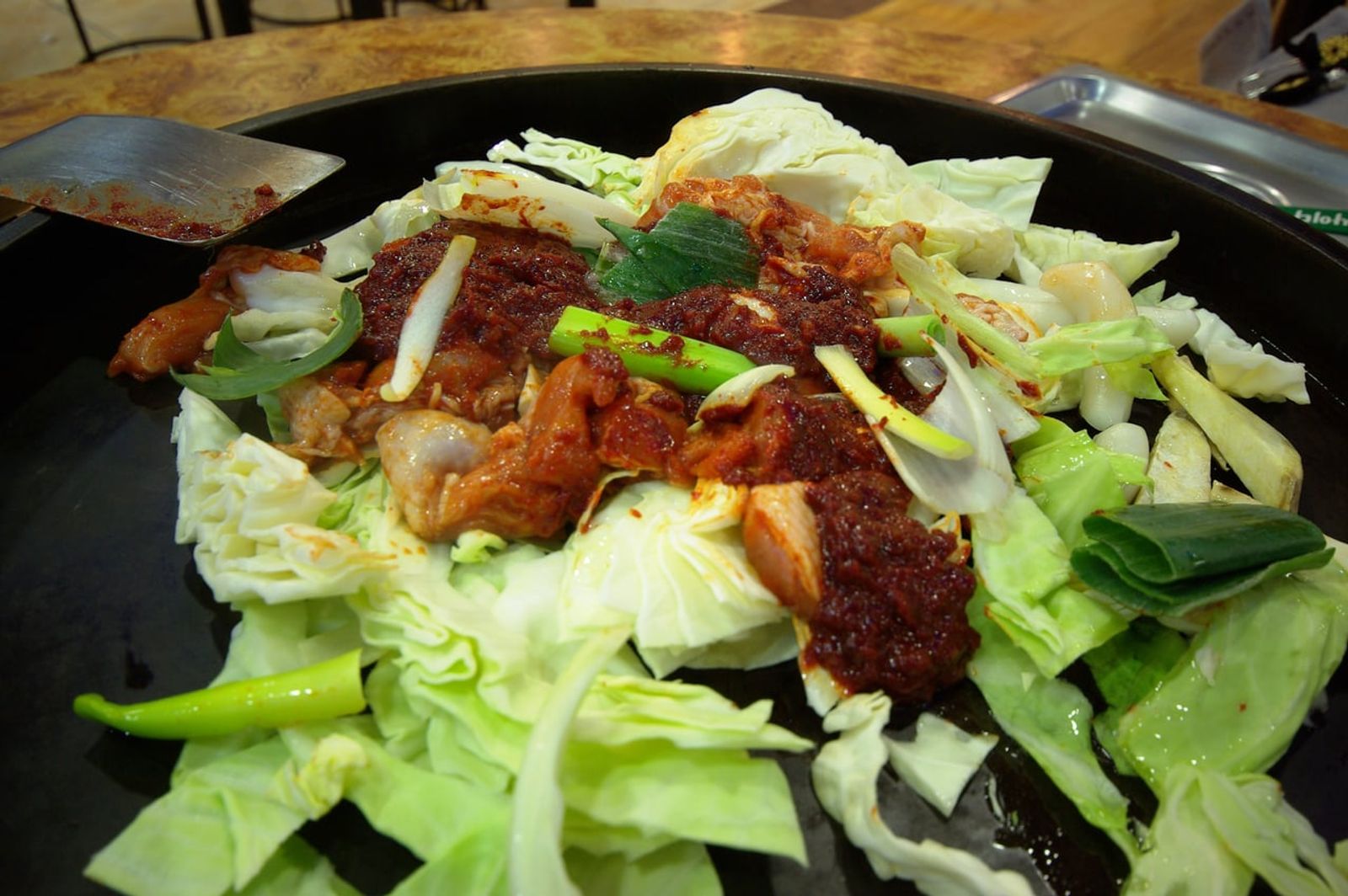
Iron-plate dakgalbi, Chuncheon Myeongdong style · Photo: Beeniru / CC BY-SA 3.0 (Wikimedia Commons)
 KoreaGangwon
Chuncheon Dakgalbi: How a "Rib" Dish With No Ribs Became a Student and Soldier Favorite
Dakgalbi contains no ribs at all. From a 1960s Chuncheon story about grilling chicken in place of pork to charcoal versus iron-plate styles and the fried rice finale, here is how to enjoy Chuncheon dakgalbi properly.
Called Galbi, Made With Chicken
Dakgalbi is chicken cut into pieces, opened out flat and marinated in a sauce of gochujang, soy sauce, garlic and ginger, then stir-fried on a large iron plate with cabbage, sweet potato, onion, green onion and rice cakes, or grilled over charcoal. Despite the name, no beef or pork ribs are involved, and it is not even made only from chicken ribs. Boneless thigh meat is typical. The story goes that the name stuck because the chicken was first seasoned and grilled the way pork galbi is. You can find dakgalbi signs all over Korea, but for most Koreans the word immediately brings Chuncheon in Gangwon Province to mind. Chuncheon is known as the place where the dish was born and spread from, and the city still has streets lined with dakgalbi restaurants.
1960s Chuncheon: Two Chickens Instead of Pork
The best-known origin story goes like this. One day in the 1960s, the owner of a small drinking spot on Jungang-ro in Chuncheon, who usually served pork, could not get hold of any. He bought two chickens instead, cut them up, seasoned them like pork galbi and grilled them over charcoal. At first it was sold as dak bulgogi, or chicken bulgogi. The timing, however, differs from source to source. Some accounts say around 1960, while others place it in the mid-to-late 1960s or at the end of the decade. Where the first shop stood is also told two ways: the back alleys of Jungang-ro, or the Hupyeong-dong and Myeongdong area. A common explanation for why the dish took off here is that poultry farming was active around Chuncheon and there were many slaughterhouses, so chicken was easy to come by.
Nicknamed "Student Galbi" and "Common Folk's Galbi"
Dakgalbi became widely known in the 1970s. Restaurants multiplied around Myeongdong, Chuncheon's busy shopping area, and the dish was a hit with soldiers on leave and university students because it was cheap and filling. With many military bases and several universities nearby, there was no shortage of customers. In the early 1970s a portion reportedly cost about 100 won, which earned it nicknames like "student galbi" and "common folk's galbi." Accounts differ on when the restaurants began clustering in the back alleys of Myeongdong, with some saying the late 1960s and others the 1970s and 80s. When the 2002 drama Winter Sonata, filmed in Chuncheon, became a hit in Japan and across Asia, dakgalbi gained fame abroad along with the city, and today it is a dish foreign travelers seek out on purpose.
Charcoal or Iron Plate, Plus Taebaek's Soupy Version
Dakgalbi started out as a charcoal dish, grilled on a wire rack. According to reports citing the National Folk Museum of Korea, a dedicated dakgalbi plate was developed in Chuncheon in 1971, after which it came to be stir-fried with vegetables on a wide, round cast-iron plate, and this iron-plate version is now the most common. Chuncheon still has plenty of charcoal dakgalbi restaurants that grill the marinated chicken over coals, so it is worth trying both. Charcoal gives a smoky, chewy result, while the iron plate blends the sauce with the sweetness released by the vegetables. Elsewhere in Gangwon, the former coal-mining city of Taebaek has its own mul dakgalbi, or soupy dakgalbi. Said to have originated there in the 1970s or 80s, it is marinated chicken simmered like a hot pot with stock, glass noodles, vegetables and shepherd's purse. Think of it as dakgalbi adapted to life in a mining town.
Ordering Tips and Where to Try It
Iron-plate dakgalbi is ordered by the portion, and many restaurants require a minimum of two, so solo travelers should check first. Staff often stir-fry it at the table for you, so just wait until it is fully cooked. You can add extras such as rice cakes, sweet potato, udon noodles or cheese, and since the sauce tends to splatter, many places hand out aprons. Once the meat is gone, the classic finish is fried rice: rice and crumbled seaweed are tossed in the leftover sauce on the plate. Locals also like to pair dakgalbi with makguksu, Chuncheon's other famous dish. The Myeongdong Dakgalbi Alley in downtown Chuncheon is the best-known spot and appears in Gangwon tourism guides as a signature food street. Chuncheon has also held a Makguksu and Dakgalbi Festival every year.