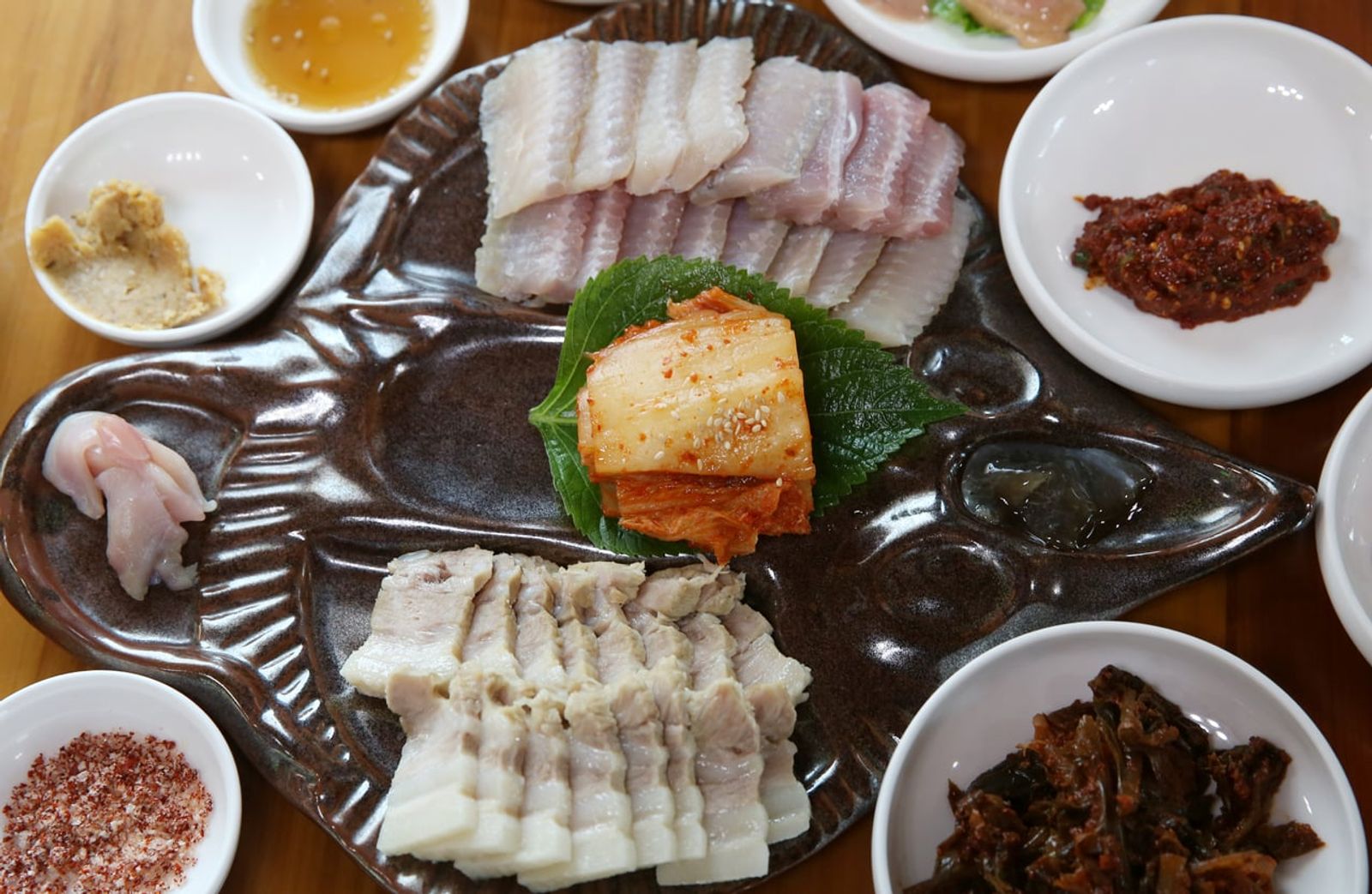
A hongeo samhap spread in Naju · Photo: Republic of Korea (Korea.net) / CC BY-SA 2.0 (Wikimedia Commons)
 KoreaSouth Jeolla
Fermented Skate and Hongeo Samhap: How Inland Yeongsanpo Became Korea's Skate Town
Fermented skate, famous for its sharp ammonia kick, is a must at any feast in Jeolla. Here is the story of the old river route that carried skate from Heuksando up the Yeongsan River, how to eat samhap and hongtak, and how to order if it is your first try.
Why Is Skate Eaten Fermented?
Skate (hongeo) is a flat, diamond-shaped cartilaginous fish. Unlike most fish, its flesh holds a lot of urea, which breaks down over time into ammonia and trimethylamine. At the point where an ordinary fish would simply go bad, skate ferments instead of rotting, and that gives it a sharp, fizzy bite that hits your tongue and nose at the same time. That is why Jeolla developed a culture of fermenting skate in earthenware jars. In the southwest there is a saying that a party without skate is not a party, and it appears at weddings, funerals and holidays alike. There is also fresh, unfermented skate tossed in spicy vinegared gochujang, so how strongly people like it varies by town and by family.
From Heuksando to Yeongsanpo: The Legend
The place most often named as the home of fermented skate is Yeongsanpo in Naju, far from the sea. According to local legend, when Japanese pirate raids grew fierce in the late Goryeo period, islanders from around Heuksando sailed up the Yeongsan River and settled in today's Yeongsanpo. Some sources say they came from Heuksando itself and others from neighboring Yeongsando, so accounts differ slightly. The story goes that the voyage took ten days to two weeks, and while other fish spoiled, the skate packed in jars stayed edible and even tasted better. This is closer to legend than recorded history. The main written clue is the Jasaneobo, a book on marine life written by Jeong Yak-jeon in exile on Heuksando in the early 1800s, which is cited as noting that people in towns near Naju enjoyed fermented skate.
A Port Without Boats: Yeongsanpo Today
Since the Goryeo period, Yeongsanpo was a busy port with a granary that collected tax rice for shipment by boat. Skate caught off Heuksando and Daecheongdo also came up the Yeongsan River to this point, and in the days before refrigeration people learned to age it in jars. It is said that in winter the jars sat on the warm ondol floor, and in spring skate was layered with rice straw inside the jar. The Yeongsan River estuary dam built in the 1970s cut off the sea route, but the skate trade stayed. According to 2026 reports, about 30 skate restaurants operate on Yeongsanpo's Skate Street, and every spring there is a festival featuring skate together with Naju hanwoo beef. It is a port town with no sea, yet full of the smell of skate.
How to Eat Samhap and Hongtak
The signature way to eat it is hongeo samhap, "three together": a piece of fermented skate stacked with boiled pork belly and well-aged kimchi, eaten in one bite. The rich pork and sour kimchi wrap around the skate's strong aroma. Add makgeolli and it becomes hongtak, from hong for skate and tak for takju, cloudy rice wine. Hongeo-ae-guk, a soup made with skate liver, and hongeo muchim, skate tossed with vegetables in spicy vinegared gochujang, often come along too. If it is your first time, rather than diving into the most fermented cut, ask the restaurant for skate that is less fermented. Plenty of pork and kimchi in each bite softens the aroma, so start with a small piece and chew slowly.
Heuksando or Imported? Where to Eat It
The most prized skate is from Heuksando. As of 2026 reports, a single Heuksando skate sells for around 250,000 to 350,000 won at retail, so restaurants often sell domestic skate and imported skate, such as Chilean, as separate items. Just check the origin label on the menu. Interestingly, a 2022 report noted that the port landing the most domestic skate is now not Heuksando but the Gunsan area in North Jeolla, so the map of skate country is shifting. The easiest destination for travelers is Skate Street in Yeongsanpo, Naju. In Mokpo, hongeo samhap is one of the city's promoted "Nine Flavors of Mokpo," so it is easy to find there too. The smell clings to clothes, so a small tip is to make it the last meal of your day or bring a change of clothes.