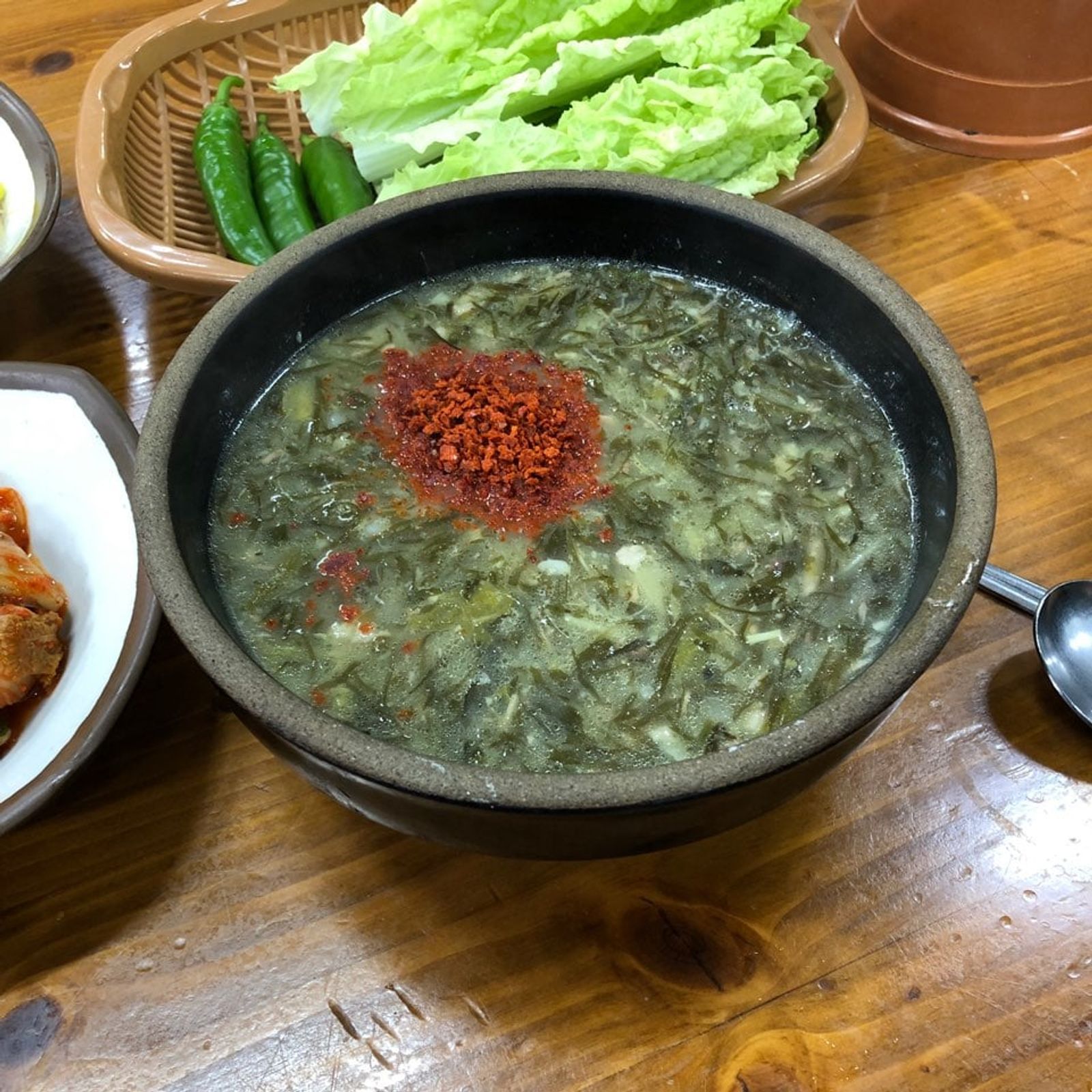
Momguk topped with chili flakes · Photo: 공석배 / CC BY 4.0 (Wikimedia Commons)
 KoreaJeju
Momguk: The Jeju Feast-Day Soup of Seaweed and Pork Broth
The name may be unfamiliar, but for Jeju people momguk is a soup full of memories of feast days. Here is what "mom" means, how the soup is tied to family feasts where a whole pig was shared, how it is made and tastes, and tips for travelers who want to try it.
"Mom" Is a Seaweed Called Mojaban
The "mom" in momguk is not the Korean word for body but the Jeju dialect word for mojaban, a sargassum seaweed. It is sometimes written with the old vowel arae-a as ᄆᆞᆷ. Momguk is a soup made by simmering this seaweed in rich broth from boiled pork, and it is counted among Jeju's signature soups. Mojaban is a brown seaweed that grows more than one to three meters long and forms underwater forests along the Korean coast. It is commonly sold at markets as food. Momguk tastes rich yet mellow, a flavor Jeju people call "bejigeunhada." A bowl full of dark green seaweed can look unfamiliar at first, but one spoonful brings the nutty depth of pork broth together with the scent of the sea.
A Soup Made Only When a Pig Was Slaughtered
Traditionally in Jeju, pigs were slaughtered only for big events such as weddings and funerals. The pork was boiled first to make sliced boiled pork, then the innards and sundae were boiled in the same broth, making it extremely rich. Instead of throwing that broth away, people added seaweed and simmered it into momguk. So it was originally hard to come by on ordinary days, a dish for special occasions such as feasts. In Jeju, the day when food prepared for a wedding was served to relatives and guests was called "gamun janchi," the family feast, and it is said to have drawn even more guests than the wedding day itself. According to one report, guests that day were served momguk along with a "gogiban," a plate of three slices of pork, a slice of sundae and a piece of dried tofu. It was also the soup shared by villagers who came to help the day before the feast.
Coast and Uplands: Same Broth, Different Soups
Interestingly, momguk was made mainly in seaside villages. According to accounts based on materials on Jeju food culture published by the National Folk Museum of Korea, coastal villages where seaweed was easy to get made momguk by adding it to pork broth, while villages in the uplands far from the sea made gosari-guk with bracken, or soups with young radish or loose-leaf cabbage, in the same broth. The same pork broth became different soups depending on what each village could easily get. Thick bracken soups can still be found in Jeju restaurants today under names such as gosari yukgaejang. Records say that on feast days, slaughtering the pig and boiling the pork and sundae was traditionally men's work, while cooking momguk or bracken soup was women's.
How It Is Made and How It Tastes
The traditional method goes like this. Seaweed soaked for five or six hours is roughly chopped and added to the broth from boiled pork, and when it boils, buckwheat flour mixed with cold water is stirred in to thicken it. Finally, garlic chives and minced garlic go in and it is seasoned with salt. The buckwheat gives the broth body and lets the seaweed soften. So momguk is less a clear soup than something close to porridge, thick and filling. The seaweed has more crunch than miyeok (wakame), and it cuts the fattiness of the pork broth, so it tastes cleaner than you might expect. Depending on the restaurant, it may come topped with chili flakes or with generous pieces of pork. There is also a story that when seaweed became scarce around the Japanese colonial period, people stretched the soup with noodles, creating "mom-guksu," but this is not confirmed by records.
How Travelers Can Try It
You no longer need a feast to try momguk; it is served at local-food restaurants and gukbap (soup-and-rice) places all over Jeju. Some noodle shops sell it alongside gogi guksu, so ordering both at one place lets you compare two faces of Jeju pork broth. In the old downtown of Jeju City there are restaurants reported to serve momguk, gogi guksu and mom-guksu side by side. If it is your first time, eating it with kimchi or kkakdugi (radish kimchi) helps you get used to the unfamiliar seaweed flavor quickly. The broth is thick and filling, so one bowl makes a full meal, and some people seek it out as a hangover soup the morning after drinking. Menus sometimes spell it with the old letter, as ᄆᆞᆷ국, so knowing that helps when you order.