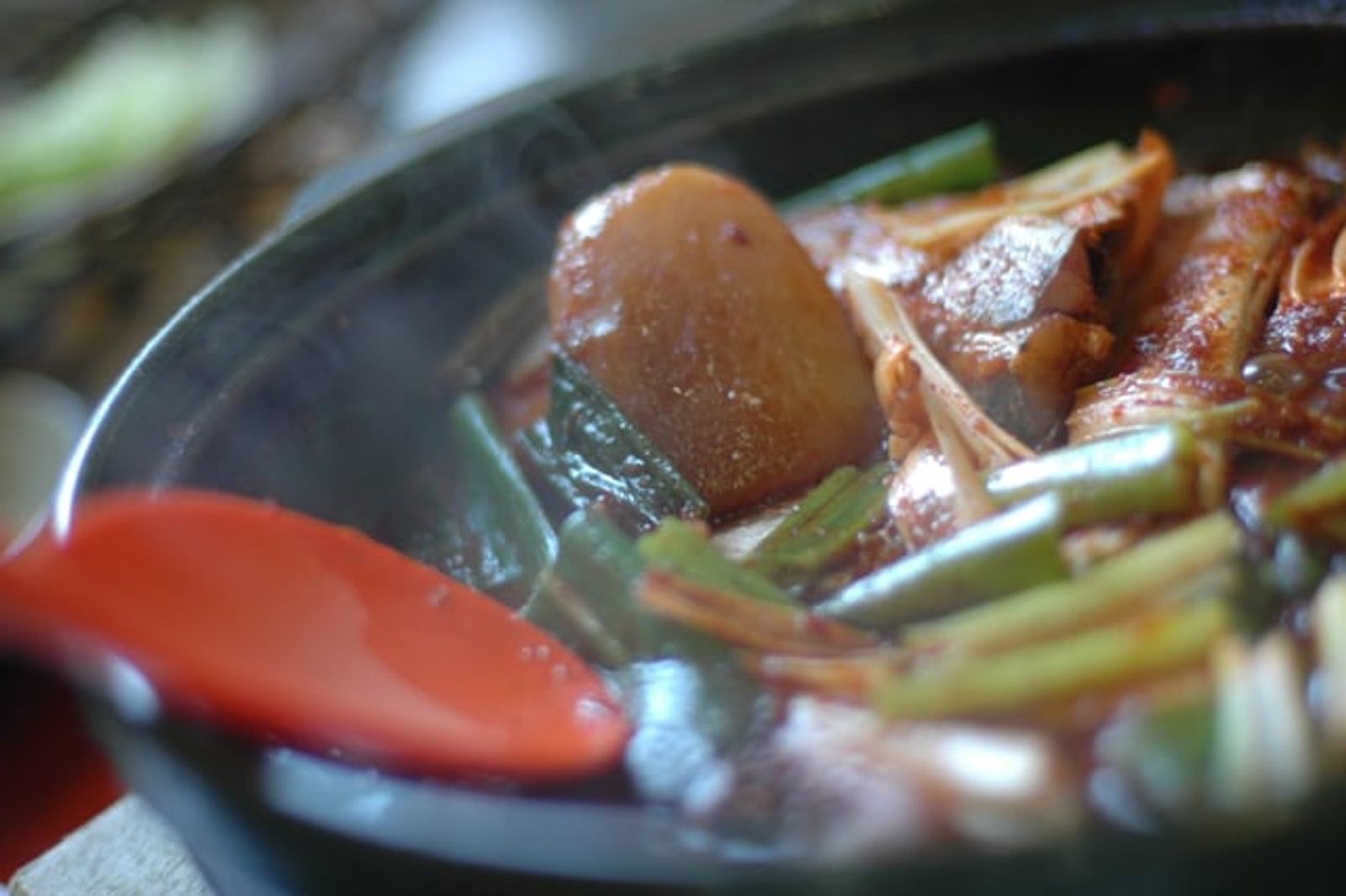
Braised hairtail eaten in Jeju · Photo: SEEMS (Flickr) / CC BY-SA 3.0 (Wikimedia Commons)
 KoreaJeju
Jeju Silver Hairtail: Eungalchi vs Meokgalchi, and Choosing Soup, Braise or Grill
Hairtail is on almost every restaurant menu in Jeju. Here is why the same fish is sold as silver "eungalchi" or dark "meokgalchi," when it is in season, what galchi-guk, a soup best tasted in Jeju, is like, and what to check when you order.
A Long, Silver, Sword-Like Fish
Hairtail (galchi) is a thin, flat sea fish that grows to around a meter long. Its sword-like body earned it the names doeo ("sword fish") and kalchi, and young ones are called pulchi. It has no scales, its whole body gleams silvery white, and it has the unusual habit of swimming upright with its head up. Hairtail is a migratory fish sensitive to water temperature: it winters around Jeju and the South Sea, then moves toward the West and South Seas as the water warms. That is why the waters around Jeju became an important hairtail fishing ground. In Jeju restaurants you will find braised hairtail, grilled hairtail, hairtail soup and even raw hairtail, which is only possible near where it is caught.
Silver vs Dark Hairtail: Different Fish?
One word always comes up with Jeju hairtail: eungalchi, "silver hairtail." Eungalchi and meokgalchi ("ink hairtail") are not different species but names based on how the fish is caught. In Jeju, hairtail is often caught by chaenakki, pole-and-line fishing with many hooks on one line, pulling the fish up one at a time. Caught this way, the silver sheen stays intact, hence "silver hairtail." Hairtail netted in the southwestern seas off places such as Mokpo bump against one another and rub against the net on the way up, so the silver coating wears off and they turn darkish. That is why they are called "ink hairtail." The silver is a thin layer made mostly of guanine that rubs off easily. Silver hairtail with its sheen intact is more marketable and tends to cost more.
When Is It in Season?
Hairtail fishing is busiest from summer to autumn, and late summer through autumn, when the flesh fattens, is most often named as peak season. Some sources describe July to October as the tastiest period for hairtail in Korea. So if you visit Jeju in autumn, it is a good time to try hairtail dishes. Hairtail is sensitive to water temperature, though, and when the sea warms sharply, schools scatter and change where they migrate. There is talk that climate change is affecting when and where hairtail are caught. Domestic catches also cannot meet all the demand, so frozen hairtail caught off Africa or the Middle East is imported. That is why markets and restaurants sell both fresh domestic hairtail and frozen imported hairtail.
Galchi-guk: A Taste Only the Source Can Offer
Mainland Koreans mostly know hairtail braised or grilled, but Jeju has galchi-guk, a clear soup made with hairtail. Fresh hairtail is simmered with ripe pumpkin, cabbage and green chili, giving a clean, gently sweet broth. A Jeju National University study standardizing local dishes also set out a standard galchi-guk recipe using kelp stock with both ripe pumpkin and young cabbage. Because a fish soup can easily turn fishy, it is said that galchi-guk only tastes right when made with fresh, never-frozen hairtail. That is why it developed in Jeju, where hairtail comes straight off the boats. Jeju has a culture of clear fish soups, such as gakjaegi-guk made with horse mackerel (gakjaegi in Jeju dialect) and mackerel soup, and galchi-guk is the best known of them. First-timers are often surprised at how clean the broth is, with no fishy smell.
Choosing Braise or Grill, and Ordering Tips
The dishes tourists order most are galchi jorim, hairtail braised in a spicy sauce with radish, potato or squash, and galchi gui, hairtail salted and grilled until golden. Menus featuring "tong galchi," a whole long hairtail grilled or braised in one piece, are also common in Jeju. If you cannot handle spice, grilled hairtail or galchi-guk lets you taste the fish itself. Always check the origin label before ordering. Fresh domestic silver hairtail is expensive, so prices differ greatly from places using frozen imports. Prices often vary by size too, so if the menu says "market price," ask first. Raw hairtail has to be extremely fresh, so it is not always on the menu even in Jeju. Hairtail has many small bones, so pull away the fine bones along the dorsal fin first to make eating easier.