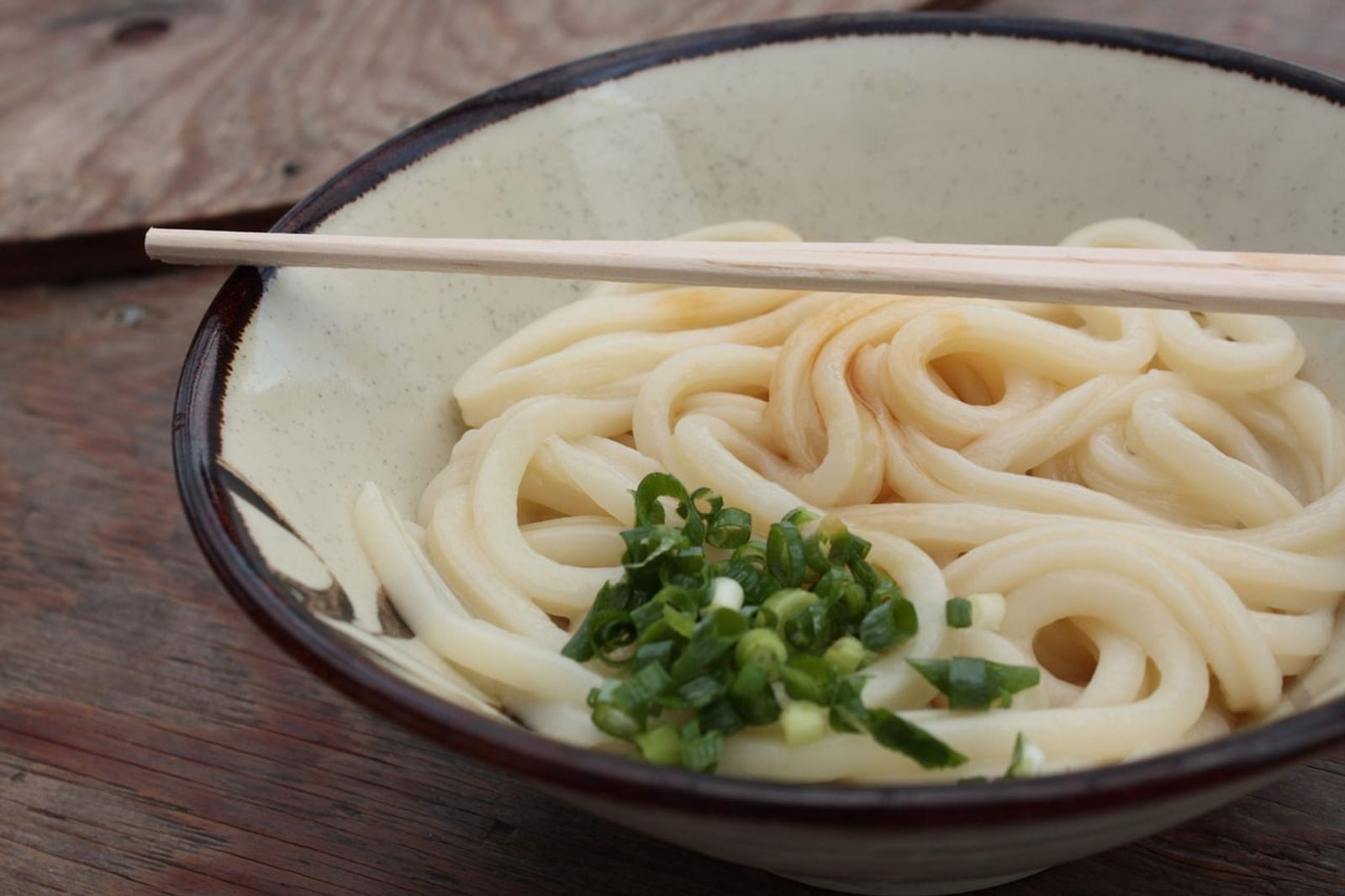
Kama-age udon in Takamatsu · Photo: sekido / CC BY 2.0 (Wikimedia Commons)
 JapanTakamatsu
How to Order Sanuki Udon: Self-Service Steps and Local Terms Like "Hiya-Atsu"
In Takamatsu, capital of "Udon Prefecture" Kagawa, there is a local way of doing things from the moment you walk into an udon shop. Here are the three kinds of shops, the self-service steps of getting, warming and saucing your noodles, terms like kake, bukkake, kamatama, hiya-hiya and hiya-atsu, and tips for enjoying it.
Why Kagawa Is "Udon Prefecture"
Kagawa’s old name is Sanuki. Thanks to the dry, sunny Seto Inland Sea climate, double cropping, planting wheat in rice paddies after the autumn harvest, flourished from the Warring States period into the Edo period. On top of good wheat, salt, soy sauce and the dried sardines locals call iriko were all local products, so udon ingredients were easy to come by. The Konpira Festival folding screen, painted around the end of the Genroku era (early 18th century), shows three udon shops in the town on the approach to Konpira Shrine. In 2011 Kagawa Prefecture and its tourism association launched a campaign under the name "Udon Prefecture." In a survey of residents, 90 percent said they eat udon at least once a week. Statistics like "bowls per person per year," however, have no clear basis, so take the numbers with a grain of salt and enjoy the atmosphere instead.
Three Kinds of Shops
Udon shops in Kagawa fall into three main types. An "ippan-ten" (regular shop) is an ordinary restaurant where you sit, order and staff bring your udon. Even at regular shops, though, side items such as rice balls and oden are usually self-serve, so the local scene is to grab some as soon as you walk in and snack while waiting for your udon. A "self" shop is one where customers pick up their own food and return their dishes. In Kagawa they appeared in the mid-1960s and were widespread by the early 1970s. A "seimenjo" (noodle factory) is a noodle-making workshop with a few simple tables so you can eat there, and most are self-service. Many have no sign or noren curtain, or sit down back alleys or deep in the countryside, looking nothing like a business, and seeking them out is part of the fun of an udon pilgrimage.
Self-Service Shops: Just Remember the Order
The basic flow at a self-service shop goes like this. First take as many portions of rinsed, chilled noodles as you want into your bowl. Sizes are chosen as "small" or "large," but standards vary, for example small being one tama (portion) and large two, so check the sign on the wall. If you want it warm, transfer the noodles to a "tebo," a strainer basket with a handle, and dip it in hot water for about 10 seconds. Next, pick your own tempura, toppings and garnishes such as scallion, then pour on the dashi (broth) by turning the tap on the broth tank or using a ladle. At most shops you pay at the register after this, before eating. Since the division of tasks between customer and shop differs from place to place, even locals sometimes get confused at a self-service shop they have never visited, so many shops post the steps instead of a menu. Return your dishes to the counter when you are done.
Menu Names and How to Read "Hiya-Atsu"
Learning the basic menu helps. "Kake" is the most basic udon, with light broth poured over and topped with scallion or tempura crumbs. "Bukkake" has a small amount of strong broth splashed on, and "shoyu" is noodles with just a drizzle of soy sauce. "Kama-age" is boiled noodles served unrinsed in their cooking water and dipped in sauce, and "kamatama" is freshly boiled noodles mixed with raw egg and soy sauce or dashi. On self-service menus, "hiya" means cold and "atsu" means hot, with the first word for the noodles and the second for the broth. Hiya-hiya is cold noodles in cold broth, hiya-atsu is cold noodles in hot broth, atsu-atsu is hot noodles in hot broth, and atsu-hiya is warmed noodles in cold broth. If you get confused, remember "noodles come first." Many people recommend the cold versions if you want to feel the noodles’ chewy firmness best.
The Secret of the Flavor and Travel Tips
The heart of Sanuki udon is a springy chewiness that seems to push back against your teeth, usually called "koshi." The broth often uses iriko (dried sardine) dashi, largely because nearby Ibukijima island is famous for iriko. Most of the wheat today is Australian, though some shops use "Sanuki no Yume," a udon wheat developed by Kagawa Prefecture. The approach we suggest for travelers is an udon pilgrimage: one "small" bowl at each of several shops. Rather than filling up at one place, trying kake, bukkake or kamatama at different shops really shows the differences. There are plenty of udon shops in central Takamatsu and around the station, and there is even one on a platform at Takamatsu Station. After the Seto Ohashi Bridge opened in 1988 and the Akashi Kaikyo Bridge in 1998, trips made specifically to tour udon shops became popular, so udon itself is a reason to travel here.