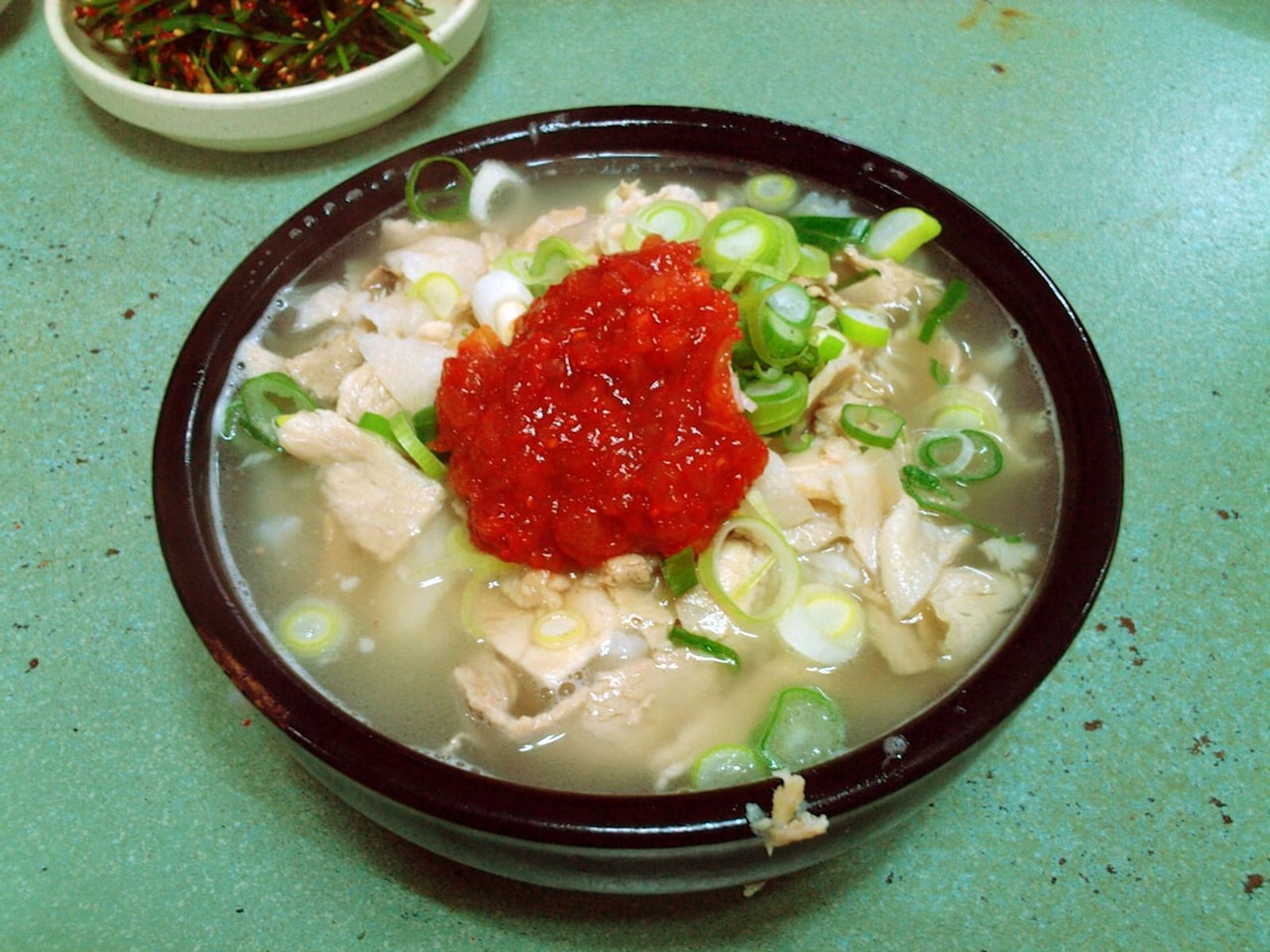
Dwaeji-gukbap topped with chili paste · Photo: Leefect / CC BY-SA 3.0 (Wikimedia Commons)
 KoreaBusan
Busan Dwaeji-gukbap: From Refugee Soup to Soul Food, Styles and How to Order
Milky broth, plenty of pork, seasoned at the table with salted shrimp and chives: dwaeji-gukbap is Busan in a bowl. Here is how it began with Korean War refugees, the clear and milky broth traditions, and how to order and season it with salted shrimp, chives and chili paste.
A Yeongnam Soup, Above All in Busan
Dwaeji-gukbap is pork and rice in a broth made by simmering pork bones. It is eaten across the Yeongnam region, including Daegu, Ulsan and Miryang in South Gyeongsang, but it is above all a Busan signature. Many restaurants open from early morning to late at night, so it is loved all day long: as a hangover cure, a hearty meal or a drinking snack. Some see it as a bone soup in the same family as seolleongtang, but made with pork bones instead of beef, eaten with rice rather than thin noodles, and seasoned with salted shrimp. Because Busan people eat it so often, everyone has a favorite place, and each restaurant has its own character in broth color, cuts of meat and even the kimchi on the side, so many locals are always on the hunt for their "gukbap of a lifetime."
The Korean War, Refugees and the "Pork" Taboo
The usual explanation is that dwaeji-gukbap came from refugees who settled in Busan after the Korean War. Before the 1970s there was reluctance in South Korea to sell food with "pork" in its name, and before refrigerators were common, summer pork was blamed for food poisoning, giving rise to sayings like "summer pork is lucky if it only breaks even." People in the north, by contrast, ate pork with relish, and when refugees brought that food culture to Busan, the soup took hold. There are other theories too: that refugees short of food boiled pork bones from U.S. military bases like seolleongtang, that a Japanese practice of making stock from pork bones was grafted on in Busan, or that the dish goes back as far as the Goryeo period. Its origin is hard to pin down, but most sources agree that the war was what rooted it in Busan.
Clear and Milky: The Different Lineages
Dwaeji-gukbap is not a single taste. English-language sources divide the broth into three broad types: cloudy broth made by long-simmering pork bones until milky, translucent broth from boiling the head meat and innards, and clear broth from boiling lean meat alone. Korean sources also describe lineages. A clear-broth style said to have started around Sinchang Market in Busan steeps lean pork and is served like gomtang; it is attributed to refugees from Hamgyeong Province who settled in Busan after the Hungnam evacuation. The Miryang style from South Gyeongsang, by contrast, is known for a milky white broth and may have been created by people who fled south overland, with some seeing an influence from the Seoul and Kaesong area. You can find both traditions in Busan, so try comparing a clear bowl with a milky one.
Salted Shrimp, Chives and Chili Paste: You Season It
Dwaeji-gukbap usually arrives barely seasoned. The basics are to salt it with the salted shrimp (saeujeot) on the table, add a generous heap of seasoned chives (called jeonggu-ji in Gyeongsang dialect), and stir in dadaegi, a chili-based paste, for heat. According to English-language sources, the salted shrimp came from the north, while the chive salad and spicy seasoning were Busan additions. Raw onion, garlic and green chili dipped in ssamjang, plus kkakdugi or kimchi, come on the side. The trick is to taste a spoonful of the plain broth first, then add salted shrimp a little at a time. If you stir in all the dadaegi at the start it is hard to appreciate each restaurant's broth, so many people add it halfway through. You can wilt the chives in the soup or eat them on the side like a salad.
How to Order in Busan
Common menu items are dwaeji-gukbap, sundae-gukbap (with blood sausage), naejang-gukbap (with offal) and seokkeo-gukbap, a mix of everything. For a first try, plain dwaeji-gukbap with mostly lean meat is a safe bet; if you like offal, go for seokkeo-gukbap. Some places serve the rice already in the soup and others on the side, and many will bring it "ttaro" (separately) if you ask. Suyuk baekban, with the boiled pork on a separate plate, or an extra plate of suyuk is also popular. You will find gukbap restaurants all over Busan, but the Seomyeon area has an alley lined with them that is easy for visitors to find. Many open 24 hours or from early morning, making them a reliable option if you arrive late at night or set off early. Broth and cuts differ from shop to shop, so the same dish can taste quite different; comparing two or three places during your stay is part of the fun.