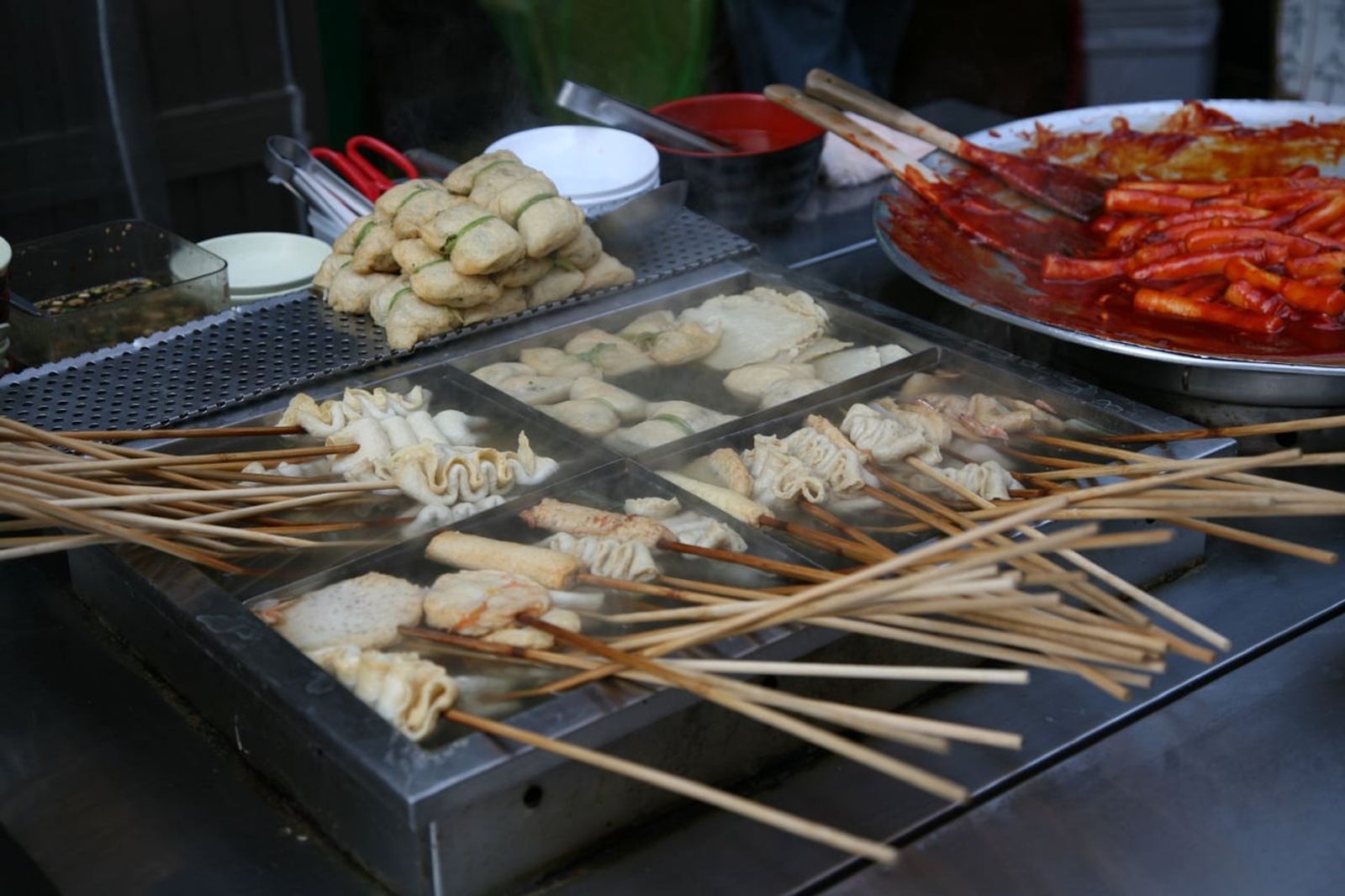
Skewered eomuk and tteokbokki at Bupyeong Kkangtong Market · Photo: Junho Jung (Flickr) / CC BY-SA 3.0 (Wikimedia Commons)
 KoreaBusan
Busan Eomuk: From the First Factory in 1907 to the Market Fish-Cake Alley
Skewered fish cakes and hot broth in a Busan market alley are a classic travel scene. Here is how Japanese kamaboko arrived and went into full production in Busan from 1907, how wartime refugees spread it nationwide, what the "Busan eomuk" label (70%+ fish paste) means, and how to eat it at the market.
Eomuk or Odeng?
Eomuk is white fish ground into a paste with salt, sugar and starch, then cooked and shaped. In Korea it is often called "odeng," but oden is originally the name of a Japanese dish in which fish cakes and other ingredients simmer in broth. In 1992 the National Institute of the Korean Language proposed "eomuk" as the Korean word to use instead, and it is now widely used, though you will still hear odeng quite naturally in markets. Today's Korean eomuk traces back to Japanese kamaboko. Joseon Korea had dishes such as sliced steamed fish and fish balls, and a book by an interpreter who visited Japan in the 1700s records kamaboko phonetically as "gamabogot," but eomuk as we know it arrived from Japan after Korea opened its ports and then took on a Korean character.
1907: Busan's First Fish-Cake Factory
There is a historical reason Busan became the fish-cake city. In 1907 a Japanese-owned fish-cake factory opened in what is now Jungang-dong in Jung-gu, Busan, beginning full-scale production in the city, and by the 1920s fish-cake factories had clustered in Busan. As a port close to Japan with abundant seafood, Busan had ideal conditions for making eomuk. There were some Korean-owned fish-cake factories during the colonial period, but the real shift came after liberation. In the 1950s a Korean who had learned the craft in Japan began making fish cakes without even a shop name and then founded a factory, which later became one of the companies most associated with Busan eomuk. This helped give rise to the fish-cake alley centered on Bupyeong Kkangtong Market in Bupyeong-dong.
Busan's Taste, Carried Nationwide by Refugees
The Korean War is what turned eomuk from a Busan food into a national one. When war broke out, refugees from all over the country poured into Busan, and many of them tasted fish cakes, until then eaten mainly around Busan. After the armistice, returning refugees kept looking for eomuk back home, and so it spread across the country. Since then eomuk has become an everyday Korean food: stir-fried fish cake as a lunchbox side dish, skewers and broth at winter street stalls, an essential ingredient in tteokbokki, and fish-cake soup. Bupyeong Kkangtong Market is said to get its name, "can market," from the canned goods and other items from U.S. military bases traded there after the Korean War; today it is a popular sight known for its fish-cake alley and night market.
The "Busan Eomuk" Label and Ingredients
Eomuk is made mainly from surimi, ground white fish, and wheat flour, with pollock the most common fish. The proportion of fish paste varies by manufacturer, and Busan City introduced a certification under which only fish cakes with at least 70% fish paste may use the name "Busan eomuk." More fish gives a springier texture and a stronger natural flavor, while more flour tends to make it dry and doughy. It is also worth knowing that most of the fish paste, including pollock, and the flour are imported. So "Busan eomuk" is best seen as a regional brand defined by method and recipe standards rather than by where the ingredients come from. Busan now has many specialty shops that display fish cakes of every shape like a bakery, and you will easily find new creations such as cheese- or vegetable-filled eomuk and fish-cake croquettes.
How to Eat Eomuk at the Market
The most common way to eat eomuk at a Busan market is on skewers. Long, folded fish cakes threaded on sticks sit in hot broth; you help yourself and pay by the number of skewers at many stalls. Sipping the broth from a paper cup is part of the pleasure, and many places give it for free. Dip the fish cake lightly in soy sauce, add some tteokbokki from the stall next door, and you have the classic Busan market snack. Bupyeong Kkangtong Market, with its fish-cake alley and night market, combines easily with a trip around Nampo-dong and Jagalchi Market. Fish-cake specialty shops let you pick an assortment or buy gift sets, which are popular souvenirs. Many need refrigeration, so check the packaging and storage instructions before a long journey. On a cold day, a steaming cup of fish-cake broth is one of the small joys of winter in Busan.