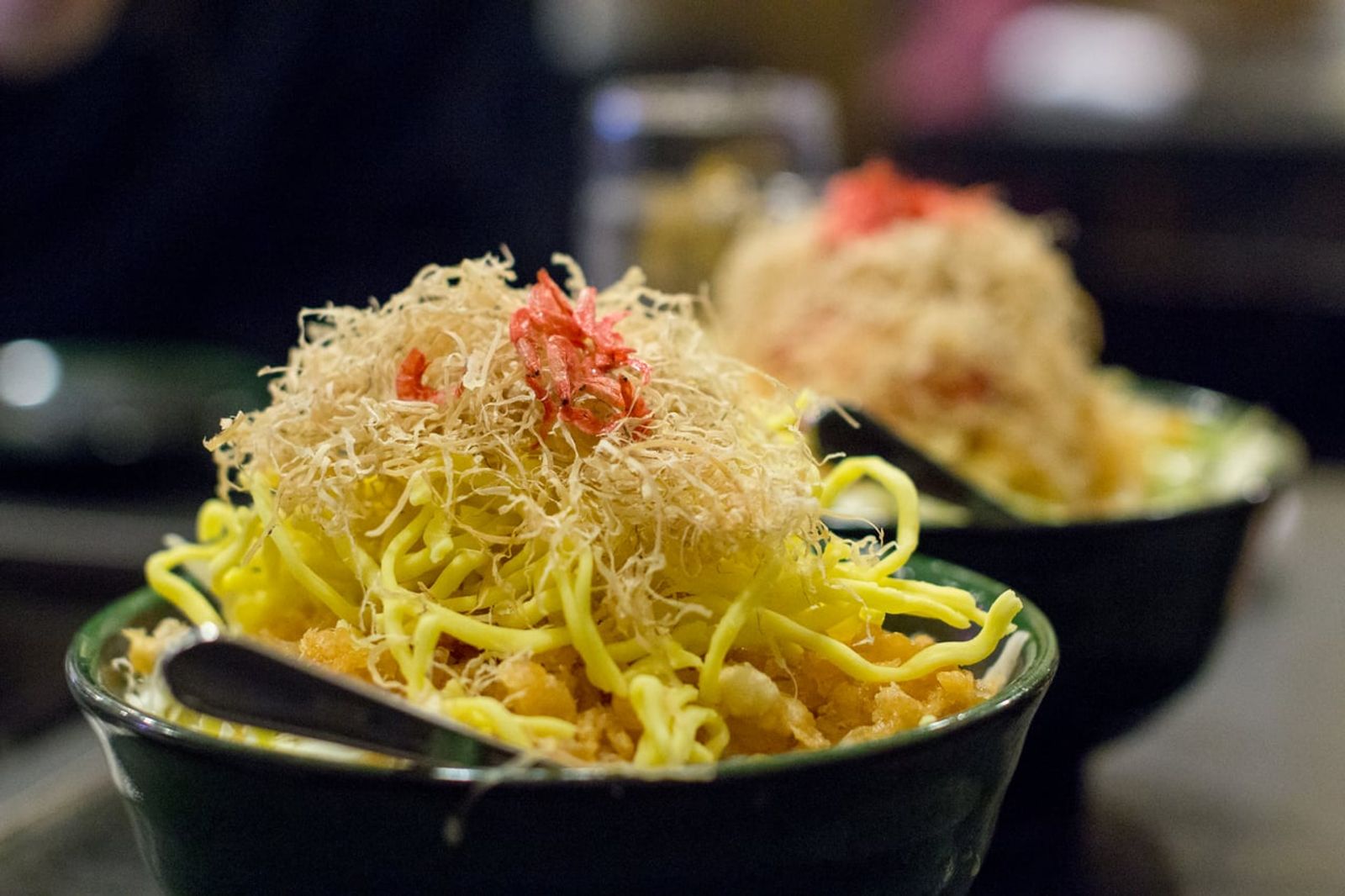
Monjayaki ingredients before cooking, Tsukishima · Photo: t-mizo from Japan / CC BY 2.0 (Wikimedia Commons)
 JapanTokyo
Monjayaki: From Candy-Shop Griddles to the Pride of Tsukishima
In Tokyo's Tsukishima, one street is lined with shops where a runny batter is poured onto a griddle and eaten straight off it with a tiny spatula. Here is where the name comes from, how it started as a children's snack, how Tsukishima became "Monja Street," and how to cook it on your first try.
The Name: "Moji-yaki," a Snack for Drawing Letters
Most accounts trace the name monjayaki to moji-yaki ("letter-grilling"), a snack sold from the Edo period into the Meiji era. A sweet batter of flour and syrup was dribbled onto a hot plate to draw letters or pictures, and books recording Meiji-era street life describe it. Spoken quickly in the Tokyo dialect, "moji" is said to have turned into "monja." What nobody can document is how a sweet treat became today's savory dish. One guess is that people began making it without syrup after the war, using rationed flour, but there is no firm evidence, so treat the origin story as tradition rather than proven history.
A Postwar Children's Snack in Old Tokyo
Monjayaki as we know it appeared in the late 1940s and early 1950s, and many accounts point to the Asakusa area as its starting point. It then spread through the working-class neighborhoods of east and north Tokyo along rail lines and Sumida River shipping routes. Cabbage and other fillings were added in the 1950s and 60s, and the technique of building a ring of fillings to hold the batter took shape around then. Until the early 1970s, most dagashi (penny-candy) shops in old Tokyo kept a monja griddle in the corner. Children brought their pocket money and sat around the hot plate, making the shop a neighborhood hangout. As shopkeepers aged and tourist-oriented restaurants took over, the candy-shop monja gradually faded away.
How Tsukishima Became "Monja Street"
Nishinaka-dori, the shopping street of Tsukishima on reclaimed land in Tokyo Bay, is nicknamed "Monja Street." Japanese Wikipedia puts the number of monja shops at about 75, while other sources range from over 50 to nearly 80, depending on whether side streets are counted. "Dozens" is the safe answer. Surprisingly few of them are old. Before the 1980s, monja was sold to children from the front of private homes with nothing but cabbage, and shops for adults served okonomiyaki and drinks as well. During the monja boom of the late 1980s, many businesses converted to monja. When the Yurakucho subway line opened in June 1988, everyday shoppers began heading to Ginza instead, yet the monja shops kept multiplying and turned the street into what it is today.
Your First Monja: Build the Wall, Pour, Scrape
Compared with okonomiyaki, monja batter is far runnier, it is never flipped, and you eat it straight from the griddle instead of moving it to a plate. Start by frying only the solid fillings from the bowl, chopping them finely as they cook. Then push them into a ring, a "dote" or embankment, and pour the remaining liquid into the center. When the liquid bubbles and thickens, break the wall, mix everything and spread it thin. Then use the hagashi, a tiny spatula about 2 to 3 cm wide, to press a little against the griddle and scoop it up. The lightly crisped bits stuck to the plate are the best part. People argue over whether the wall really affects the taste, and some regions never build one, so don't stress if yours collapses.
Tips for Eating Monja in Tsukishima
Tsukishima Station on the Yurakucho and Toei Oedo subway lines opens right onto the area, so it is easy to reach. Many shops are known to help with the cooking if you ask, so mention it when you order if it is your first time. Combination fillings such as mentaiko (spicy cod roe), mochi and cheese are popular, and many shops also serve okonomiyaki and teppanyaki. Because everyone cooks together around the griddle, it is more fun with two or three people or more. Monja is not unique to Tokyo, either. Isesaki in Gunma has versions flavored with strawberry syrup or curry powder, Ashikaga in Tochigi bakes it thin and eats it like a cracker, and parts of Saitama knew it under other names such as "bottara." The same griddle snack grew up differently in each town.