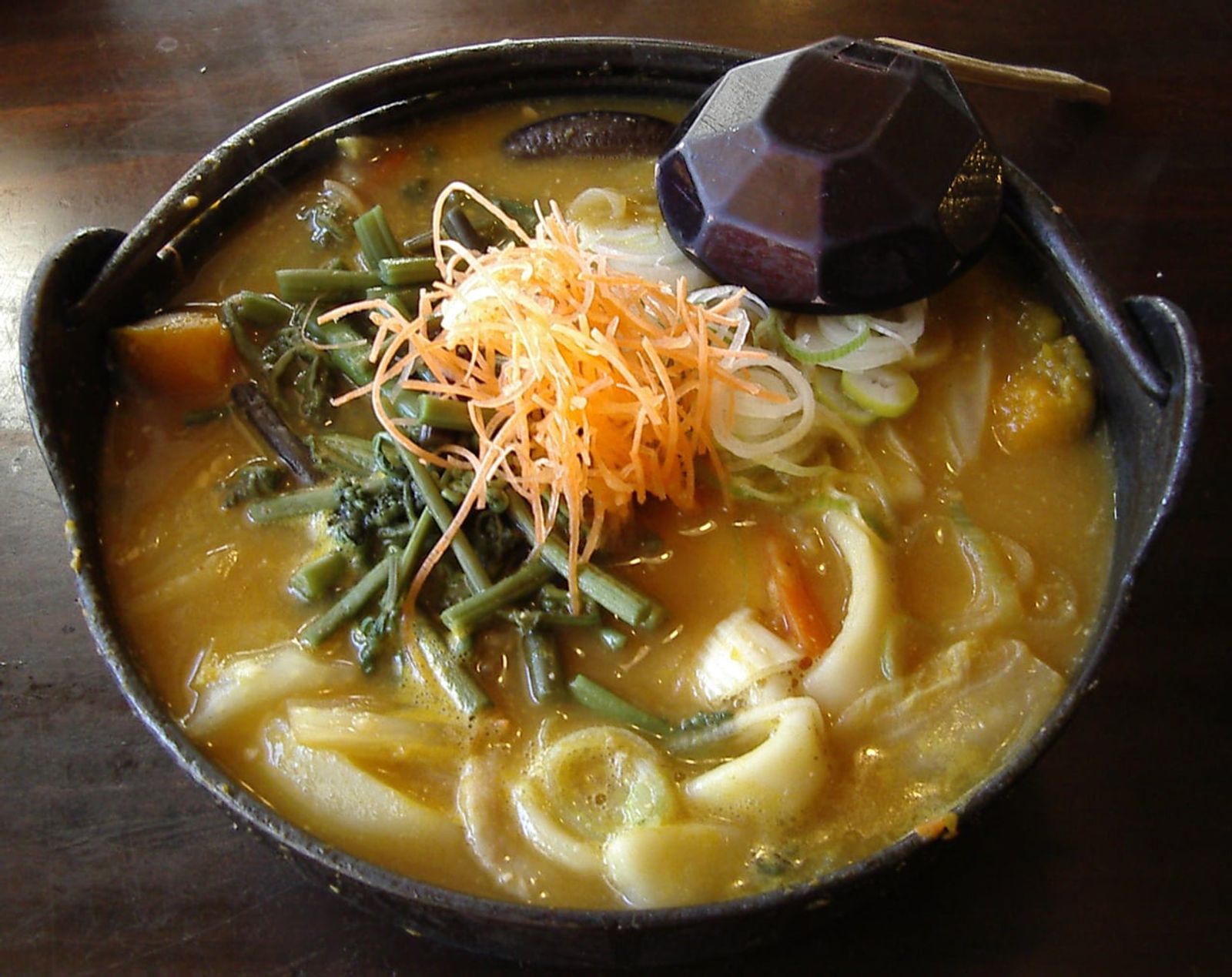
Hoto served in an iron pot · Photo: Jungle (ja.wikipedia) / CC BY-SA 3.0 (Wikimedia Commons)
 JapanKawaguchiko
Hoto: Yamanashi's Flat Noodle Miso Stew at the Foot of Mt. Fuji, and How It Differs from Udon
Hoto is the dish everyone recommends on a trip to Lake Kawaguchi: flat noodles, pumpkin and vegetables simmered in miso broth in an iron pot, a local dish of Yamanashi. Here is the story of a land where rice was scarce, how hoto differs from udon, the theories about its name and how to enjoy it.
Flour Over Rice: Life at the Foot of Mt. Fuji
Hoto is a Yamanashi local dish of thick, wide-cut wheat noodles simmered in miso broth with vegetables such as pumpkin. In 2007 it was chosen as one of the "100 Local Dishes of Farming, Mountain and Fishing Villages" by Japan's Ministry of Agriculture, Forestry and Fisheries. The land explains why flour dishes developed here. The northern foot of Mt. Fuji, where Lake Kawaguchi lies, is volcanic terrain where irrigation is difficult, so rice farming was hard and wheat-based foods such as udon and dumplings took hold. In the Edo period, as silk farming boomed and fields were turned into mulberry orchards, farmers planted winter wheat between the trees, and flour dishes became even more common. Hoto, which stretched a little flour with plenty of vegetables, suited that way of life perfectly.
How It Differs from Udon: No Salt, No Pre-Boiling
Hoto looks like udon but is made differently. Udon dough is salted and kneaded well to develop chewy gluten, while hoto dough is not kneaded that way and is rarely rested. Because the dough contains no salt, there is no need to boil the noodles separately to remove saltiness. Instead, the fresh noodles go straight into the broth and simmer with the vegetables. Flour from the surface of the noodles dissolves into the broth and thickens it naturally, which is a big part of hoto's appeal. The noodles are wider and a bit thinner than udon, with a soft, hearty texture rather than a springy one. If you expect udon it may seem different; think of hand-cut noodles in a thick miso stew.
Pumpkin and Miso, Different in Every Home
Miso is the base of hoto broth. In the past, families reportedly made their own Koshu miso with rice and barley koji, while many households today use store-bought rice-koji miso. Pumpkin is the signature ingredient, along with seasonal vegetables such as daikon, carrot, napa cabbage, potato, taro, mushrooms and green onion. The way pumpkin is handled varies by area. Around the Kofu Basin it is simmered until it melts into the broth, making it sweet and rich, while in the southern areas it is not cooked that long. Yamanashi once had a saying that a woman who could not make hoto was not ready to marry, which shows how central it was to home cooking. As a result, hoto tastes a little different in every home and every restaurant.
The Name: From a Heian Dictionary to a Takeda Shingen Legend
There is no confirmed origin for the name "hoto," only several theories. The best known traces it to hakutaku (餺飥), a flour dish from China, and the Heian-period dictionary Iroha Jiruisho records "餺飥: hakutaku, hauto." Another theory derives it from "hataku," an old word for pounding grain into flour. The story you will most often hear on your trip is that the warlord Takeda Shingen cut the noodles with his treasured sword (hoto, 宝刀). Japanese Wikipedia, however, describes this as a tale that arose during the postwar tourism boom and notes that linguists reject it. In written records, hoto appears as a local specialty of Kai Province (today's Yamanashi) in the 1815 diary of the itinerant monk Noda Senkoin.
How to Enjoy It, Plus Variations
There are plenty of restaurants serving hoto around Lake Kawaguchi, making it an easy meal between sightseeing at the lake and Mt. Fuji. It usually arrives bubbling hot in an individual iron pot, so ladle some into a small bowl and let it cool as you eat. Portions are generous and the noodles keep soaking up broth, so start eating as soon as it arrives. It is especially welcome on a cold-season trip to Fuji. There are variations, too. In summer there is "ozara," chilled hoto noodles dipped into warm broth, which a Kofu shop reportedly began selling as a summer dish around 1970. There is also sweet "azuki boto," hoto noodles in a thick red bean soup. In 2004 the Wakamiko Hoto Festival in Sutama, Hokuto City, was designated an intangible folk cultural property.