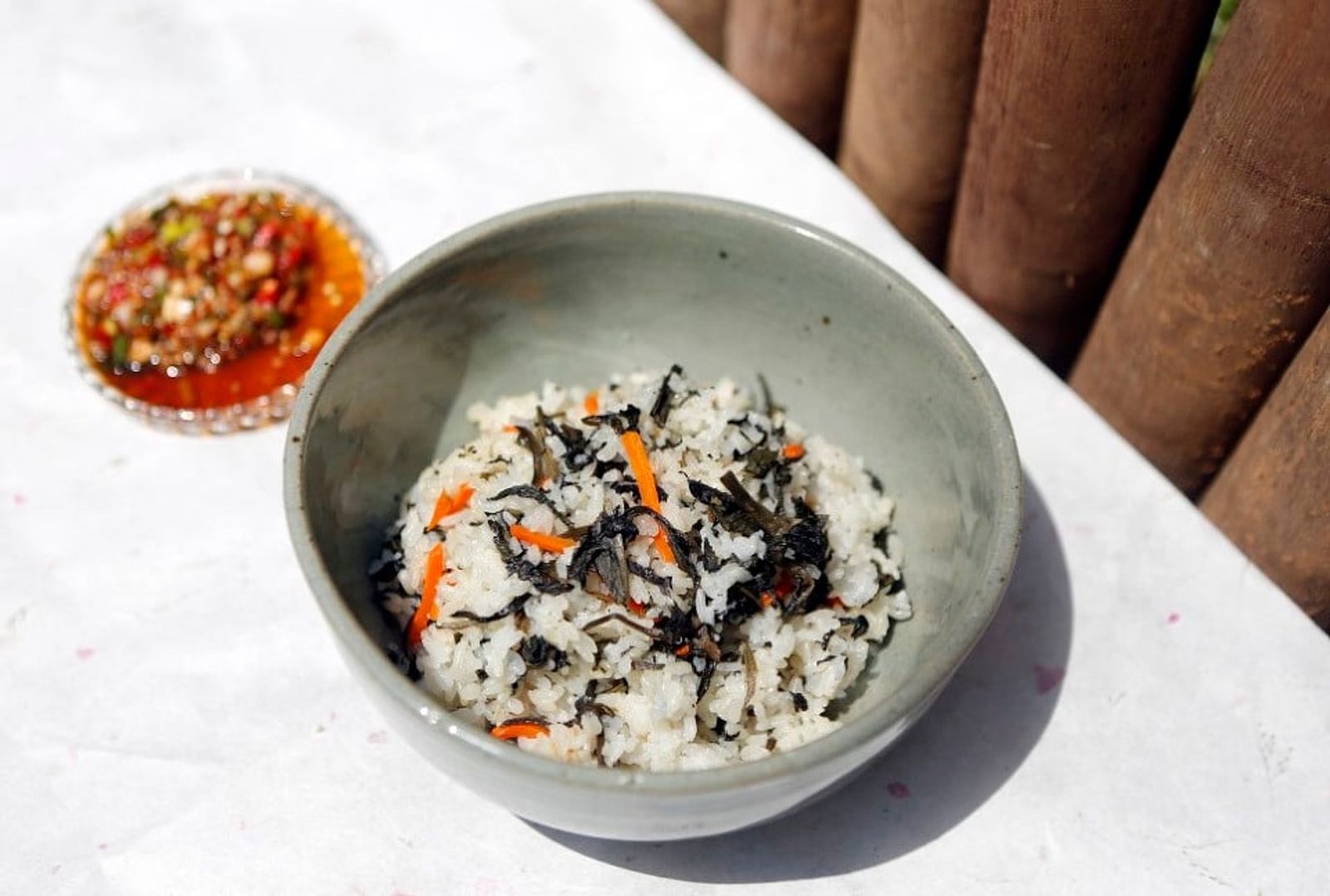
Gondeure rice with seasoned soy sauce · Photo: 방신애 / CC BY 4.0 (Wikimedia Commons)
 KoreaGangwon · Jeongseon
Jeongseon's Gondeure Rice and Kotdeungchigi Noodles: Market-Day Flavors From a Mountain Valley Short on Rice
In Jeongseon, a mountain county with little paddy land, people stretched scarce rice with a wild green called gondeure and cut buckwheat dough into noodles. Here is where gondeure rice and kotdeungchigi noodles come from, how to eat them and how to enjoy them at the Jeongseon five-day market.
What Gondeure Is
Gondeure is the local name for Korean thistle (Cirsium setidens), a perennial in the daisy family. It grows widely in the Gangwon highlands, and its young leaves are picked in spring. Korea Forest Service material notes that it has almost no distinctive aroma, so it is blanched and used in rice, seasoned side dishes, soups and dried greens, and keeps all year if frozen. It became Jeongseon's signature food because of hungry times. In spring, when grain ran out in the so-called "barley hump" season, families made gondeure porridge to get by, and for slash-and-burn farmers on the hillsides it is said to have been close to a staple in place of rice. Today people seek it out as healthy food, but it began as a green for survival.
Gondeure Rice: Stretching the Rice
Jeongseon is so mountainous that rice paddies are hard to keep, and rice was always precious. People first made porridge with gondeure and a little rice, and gondeure rice, cooked with the greens laid on top of the rice, grew out of that. A Segye Ilbo article likewise says the dish began in mountain villages where grain was scarce and greens were used to stretch the rice. Restaurants today usually season blanched gondeure with perilla oil and soy sauce or salt and cook it with the rice, often in a stone pot. Fresh gondeure has a green, grassy aroma while dried gondeure is nuttier, so it tastes a little different by season. Since it keeps all year once blanched and dried or frozen, you can eat gondeure rice anywhere in Jeongseon even outside the season.
How to Eat Gondeure Rice
Gondeure rice is barely seasoned on its own, so the basic way to eat it is to mix in the sauce served alongside. That sauce is usually soy sauce with chopped scallion and garlic, perilla or sesame oil and sesame seeds, sometimes with chili flakes or hot green chili for heat. To keep the delicate aroma of the greens, add the sauce a little at a time rather than all at once. It often comes with doenjang stew or water kimchi, and Gangwon mountain restaurants tend to add a spread of wild-green side dishes. If it arrives in a stone pot, scoop the rice into your bowl, pour hot water into the pot and finish the meal with the scorched-rice soup (nurungji). Gondeure itself is light on protein, so tofu or grilled fish on the side makes a more balanced meal.
Kotdeungchigi: The Noodle That Slaps Your Nose
Alongside gondeure rice, the dish people seek out most at the Jeongseon five-day market is kotdeungchigi guksu. Buckwheat dough is rolled out with a pin and cut by knife into thick noodles served in broth, often a stock made with anchovies and other ingredients and seasoned with doenjang. Because buckwheat has little gluten, the noodles are rustic and break easily. The most widely told explanation for the name, which means "nose-slapper," is that when you slurp the thick noodles, the ends flick up and hit the bridge of your nose. It was a common people's dish for when grain ran short in Gangwon, and it is also described as a folk food carrying the hardships of mountain slash-and-burn farmers. One article counts it, with gondeure rice and hwanggi jokbal (pig's trotters cooked with milkvetch root), among Jeongseon's three signature local dishes.
Where to Eat: The Jeongseon Five-Day Market
The best place to try both dishes is Jeongseon Arirang Market in Jeongseon-eup. It is open every day, but it is best known for the five-day market held on dates ending in 2 and 7 (the 2nd, 7th, 12th, 17th, 22nd and 27th), when stalls of wild greens, medicinal herbs and buckwheat food stretch down the lanes. There have even been tourist train packages from the Seoul area timed to market days. Schedules can change, so check before you go. In the market's food alley you can try a sampler of Gangwon mountain food: besides kotdeungchigi and gondeure rice, buckwheat crepes, sorghum pancakes, mung bean pancakes and olchaengi guksu, "tadpole noodles" made from corn starch. Dried gondeure makes a good souvenir; soak it well and blanch it before cooking, and use a little less water than usual since the greens release moisture.