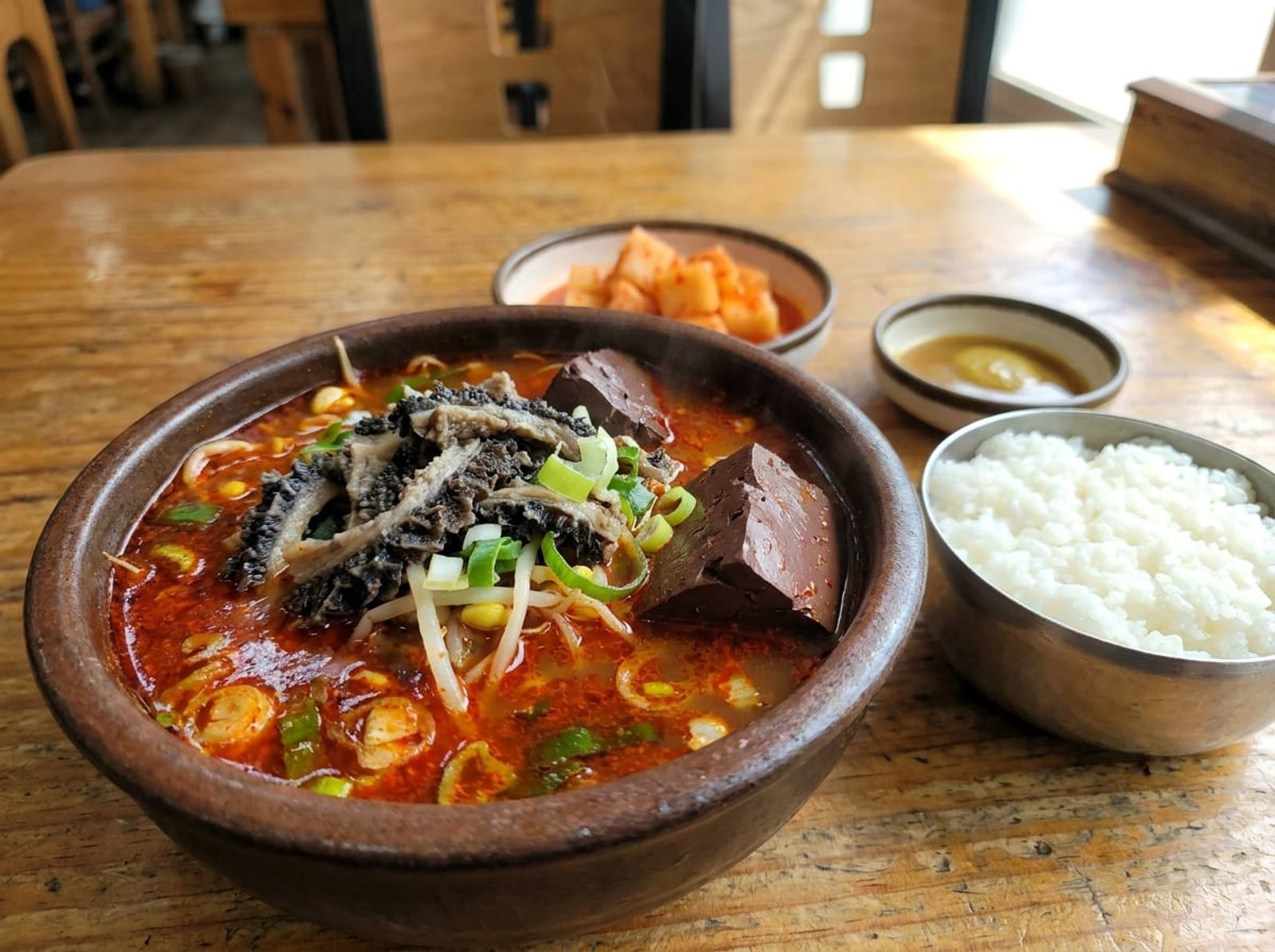
Yangpyeong Haejangguk
 KoreaGyeonggi · Yangpyeong
Yangpyeong Haejangguk: The Hangover Soup Built on a Cattle Market
You will see 'Yangpyeong Haejangguk' signs all over Korea, but its home is Yangpyeong on the Namhan River. Here is how this soup of beef tripe and blood curd topped with chili oil came out of a cattle market, how to eat it, and tips for trying it in Yangpyeong.
Yangpyeong's Market and Cattle Trade
To understand Yangpyeong haejangguk, start with the market. Cattle are said to have been the biggest-value item traded at Yangpyeong's market, and in the 1930s it was reportedly one of Gyeonggi's higher-turnover markets. Yangpyeong is known for having long raised cattle and pigs for Seoul, and with a busy cattle market and slaughterhouses, bones, offal and blood were plentiful. That is the soil in which a cheap, filling hangover soup grew up at a country market. Later, when the Yangpyeong area was designated a water-source protection zone, the cattle market moved and trade dwindled, but the soup survived, carrying Yangpyeong's name.
Who Made It First? Origin Stories Differ
Several stories describe how it began. One says that in the 1970s people made stock from beef bones and offal from the Yangpyeong cattle market, then added blood curd, offal, bean sprouts, dried radish greens and chili oil for a spicy soup. Another credits an old woman who, around the 1970s and 1980s, sold gukbap made from offal and bones bought at the cattle market to workers building a bridge from rafts on the Bukhan River. Since Gaegun-myeon lies some way from the Bukhan, one journalist suggests the soup the river workers ate later moved down and settled there. The place most often named as the original is a soup house around Sinnae in Gaegun-myeon, Yangpyeong, but even its opening year varies by source: one piece says 1982, while a newspaper feature describes it as older. 'Sinnae' here is a village in Yangpyeong, not Sinnae-dong in Seoul. With several houses claiming to be the original, it is fairest to see the soup as something the market and its cattle trade created together rather than accept one story as fact.
What Goes In: Tripe, Omasum, Blood Curd, Sprouts and Chili Oil
The base is a broth of boiled beef offal, loaded with yang (the first stomach, or tripe), cheonyeop (the third stomach, or omasum), big chunks of seonji (blood curd) and bean sprouts. Many places also add dried radish greens or green onion. What most sets it apart from other hangover soups is that the heat comes from chili oil floated on top rather than chili flakes stirred into the broth, so you see red oil beads on a clear soup. The freshness of the sprouts and the bite of the chili oil combine into a true 'soothe your stomach' flavor. Portions are generous, and one article notes it tends to cost a little more than a typical Seoul hangover soup.
How to Eat Yangpyeong Haejangguk
The soup arrives bubbling in its earthenware bowl, so take the first spoonful carefully. Break off the blood curd a piece at a time, fish out the tripe and omasum, then add your rice and top each spoonful with radish kimchi or kimchi. If you cannot handle spice, some houses offer a clear version without chili oil, often called baektang, so ask when ordering. If blood curd is not for you, choose naejangtang (offal soup); some houses also offer a combination of the two, so ask. As a soup made to settle the stomach, it suits the first meal of a Yangpyeong trip or a warming bowl after a walk at Dumulmeori.
Where to Eat: Yangpyeong Itself and 'Yangpyeong' Signs Nationwide
'Yangpyeong haejangguk' has become a dish name in its own right, and restaurants with the name are found across Seoul, the capital region and beyond. To eat it at home, head for Yangpyeong-eup and Gaegun-myeon, where the long-running soup houses cluster, an easy stop on a drive along the Namhan River. In Yangpyeong-eup, the five-day market runs on dates ending in 3 and 8 (the 3rd, 8th, 13th, 18th, 23rd and 28th) around Yangpyeong Mulmalgeun Market and Yangpyeong Station, with a food corner, so you can plan market browsing and a bowl of soup together. The Gyeongui-Jungang subway line runs from Seoul, so no car is needed, and many travelers make a day of it with riverside spots such as Dumulmeori and Semiwon.