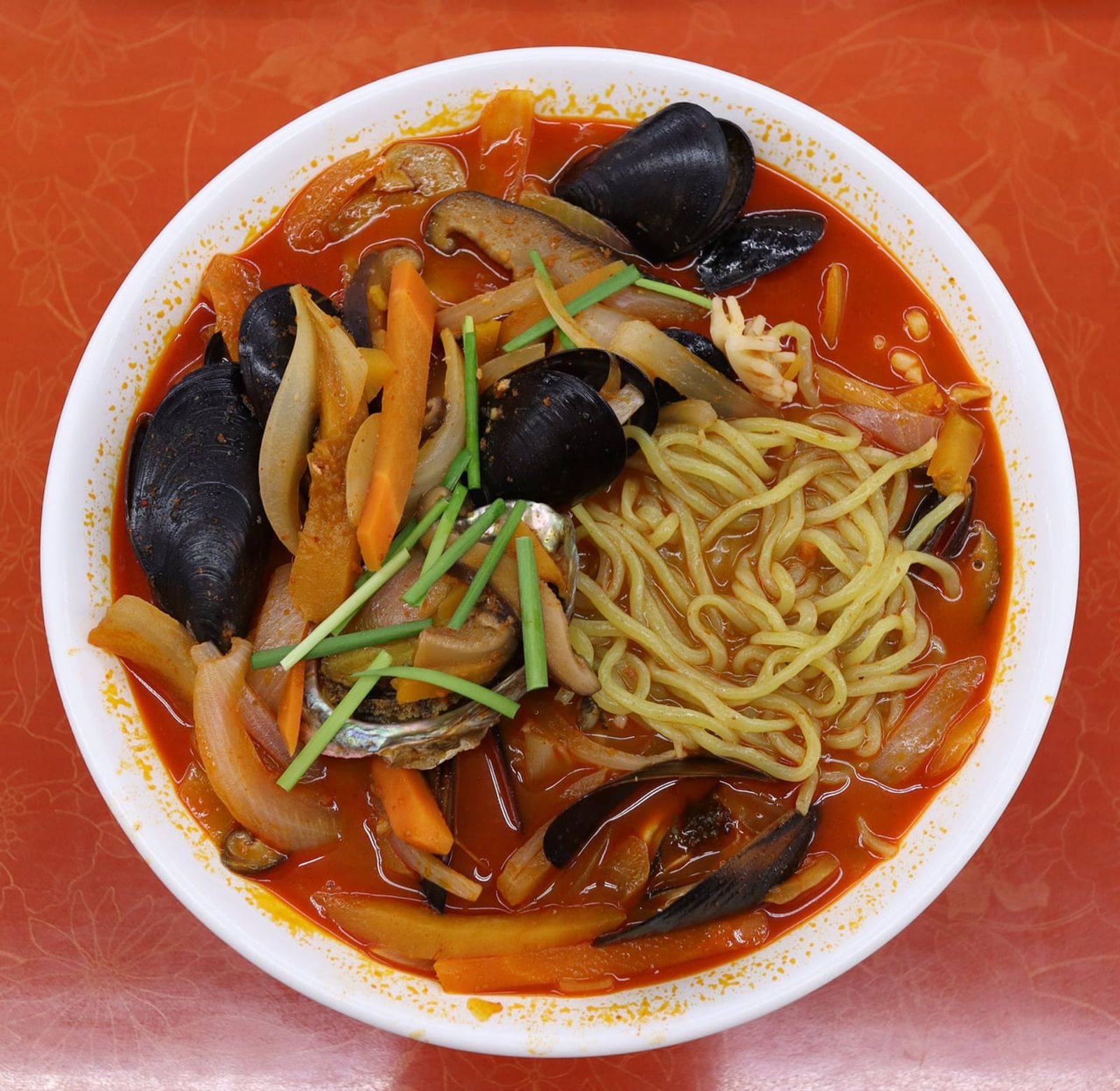
Jjamppong topped with plenty of mussels · Photo: Mobius6 / CC BY-SA 4.0 (Wikimedia Commons)
 KoreaNorth Jeolla · Gunsan
Gunsan Jjamppong: Chinese-Korean Restaurants, a Heritage-Listed Dining Room and a Noodle Street
Gunsan is known for spicy jjamppong loaded with mussels and clams. Here is the story of the ethnic Chinese restaurants that took root after the port opened in 1899, a dining room listed as national heritage, the city's jjamppong street and its autumn festival.
Gunsan, a Treaty Port, and Its Chinese Community
Jjamppong is a Korean-Chinese noodle soup: seafood and vegetables are stir-fried, then simmered into a red, spicy broth with chilli powder and poured over noodles. Together with jajangmyeon, it is one of the two signature dishes of Korean Chinese restaurants. Gunsan's fame for jjamppong goes back to its port. After the 1882 Imo Incident, a trade agreement between Joseon and Qing China allowed Chinese merchants into Korea, and Gunsan, then a small inlet of Okgu County, became a major port city when it opened on 1 May 1899. Chinese immigrants settled and opened restaurants, and at their peak Gunsan had more than 60 Chinese-run eateries. Around ten are said to be still in business.
A Chinese Restaurant Listed as National Heritage
One place sums up the history of Gunsan's Chinese restaurants. Opened in 1952 and run by a second-generation ethnic Chinese family, it is regarded as Gunsan's oldest Chinese restaurant, and in 2018 it was designated Registered National Heritage No. 723. Interestingly, it was the distinctive layout of the interior, rather than the façade, that was judged worth preserving. It has also appeared as a film location. A restaurant becoming heritage fits Gunsan's character. The old town keeps many buildings from the treaty-port and colonial eras and is known as a modern-history city, and the Chinese restaurants are part of that streetscape. It is still a working restaurant, though, so be considerate of diners if you look around.
What Gunsan Jjamppong Tastes Like
Nobody knows exactly where Gunsan's jjamppong style came from; the best guess is that it took root through the city's Chinese restaurants. So there is no single fixed 'Gunsan recipe'. There are common threads, though. As befits a Yellow Sea port, mussels, clams and other seafood go in generously, and the broth is often described as sharp, spicy and rich. Every restaurant has its own recipe: some keep it clean with seafood alone, others use a beef-bone stock with smoky wok-fried flavour. Some Chinese restaurants in Gunsan also serve 'mul-jjajang', a soupier take on black-bean noodles, so it is worth trying alongside your jjamppong.
The Jjamppong Street Beside the Old Town
Gunsan designated the Dongnyeong-gil and Jangmi-gil area of Jangmi-dong in the old town, where Chinese restaurants had long clustered, as its Jjamppong Specialty Street. The project was selected in a 2018 Ministry of Agriculture programme, and some sources date the street's completion to 2019. Long-standing Chinese restaurants here have been joined by newer jjamppong places, cafés and snack bars. The street connects directly to the modern history district with the old Gunsan Customs House and other early 20th-century buildings, so it is easy to explore both on foot. A good plan is to walk the old streets in the morning and have jjamppong for lunch. Popular places get long queues at midday, so go a little early or avoid the peak.
The Autumn Jjamppong Festival
Gunsan is making jjamppong the centrepiece of its food tourism. Each autumn the Gunsan Jjamppong Festival is held near the jjamppong street; in 2026 it ran from 9 to 11 October around Jangmi-dong. About 20 booths run by local Chinese restaurants and chefs sold jjamppong and jajangmyeon in half portions, so visitors could compare several places. Outside festival time the approach is similar. Portions are generous at many places, so if you go as a group, share jjamppong, jajangmyeon and sweet-and-sour pork. Some restaurants will adjust the spice level, so ask when ordering if you are sensitive to heat. With so much shellfish, many places also give you a separate bowl for the shells.