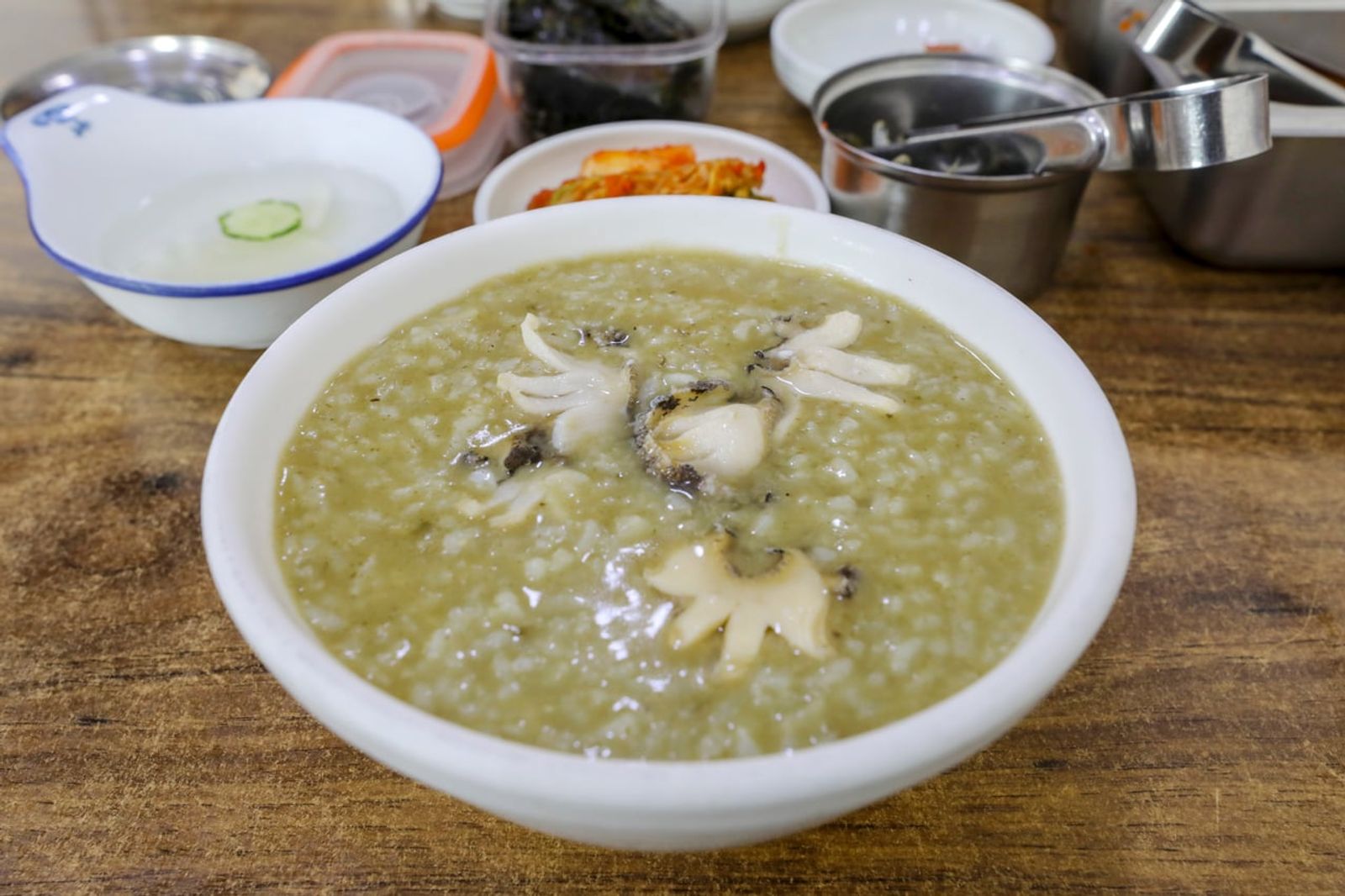
Abalone porridge, tinted green by the innards · Photo: bryan... / CC BY-SA 2.0 (Wikimedia Commons)
 KoreaSouth Jeolla · Wando
Wando Abalone: How to Eat It on the Island That Grows Three-Quarters of Korea's Supply
Most of the abalone eaten in Korea comes from Wando in South Jeolla Province. Here is how this seaweed-fed abalone made Wando the country's top producer, how to enjoy it raw, in porridge or grilled, and how to read the size grades.
Wando, Home of Korean Abalone
Abalone has long been prized as a luxury of the sea, and much of the reason it is now relatively easy to eat in Korea is Wando in South Jeolla Province. Wando is the country's largest producer, accounting for about 74 percent of national abalone output. According to 2026 reports, Wando's production rose from 23,317 tonnes in 2024 to 27,177 tonnes in 2025 and was expected to top 30,000 tonnes in 2026. Head out on the water off Wando and you will see grids of square sea cages stretching across the surface, many of them for abalone. Most abalone in Korea is farmed this way, and Wando is the center of it all. As a result, "Wando abalone" works in Korea both as a place of origin and as a byword for quality.
Abalone Raised on Seaweed
Abalone feed on seaweed. Asked why Wando became the top producer, local growers point to clean water and to their own expertise in farming wakame and kelp, the abalone's food. Some explain that Wando's waters are so rich in seaweed that farmers do not need to buy in feed. Geumildo, one of Wando's islands, is described as producing a large share of Korea's kelp. Abalone is not a fast-growing creature. One Wando farmer who took up abalone farming in the late 1990s managed, after much trial and error, to cut the growing period from four years to two or three. It is a food that demands time and care. Seaweed-fed abalone is said to be edible down to the innards, with chewy flesh and little fishy smell.
Raw, Porridge or Grilled: Three Ways to Eat It
At the source the first recommendation is jeonbok-hoe, raw abalone. The live abalone is cut from its shell and sliced thin, so you get the crunchy bite and the full taste of the sea. Dip it in chojang, vinegared chili paste, or in sesame oil with salt. Jeonbok-juk, abalone porridge, is the abalone dish Koreans know best. The meat is diced and sautéed in sesame oil, then soaked rice is added and simmered; if the innards go in too, the porridge turns a greenish color and tastes noticeably richer. It is gentle on the stomach and makes a good breakfast. Butter-grilled abalone and abalone braised in soy sauce are also popular. Wando County has worked with local restaurants to introduce new abalone dishes too, such as spicy pork with abalone, abalone and dried pollack hangover soup and abalone rice bowls.
Reading Sizes and Today's Prices
Abalone size is usually described by how many fit in one kilogram. The fewer per kilogram, the bigger each one and the higher the price. The number you see on signs at markets and producer shops is exactly this count, so choose larger ones if you want sashimi and smaller ones for porridge or braising. Recently production has risen sharply while demand has not kept up, and farm-gate prices have dropped a lot. According to 2026 reports, the producer price for abalone at 20 per kilogram fell from 26,000 won in 2022 to 13,000 won in July 2026, about half, and the government and Wando County are working on measures to cut cage numbers and boost consumption. For travelers, that makes this a good time to enjoy quality abalone at the source without breaking the bank.
Where to Try It
Around Wando Port in Wando-eup you will find a seafood market, raw-fish restaurants and abalone specialists side by side, so abalone sashimi and porridge are easy to come by. Many travelers pick out live abalone at the market and have a nearby restaurant prepare it, or ship a box home. Starting the day with a bowl of abalone porridge before heading off to explore the islands makes a fine plan. In spring the Wando Jang Bogo Seafood Festival is held around Wando Beach Park. In 2025 it ran from May 3 to 6, a chance to taste and buy abalone and the rest of Wando's seafood. Dates change each year, so check the county's tourism information. Wando is connected to the mainland by bridge, so you can drive there, and it pairs well with a trip through Haenam and Gangjin in South Jeolla.