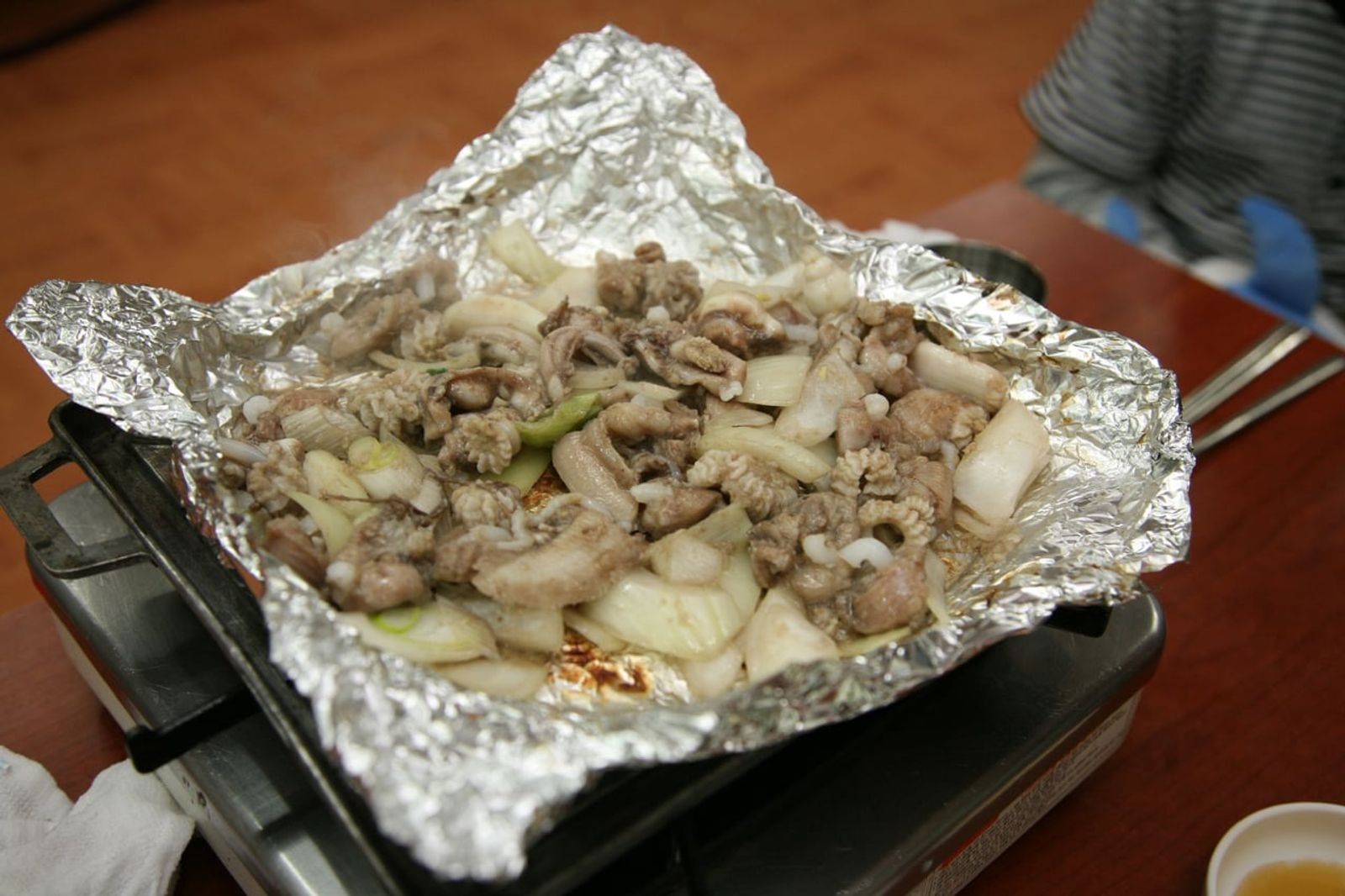
Grilled hagfish at Haeundae Market, Busan · Photo: Junho Jung (Flickr) / CC BY-SA 3.0 (Wikimedia Commons)
 KoreaBusan
Busan's Grilled Hagfish: From Leather-Factory Scraps to the Pride of Jagalchi and Gijang
Along the waterfront at Jagalchi Market, tent-style eateries grill hagfish, locally called kkomjangeo, over coal briquettes. Here is why this odd fish became a Busan icon and how the spicy, salt-grilled and Gijang straw-fire versions differ.
Kkomjangeo, Gomjangeo, Meokjangeo: One Fish
The fish Busan people call kkomjangeo or gomjangeo is officially meokjangeo, the inshore hagfish. According to the Maeil Shinmun, the nicknames come from the way it squirms, gomjirak or kkomjirak in Korean. Despite the 'eel' in its name it is nothing like a freshwater or conger eel; it is a primitive sea creature whose eyes have all but disappeared. The paper notes that Korean-caught hagfish have a coppery sheen with a clear white line down the back, while imported ones look darker. Interestingly, Japan hardly eats hagfish, so much of what is caught off Japan ends up in Busan, reportedly carried on the ferries between Busan and Shimonoseki. In other words, the very culture of grilling hagfish grew up around Busan.
The Skin Went to Japan, the Meat Fed Busan
The Kyunghyang Shinmun estimates that Koreans only began eating hagfish in earnest in modern times, since old texts barely mention it, unlike freshwater or pike eels. Under Japanese colonial rule, the Japanese prized its soft but tough skin for clog straps and hat trims. Tanneries around Gwangbok-dong in Busan kept the skins and threw away the meat or sold it for next to nothing. Koreans who bought those scraps and grilled them to fill their stomachs are said to have started the hagfish-grilling tradition centred on Jagalchi Market. A Segye Ilbo column cites a 1936 South Gyeongsang fisheries station report recording hagfish dishes at cheap eateries near Busan and Ulsan. According to the Maeil Shinmun, hagfish skin, tougher than cowhide, remained a valuable export into the 1970s.
How Wartime Refugees Built Jagalchi's Hagfish Alley
What made grilled hagfish a Busan signature was the Korean War. After liberation, refugees who settled around Jagalchi Market in the years around the war set up makeshift stalls grilling and selling the hagfish meat the tanneries discarded, so leather factories and grill stalls ended up sharing the same neighbourhood. As those stalls multiplied, they became today's Jagalchi hagfish alley. The fish's status has changed so much that people now say it is treated as more precious than eel. According to the Maeil Shinmun, the hagfish-grilling habit spread from the 1970s across Busan and on to cities such as Daegu. If you see hagfish restaurants in other Korean cities today, they are the descendants of this Busan dish.
Jagalchi's Coal Briquettes vs. Gijang's Straw Fire
Busan's grilled hagfish splits into two main styles depending on the fire. The first is the Jagalchi style over coal briquettes. The Maeil Shinmun reports around 130 tent-style hagfish eateries along the Jagalchi waterfront, most cooking over briquettes. You can order it spicy, tossed in a hot red sauce, or salt-grilled, and plates with half of each are common. The second is straw-fire hagfish from Gijang County, east of the city. The fish is charred whole, skin on, over burning rice straw, then the blackened skin is peeled off to reveal the flesh. According to the paper, straw flares up hot and dies down quickly, which suits hagfish, while pine or oak burns too fiercely. This style is also said to come from wartime refugees grilling hagfish over straw, and specialist restaurants cluster around Gongsu village in Gijang.
Ordering Tips
On a first visit, order half spicy and half salt-grilled to compare. The salt version shows off the chewy texture and clean flavour; the spicy one soaks up a sweet-hot sauce that goes well with a drink. Hagfish curls up as it cooks; once the surface turns golden and firm it is ready. Leave it too long and it toughens, so take it off in time. Many of the Jagalchi waterfront spots seat you facing the sea, which is half the fun. For the straw-fire version you need to head out to Gijang, usually by car from around Haeundae. Prices move with the market and the fish's origin, so it is worth checking the origin labelling on the menu.