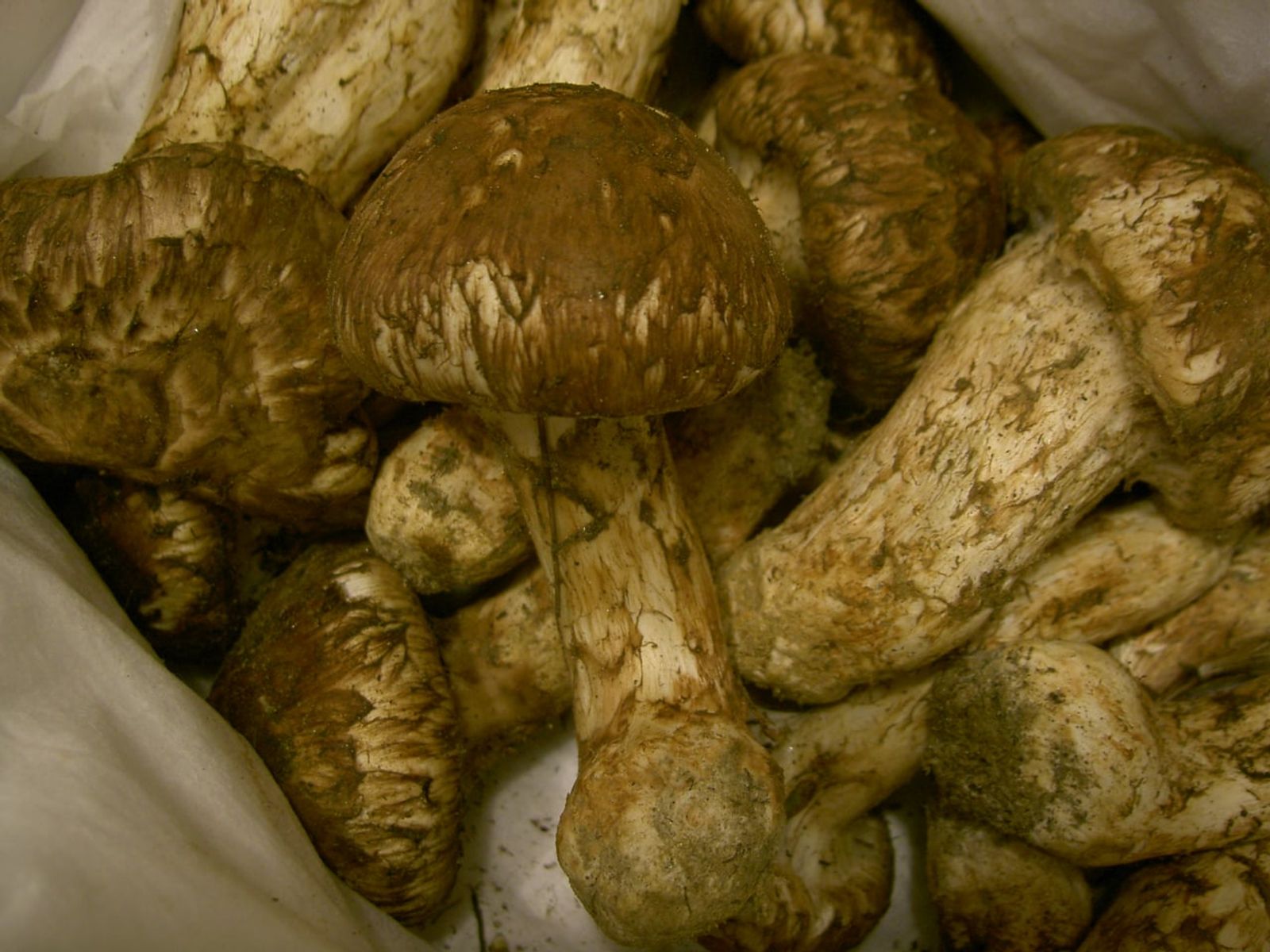
Freshly picked pine mushrooms (songi) · Photo: Stegano / Public domain (Wikimedia Commons)
 KoreaGangwon · Yangyang
Yangyang Pine Mushrooms: The Autumn Scent of a Pine Forest
Every autumn, pine mushrooms pour into the forestry cooperative auction hall in Yangyang, Gangwon Province. Here is why they cannot be farmed, how the top grade is decided, how Yangyang became Korea's first geographical-indication forest product, and how to eat them without losing the scent.
The Mushroom That Draws Everyone to Yangyang in Autumn
Songi, the pine mushroom (matsutake), is considered the most prized mushroom in Korea. Korean media often quote the classic medical text Dongui Bogam as calling it the finest of mushrooms, sweet and fragrant and steeped in the spirit of the pine. The main producing areas are Yangyang and Bonghwa in North Gyeongsang, both rich in red pine forests. Yangyang is also where much of the trading happens. In 2001 the Kyunghyang Shinmun reported that Yangyang was the country's largest collection point, with 80 percent of national output traded there. Every autumn the Yangyang-Sokcho forestry cooperative still buys freshly picked mushrooms at its auction hall and sets prices by open bidding. The first auction of the season and that year's top price make the news every year, which shows how much Yangyang songi means to autumn in Gangwon.
A Mushroom You Cannot Farm
The main reason songi is so expensive is that nobody can grow it at will. According to Korea's National Institute of Forest Science, songi lives in symbiosis with the roots of living pine trees, so it cannot be raised on logs or growing media the way shiitake can. A ring-shaped fungal structure that forms around pine roots is the key to whether mushrooms appear. The institute has experimented with planting young pines where songi already grows, letting the fungus colonize their roots, and then moving them to other forests. In 2017 mushrooms sprouted from such transplanted seedlings, which was reported as a world first in artificial cultivation. Even so, almost all songi on the market is still wild, found and picked by hand in the mountains. That is why the harvest swings so sharply with each year's rain and temperature.
How the Top Grade Is Decided
Mushrooms brought to the auction hall are graded by size, shape and how far the cap has opened. According to press reports, the top grade must be at least 8 cm long with a normal shape and an unopened cap. Mushrooms 6 to 8 cm long, or with caps opened up to a third, go to the second grade. Open-capped mushrooms, stunted ones and broken or insect-damaged ones are sorted separately. A closed, firm cap is thought to hold the aroma longer and stronger. Prices vary hugely from year to year. At the first auction of 2017 the top grade went for about 400,000 won per kilogram, while records followed one after another: 1,611,200 won per kilogram in October 2025 and 1,623,700 won on September 30, 2026, according to press reports.
Why It Became Geographical Indication No. 1
Yangyang songi was registered in 2006 as the Korea Forest Service's first geographical-indication forest product. Behind that was a long-running problem. According to a 2005 Kyunghyang Shinmun report, the Yangyang name was so valuable that mushrooms from other regions or from China were often passed off as Yangyang songi, and mixing them caused quality disputes and kept local growers from getting a fair price. So Yangyang County formed a registration committee, held briefings for residents, set up a producers' association and filed the application. A geographical indication names the place of origin to reduce consumer confusion and guarantee quality. Today the first auction of each season is still run jointly by that producers' association and the Yangyang-Sokcho forestry cooperative, and graded mushrooms go out labeled with where they came from.
Eating It for the Aroma, and Where to Go
Because songi is all about scent, the simpler the cooking, the better, people say. The cleaning tip often given in Korean media: never soak it, just scrape off the soil gently with a small knife under running water. Then tear it along the grain and savor it raw, or sear it very briefly in a pan and dip it in sesame oil with salt. Songi skewered with beef (songi sanjeok), grilled songi and songi rice are other classics. The season usually runs from mid-September through October. Yangyang County holds a festival around October each year, and in 2026 it was merged with the Namdaecheon salmon festival and held as a joint pine mushroom and salmon festival on October 16–18. Once the season ends, songi dishes in town become scarce, so time your visit for autumn.