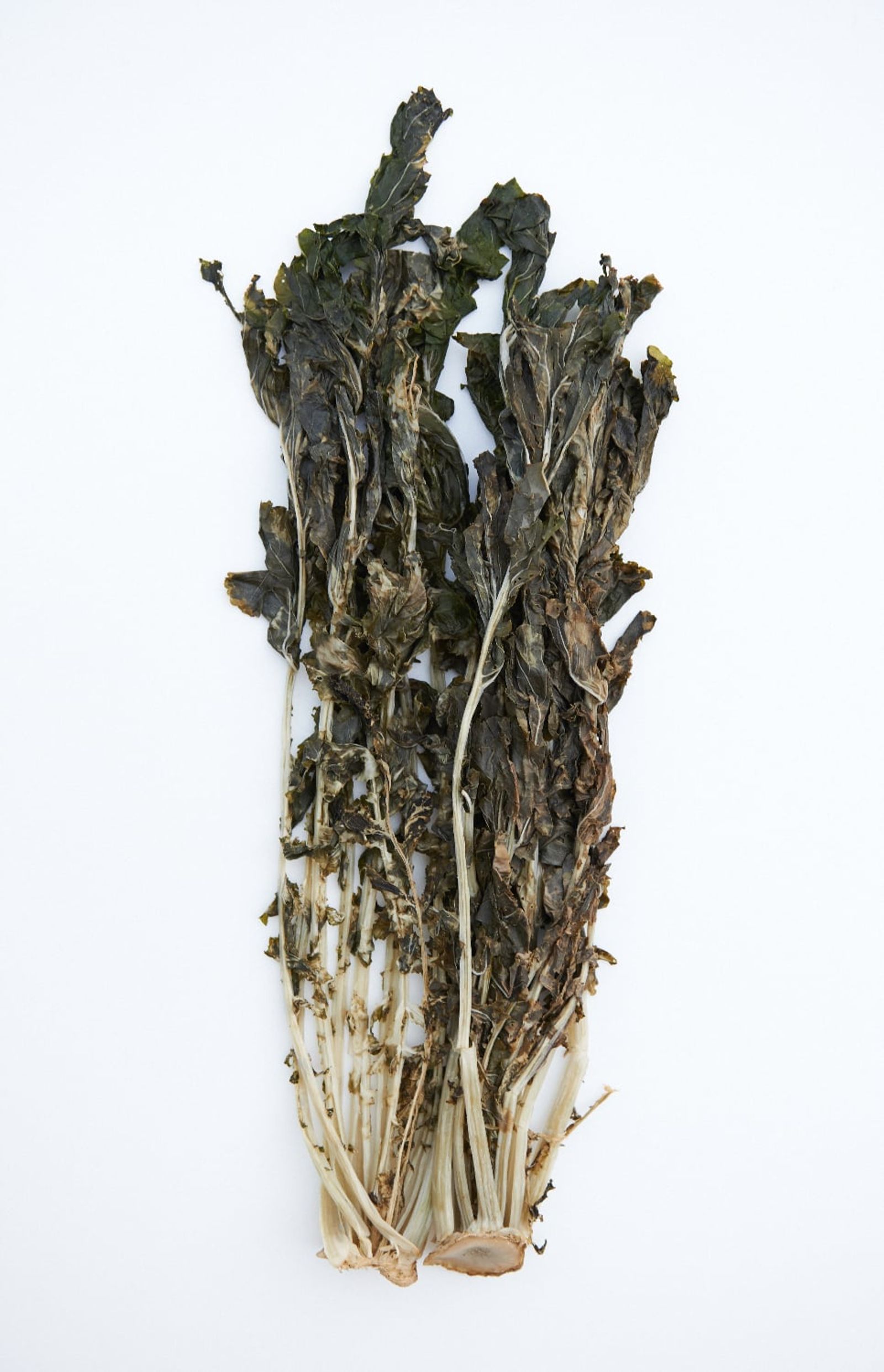
Siraegi, fully dried radish greens · Photo: 국립국어원 / CC BY-SA 2.0 KR (Wikimedia Commons)
 KoreaGangwon · Yanggu
Yanggu Punchbowl Siraegi: Radish Greens Dried by Winter Wind Near the DMZ
Just south of the Korean truce line lies a bowl-shaped basin nicknamed the Punchbowl, where radish greens hang on drying racks every winter. This is how siraegi went from famine food to the specialty that supports a whole township, plus the dishes to try in Yanggu.
A Valley Shaped Like a Punch Bowl
Haean-myeon in Yanggu County, Gangwon Province, is a basin ringed by mountains. According to a Rural Development Administration webzine, its bowl-like shape earned it the nickname Punchbowl during the Korean War. It was the scene of fierce fighting, including the battles of the Punchbowl, Dosolsan and Gachilbong, and war memorials and minefield warning signs remain today. Haean is described as the only township in Korea located inside the Civilian Control Line, with about 1,700 residents. Because access was restricted for decades after the war, the natural environment is well preserved. Sitting 400 to 500 meters above sea level, the basin has such wide temperature swings that cold winds and frost can linger into spring. That cold, windy weather is exactly what gives Punchbowl siraegi its character.
What Is Siraegi?
Siraegi is dried radish greens, the leaves and stems of the Korean radish. After radishes are pulled for winter kimchi making, the leftover tops are tied on straw rope and hung under the eaves or in the shade, where they freeze and thaw again and again over the winter until fully dry. Before cooking, they are soaked, boiled until tender, stripped of their tough outer film and rinsed. In leaner times siraegi was famine food that helped families survive winter and the hungry spring. Today it is valued as health food. The Rural Development Administration webzine notes that drying multiplies the dietary fiber three to four times, and that siraegi is rich in iron and vitamins. Its nutty, mild flavor and soft chew suit soybean paste soup, braises, simmered fish and seasoned rice alike.
From Five Farms to a Township Industry
Punchbowl siraegi goes back to the early 1990s. The Seoul Shinmun (2013) says it began when five farms in Mandae village in Haean started selling siraegi after their potato harvest. Siraegi dried in temperatures below minus 20 degrees Celsius caught on, and more farmers joined. Serious siraegi farming took off in 2007. According to the Rural Development Administration webzine, highland radish, cabbage and potato crops kept running into trouble, so farmers turned to siraegi, and that same year they worked with the National Institute of Crop Science to develop a radish variety bred for its tops. Press reports say 64 farms earned 2.4 billion won in 2012, and by 2015 about 120 farms produced some 470 tonnes and earned more than 4.6 billion won.
Dried by Winter Wind, Not Machines
The secret most often credited for Punchbowl siraegi is how it is dried. According to press reports, the radishes are sown in mid-August and the greens are harvested in November and hung on drying racks. Farmers stick to natural drying instead of mechanical dryers. With wind circling inside the basin and big swings between day and night temperatures, the greens freeze and thaw all winter and dry slowly. The Seoul Shinmun quoted locals as saying that drying in such cold keeps nutrient loss low and fiber high. Relying on the weather means each year's November conditions decide the harvest. Demand is steady, too. Stock usually sells out by early December when the new crop arrives, but in 2015 it was reported to have sold out as early as early November. Drive through Haean in winter and the rows of drying racks across the fields are the village's winter scenery.
Siraegi Meals and the Festival in Yanggu
In Yanggu it is easy to find meals built around siraegi. The Rural Development Administration webzine lists siraegi rice, siraegi with beef bulgogi, siraegi with thick soybean paste, and mackerel braised with siraegi as signature dishes. Restaurants around Yanggu town and Haean serve set meals like these, and you can buy dried or boiled siraegi to take home. Every autumn Haean hosts the Yanggu Punchbowl Siraegi and Apple Festival. It began with siraegi alone, but as climate change pushed apple growing north, highland apples spread in the Punchbowl too, and apples joined the festival in 2022. In 2024 it ran from November 1 to 3, so check Yanggu County's announcement for the year's dates. Security tourism sites such as the Fourth Infiltration Tunnel and Eulji Observatory are nearby.