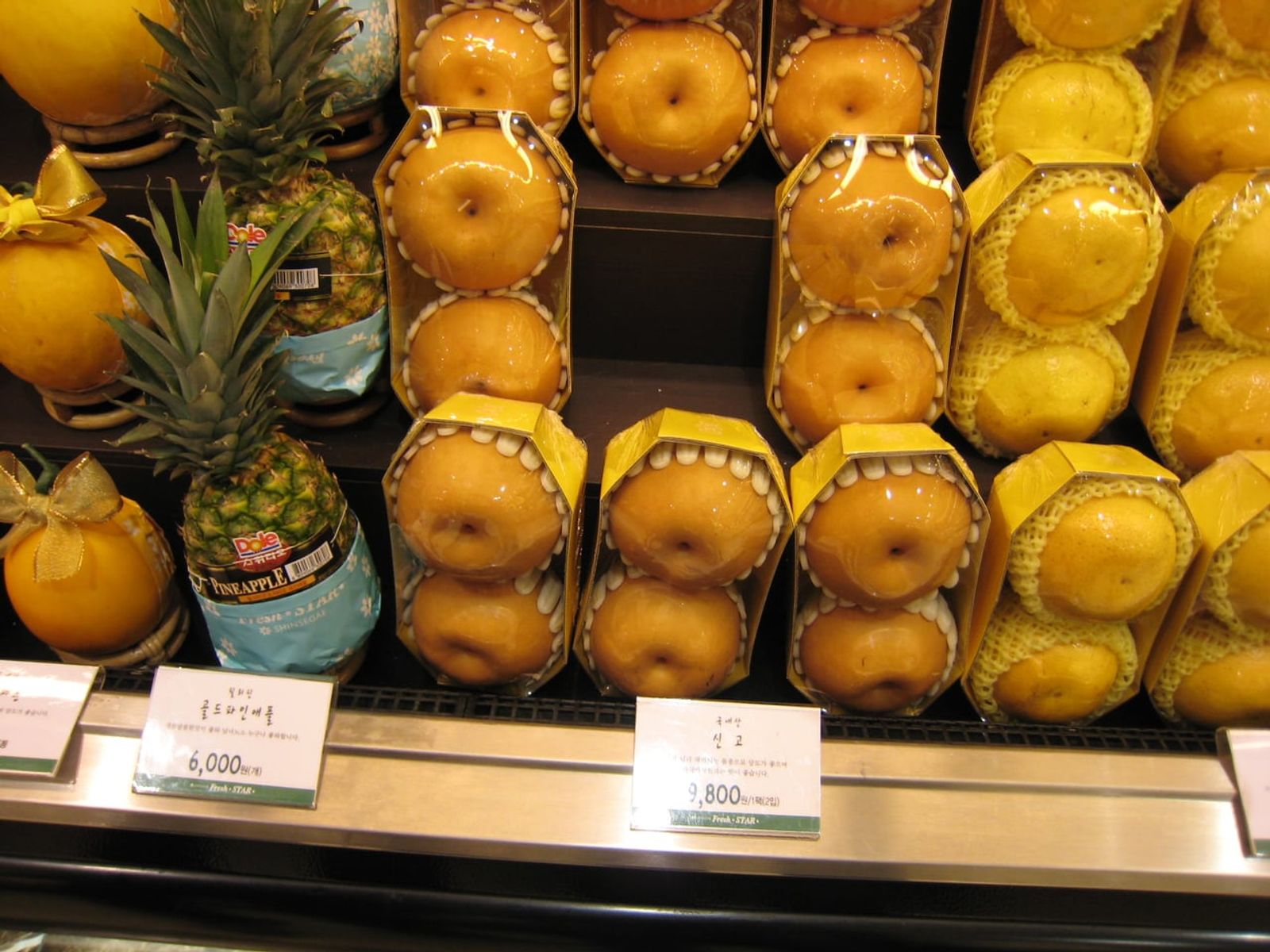
Namyangju Meokgol Pears · Photo: karendotcom127 / CC BY 2.0 (Wikimedia Commons)
 KoreaGyeonggi · Namyangju
Namyangju Meokgol Pears: A Name Born in Seoul, a Harvest Carried On in Gyeonggi
The name Meokgol pear comes from an old place name around Muk-dong in Seoul's Jungnang District. When urban development shrank Seoul's orchards, Namyangju carried the name on. Here is the royal-tribute legend, the dispute over the name, the pears of the mountain-ringed fields around Byeollae, and how to pick a good one.
Meokgol Was a Neighborhood in Seoul
Meokgol pears are now counted among Namyangju's signature fruits, but the name was born in Seoul. According to Seoul Shinmun, the area of today's Jungnang District was called Mukdong-ri in the late Joseon period, and the story that pears grown there were sent as tribute to the royal household is given as the reason the district had so many orchards. Later, as workshops making ink sticks and brushes multiplied in Mukdong-ri, the place came to be called Meokgol, roughly 'ink village', and the name Meokgol pear became hugely popular. Meokgol Station on Seoul Subway Line 7 is a reminder that the name survives. That said, several explanations circulate for the name Muk-dong itself, such as that ink sticks (muk, 墨) were made there in the Joseon era, or a belief that putting 'ink' in a place name would make learning flourish, so its roots are hard to pin down to one story.
A Legend of a Loyal Official's Pear Trees
Meokgol pears also come with a legend reaching back to the early Joseon period. According to a 2012 Seoul Shinmun article, an official who had followed the boy king Danjong (1441-1457) into exile after his uncle Sejo seized the throne returned to the capital, gave up his post and consoled himself by growing pear trees. The trees spread in every direction, the story goes, and that is how Mukgol's pears won their fame. The article does not name the official, and the tale is best taken as legend. The idea of a tribute fruit also appears in sources about Namyangju. A 1997 Seoul Shinmun article introduced Namyangju Meokgol pears as a fruit once presented to the Joseon royal court. The image of a pear fit for a king has long added to the name's value.
Seoul's Orchards Shrink, the Name Moves On
As Seoul grew, the orchards around Muk-dong steadily disappeared. The 2012 article says that as development cut Seoul's growing area, Gyeonggi Province carried on the Meokgol name, and today Guri and Namyangju are the leading producers. Fame brought problems too. According to a 2015 Seoul Shinmun report, the value of the name actually fell as growers in Gyeonggi, Gangwon and elsewhere all used it, and local governments clashed over it. When a court ruled that the name was not worth protecting as a trademark, Seoul's Jungnang District reportedly created a separate brand under a different name. So today Meokgol pear is less a trademark of any one city and more a term for a pear-growing tradition that runs from northeast Seoul into Namyangju and Guri.
The Mountain-Ringed Fields of Byeollae
The main growing area for Namyangju's Meokgol pears is the Byeollae area. A 1997 Seoul Shinmun article named the stretch along National Route 43 between Namyangju and Uijeongbu in Gwangjeon-ri, Byeollae-myeon, as the heart of production, with 463 hectares under cultivation centered on Byeollae-myeon, Jinjeop-eup and Jingeon-myeon. Around 500 farms harvested 8,892 tons a year at the time, so it was a sizable operation. Keep in mind that the landscape has changed a lot since, with a new town now built in Byeollae. The same article credited the terrain for the flavor. Surrounded by mountains, the area gets little wind and wide swings between day and night temperatures, which is said to make the flesh firm, juicy and sweet. When the trees bloom in spring, growers pollinate the flowers by hand, then wrap each fruit in a paper bag until autumn.
How to Choose and Enjoy a Good Pear
The 'top grade' criteria described in that 1997 article are still useful. Look for a clear yellowish-brown skin, a round shape and a smooth, glossy surface. A good pear should feel cool and refreshing when you bite into it, without a dry, gritty aftertaste. A Gyeonggi Province magazine puts pear season from September to November, which is why pears are so popular as Chuseok gifts and on ancestral-rite tables. The basic way is simply to peel and eat it, but pears are also juiced or made into tea, and even turned into side dishes such as bae-sobagi, where pear slices are tossed with garlic chives and chili-flake seasoning. Namyangju has also run direct-sale markets for Meokgol pears in harvest season (in November 2022 one was held at Jamsil Station in Seoul). If you pass through Namyangju in autumn, look for a chance to try pears from the source. Event schedules change every year, so check the city's announcements.