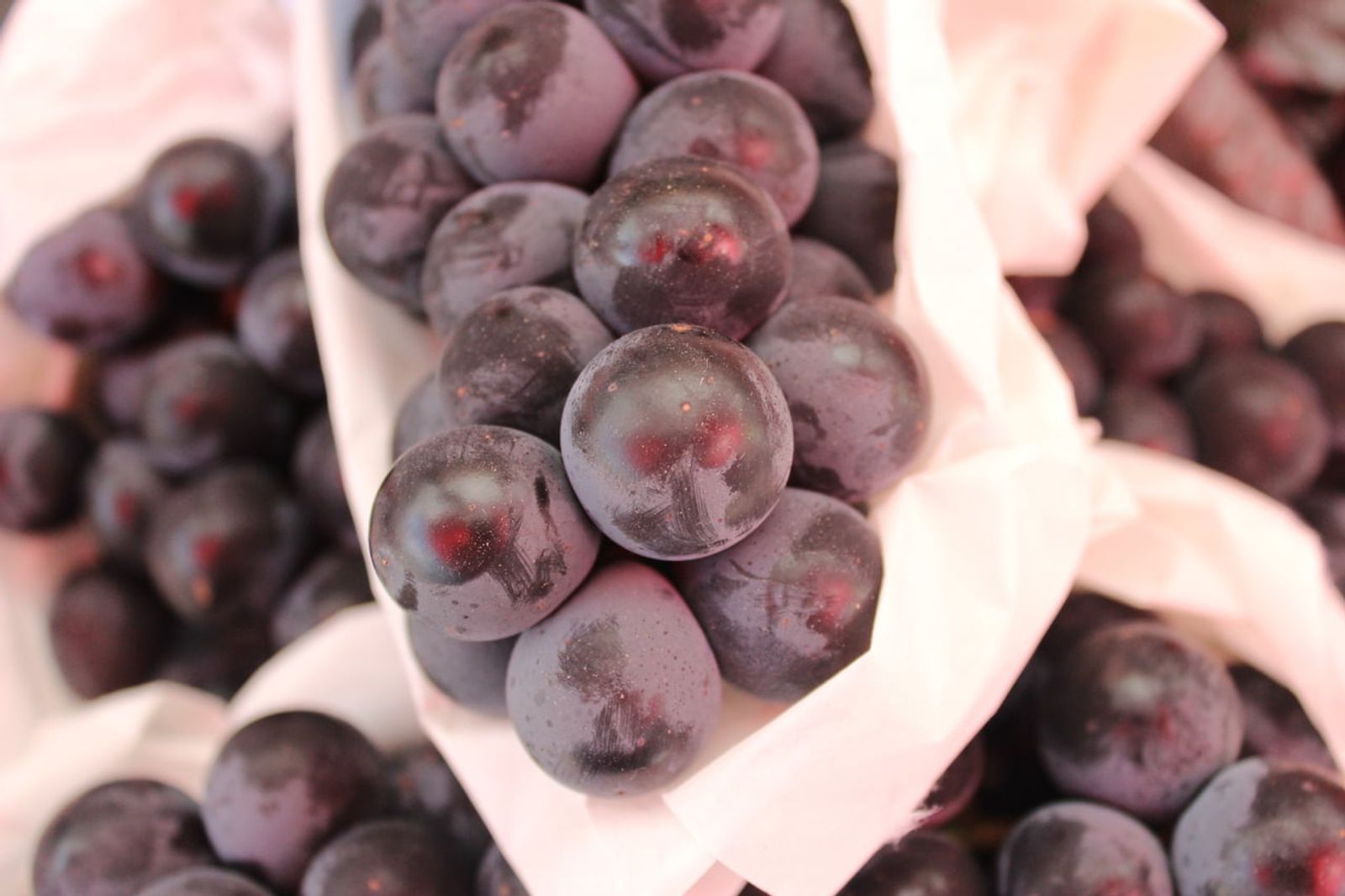
Campbell Early, the grape variety most widely grown in Korea · Photo: Tae Hun Kim / CC0 (Wikimedia Commons)
 KoreaGyeonggi · Hwaseong
Hwaseong Songsan Grapes: Sea-Breeze Grapes Grown on Reclaimed Land
The Songsan area of Hwaseong, Gyeonggi Province, was once surrounded by sea on three sides. When the Sihwa seawall project of the late 1980s changed both the land and local livelihoods, residents turned to grapes. Here is how Songsan grapes grew from Campbell Early to some 30 varieties and open-field smart farms, and how to enjoy them in season.
Songsan, Once Surrounded by Sea
The story of Songsan grapes begins at sea. Before the Sihwa seawall was built, Songsan-myeon in northwestern Hwaseong was surrounded by water on three sides, and residents are said to have made a living from both farming and fishing. Change came in the late 1980s. As the seawall project turned tidal land into reclaimed fields, the surroundings and local livelihoods shifted dramatically, and people in Songsan-myeon and neighboring Seosin-myeon had to find new sources of income. The crop they chose was grapes. According to Seoul Shinmun, grape growing in Songsan began right around then, on land reclaimed by the seawall. In a sense, a village that lost its sea found a new path in vineyards.
Sea Wind, Big Temperature Swings and Reclaimed Soil
Why grapes, of all things? According to Seoul Shinmun, residents judged that the west coast's maritime climate, the large gap between day and night temperatures and the mineral-rich, loess-like reclaimed soil suited grapevines. Other articles also trace Songsan grapes' character to the sea breeze. Because the area borders the west coast, sea wind blows all year and the daily temperature swing is wide, which is said to give the grapes deep-colored skins, high sugar and dense flesh. A 2006 Kyeonggi Ilbo article also credited the rich soil, full of crushed seashells, for the deep color and high sugar of Hwaseong's grapes. Land made by shutting out the sea ended up giving the grapes their personality. That is also why Hwaseong puts 'sea breeze' front and center when promoting its grape festival.
From Campbell Early to Some 30 Varieties
In the early years, Songsan is said to have grown mostly purple grapes such as Campbell Early. A 2006 Kyeonggi Ilbo article explained that serious grape growing in Korea began when American varieties were introduced at the end of the Joseon era, and that most grapes grown at the time were Campbell Early. It is the sweet-tart, intensely aromatic purple grape most Koreans know best. Songsan growers then broadened their range, adopting rain-shelter cultivation and eco-friendly methods. In 2018 Hwaseong announced it would expand Shine Muscat, a green grape developed in Japan, led by young farmers, and today some 30 varieties are grown, including Shine Muscat, Beni Balad and Cocoball. In 2015 Hwaseong developed what it calls Korea's first smart-farm program for open-field grape vineyards, and about 70 farms now control watering, ventilation and more remotely by smartphone.
Songsan Grapes by the Numbers
According to a 2026 Seoul Shinmun report, Hwaseong had about 750 hectares of vineyards and some 1,500 grape farms as of 2025. Annual output is put at about 2,400 tons, based on shipments through the Songsan, Seosin and Mado agricultural cooperatives. In less than 40 years since it began on land taken from the sea, the area has become one of Gyeonggi Province's leading grape regions. The grapes travel abroad too. An export council of about 40 farms reportedly ships around 200 tons a year to ten countries, including the United States and Southeast Asia. Farmers in Songsan-myeon and Seosin-myeon have also formed a cooperative to ship together to department stores. On the expressway through Hwaseong there is even a rest area named Songsan Podo, literally 'Songsan Grape', a name that hints at the fruit's place in Hwaseong.
When and Where to Taste Them
Songsan grapes are in season from the tail end of summer into early autumn. Hwaseong has said it ships Shine Muscat mainly from late July to mid-September, and purple grapes such as Campbell Early also come out in late summer. The easiest way to taste them is the festival. The 12th Hwaseong Songsan Grape Festival was held on September 5-6, 2026, at Hwaseong Eco Farm Theme Park, with grape picking and grape stomping, grape drinks and desserts made by young farmers, and discount stalls. In August that year the Gyeonggi Tourism Organization also ran a 'Sweet Week' combining farm experiences and smart-farm tours. Dates change every year, so check Hwaseong's announcements first. The festival has discount stalls, so stopping by on a west-coast drive to pick up a box is another option.