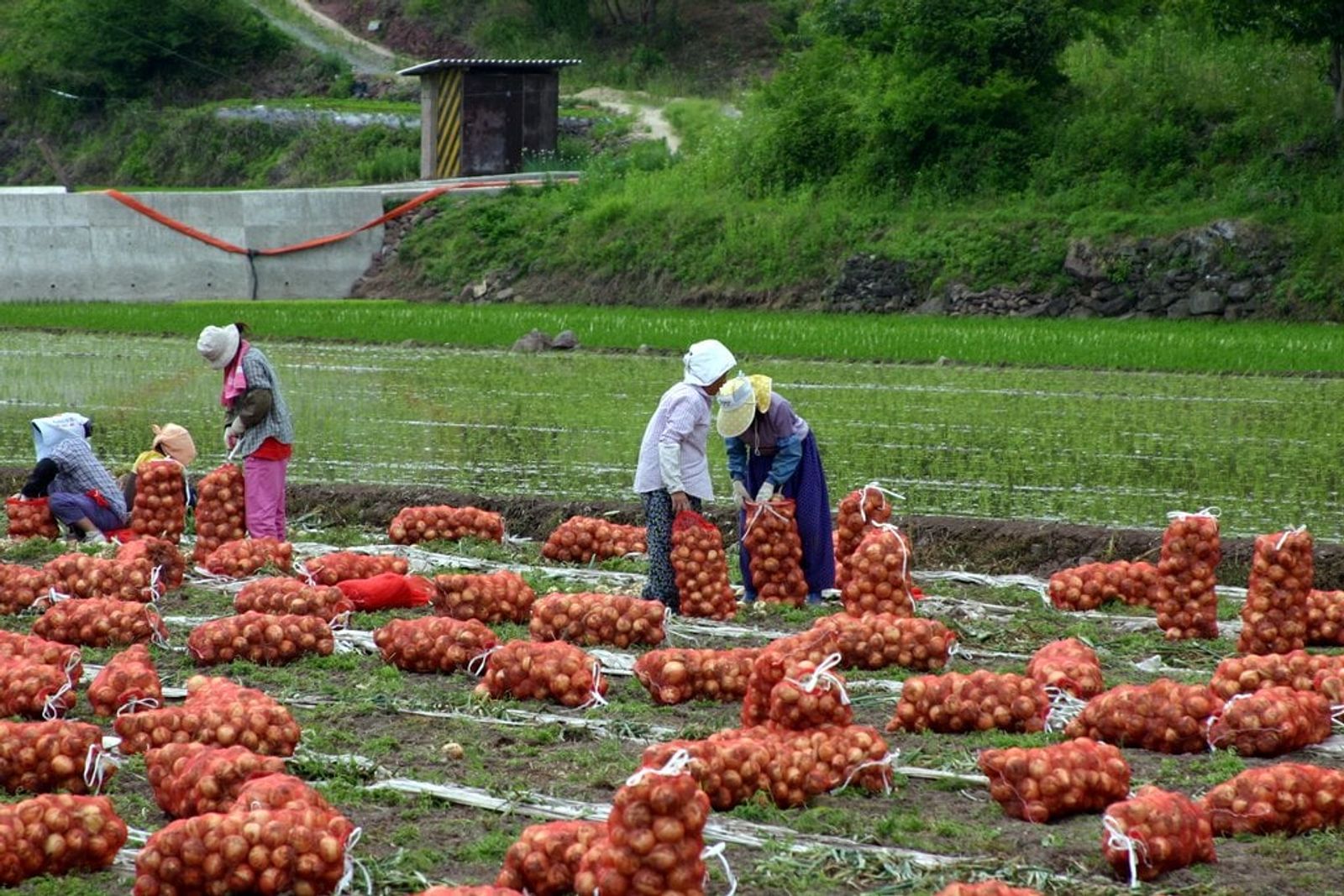
Changnyeong Onions · Photo: Robert at Picasa / CC BY 3.0 (Wikimedia Commons)
 KoreaSouth Gyeongsang · Changnyeong
Changnyeong Onions: The County Where Korea First Grew Onions
Onions are on every Korean table today, but the place they first took root in Korean fields is said to be Changnyeong in South Gyeongsang Province. Here is the record kept at one family's old house, how its seeds spread nationwide, when today's onions are harvested and what to eat at the local market.
The Place Called Korea's Onion Birthplace
Changnyeong County in South Gyeongsang Province, along with local media, calls itself the birthplace of Korean onions, the first place in the country where they were grown. The site most often cited is the old house of the Changnyeong Seong family in Seok-ri, Daeji-myeon. According to the heritage description, a man named Seong Gyu-ho settled in Seok-ri in the 1850s and a Seong clan village grew up around him. His son Seong Chan-yeong is said to have become the first person in Korea to successfully grow onions, in 1909. The house is also described as the home of the family that first spread onions around Changnyeong. The "first in the country" claim rests mostly on this description and local sources, so it is best read as the place known as the starting point of onion farming in Korea.
From One Family's Seeds to the Whole Country
Growing onions is one thing; producing your own seed is another. The same heritage description says that in the late 1950s Seong Chan-yeong's descendant Seong Jae-gyeong succeeded in harvesting onion seed and distributed it nationwide. The Korean text and the family tree make him a grandson, while the English text calls him a great-grandson, so sources differ slightly. The house itself is a hanok built in 1929 and was designated a South Gyeongsang cultural heritage material in 2004. It was once a large estate of dozens of buildings, but most of it burned during the Korean War, and several buildings were rebuilt in the 2000s. Standing among the onion fields, it is a reminder of how one family's farming experiment changed a whole country's dinner table.
Changnyeong Onions Today
Changnyeong onions are recognized as a geographical-indication product by the National Agricultural Products Quality Management Service, and Korean media describe them as juicy, sweet and firm. Production figures vary by year and by how they are counted: a 2021 report cited about 1,000 hectares and roughly 80,000 tonnes, while a 2024 report gave 563 hectares for that year. About 85% of Changnyeong's crop is said to be mid-to-late varieties. These are usually transplanted around late October, spend the winter in the field and are harvested in earnest from early June. A 2024 report, amid worries about unusual weather, expected Changnyeong to suffer less damage than other counties and to have a good crop. Drive through Changnyeong in early June and you will see piles of onions in red mesh sacks across the fields.
Getting the Most Out of Onions
On the Korean table onions are less the star than a dependable supporting actor. At barbecue restaurants, raw onion is often sliced thin and served in a soy-based sauce, and at gukbap (soup and rice) shops, pickled onion is a common free side dish. Introductions to a gukbap shop at Changnyeong's market also list onion pickles among the basic sides. Freshly harvested new-season onions are juicy and milder, which makes them good raw. If the sharpness is too much, a common trick is to soak the slices briefly in cold water. Cooked slowly for a long time, onions turn sweet and add depth to curries and stir-fries. If you pass through Changnyeong around June, you will see new onions sold by the net bag at co-op stores and markets. They are heavy, but they make cooking at home fun for a while.
What Else to Eat at Changnyeong Market
Changnyeong-eup's traditional market holds a five-day market on dates ending in 3 and 8. One local dish that travel guides point to around this market is sugure gukbap. Sugure is a chewy layer taken from the inside of cowhide and is considered a hard-to-find specialty cut. It is simmered in a spicy broth with seonji (beef blood curd), bean sprouts and green onion. Its springy texture divides people, so if you are trying it for the first time, ordering it alongside a seonji gukbap and sharing both is a good idea. After the market, stop by Upo Wetland, a short drive away and often described as one of Korea's largest inland wetlands. Onion fields, wetland and a bowl of market soup make a very Changnyeong half-day.