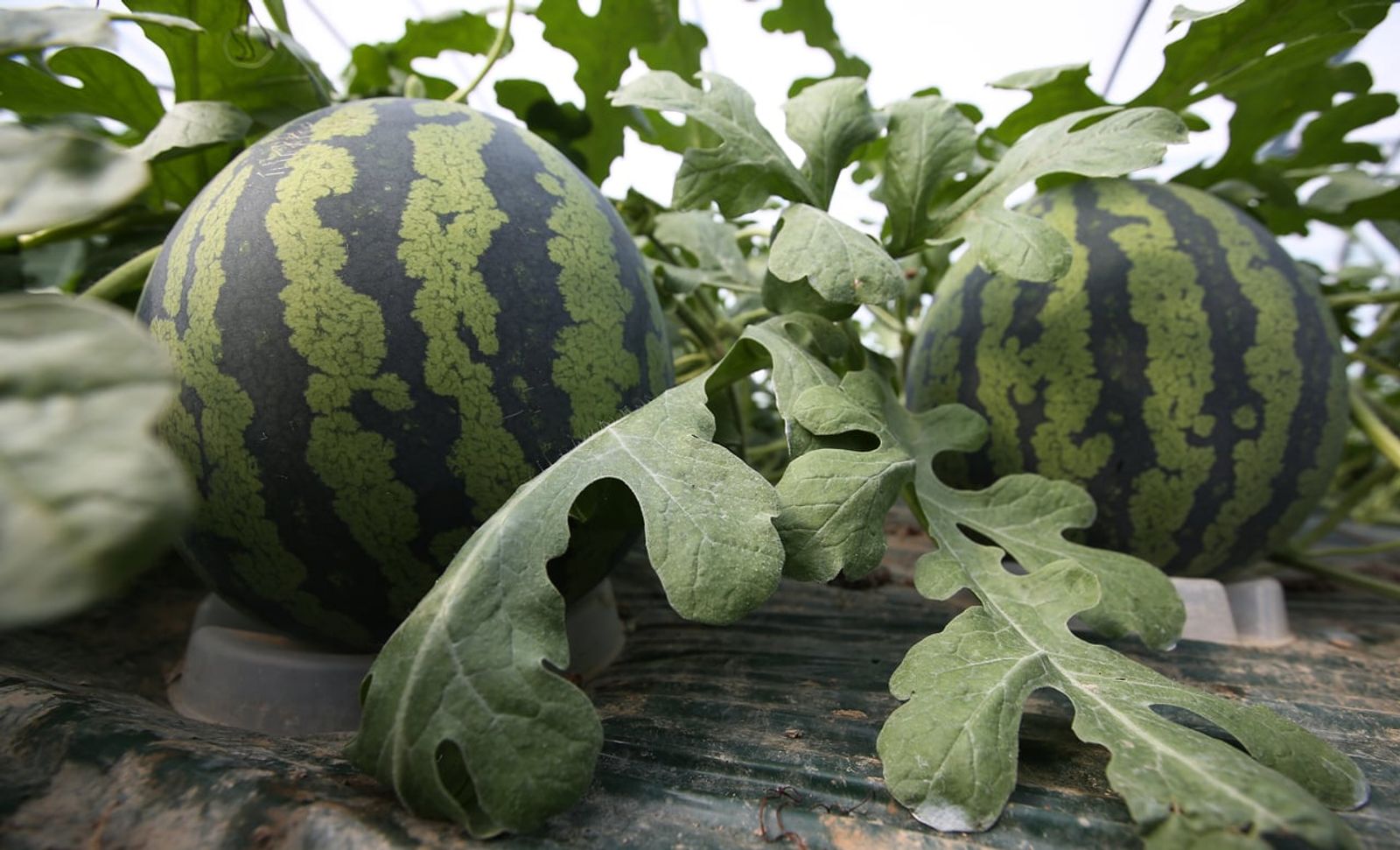
Watermelons growing in a Haman greenhouse (March 2015) · Photo: Republic of Korea (Korea.net) / CC BY-SA 2.0 (Wikimedia Commons)
 KoreaSouth Gyeongsang · Haman
Haman Watermelons: The Riverside Greenhouses That Put Watermelon on Winter Tables
Watermelon is a summer fruit in Korea, yet many of the watermelons in supermarkets in winter and early spring come from Haman in South Gyeongsang Province. Here is the plain where the Nam and Nakdong rivers meet, how 1970s greenhouses changed farming here, the winter shipping calendar and the watermelon festival.
Watermelons Where Two Rivers Meet
Haman County in South Gyeongsang Province sits where the Nam River joins the Nakdong. Its fertile alluvial plains along the rivers and its relatively mild climate all year are said to make its watermelons especially sweet. Watermelon farming here goes back a long way. A 2023 report said Haman has grown watermelons since the 1800s and that they were once sent as tribute to the king, while a 2016 report said cultivation began in the 1900s. Sources disagree on the start date, but they agree that Haman has been a watermelon town for a long time. Today the fields spread across several towns and townships, including Gaya-eup, Gunbuk-myeon, Daesan-myeon and Beopsu-myeon, and the riverside plains are lined with rows of silvery greenhouses.
How Greenhouses Changed the Watermelon Season
What made Haman watermelons famous nationwide was the greenhouse. According to a 2023 report, arched greenhouses built on pipe frames spread here in the 1970s, turning Haman into a major center for greenhouse watermelons and making it the first area in Korea to ship them each season. Changes came quickly after that. The same report says Haman began exporting to Japan in 1995, created a dedicated watermelon department in the county office in 2001 and brought colored watermelons, with unusual rind or flesh colors, and seedless watermelons into practical production in 2007. It was registered as a geographical indication in 2008, and in 2009 it formed a growers' council; the report presents these as national firsts for Haman. If Koreans can eat this summer fruit in winter and spring, these riverside greenhouses deserve much of the credit.
How Winter Watermelons Are Grown
Haman is considered Korea's biggest producer of winter watermelons. According to press reports, watermelons planted in greenhouses in September and October are harvested between December and the following June, and Haman supplies about 70% of all winter watermelons shipped in Korea. There is an order even within the county. A 2014 report named Wolchon-ri in Gunbuk-myeon and Baeksan-ri in Beopsu-myeon as the heart of winter production, with Wolchon-ri's melons the first to ship. Clear water and plenty of winter sunshine keep greenhouse temperatures right for growth, the report said, so the fruit is sweet and as large as summer watermelons. According to the same report, melons transplanted into the greenhouses in September start to be picked from mid-December, and about 70% of the nation's winter watermelons are shipped by February. Many of the winter melons sold at Seoul's Garak wholesale market come from Haman.
Haman Watermelons in Numbers
According to a 2016 report, about 2,000 farms in Haman grew watermelons in some 1,700 hectares of greenhouses. That was 13% of Korea's watermelon acreage and 47% of South Gyeongsang's, with an annual harvest of 65,022 tonnes. A 2014 report also said Haman's winter watermelons accounted for about 60% of sales at Seoul's Garak wholesale market. In December 2016 the government designated Haman a Watermelon Industry Special Zone. The zone links watermelon-growing areas in seven towns and townships, including Gaya-eup, Gunbuk-myeon and Daesan-myeon, and from 2017 to 2021 some 17.6 billion won went into specialized production, high-quality varieties such as colored and seedless watermelons, and producer-led distribution. It was reportedly extended by two years in 2022. In Haman, a single fruit has become an entire county's industry.
When to Go: The Watermelon Festival
If you want to enjoy Haman watermelons at the source, spring is best. Haman holds a watermelon festival every year; it was expanded into the Korea Watermelon Festival in 2019 and held online during the COVID-19 years. In 2023 it was reported to be scheduled for April 21 to 23. Dates change every year, so check Haman County's announcements. If you travel in Korea in winter or spring, look at the origin labels at supermarkets and markets: watermelons at that time of year often come from Haman. While in Haman, visit the Malisan tumuli, one of the Gaya Tumuli sites inscribed as a UNESCO World Heritage Site in 2023. Between the watermelon fields and the ancient mounds, you get a feel for Haman as a Gaya-era heartland.