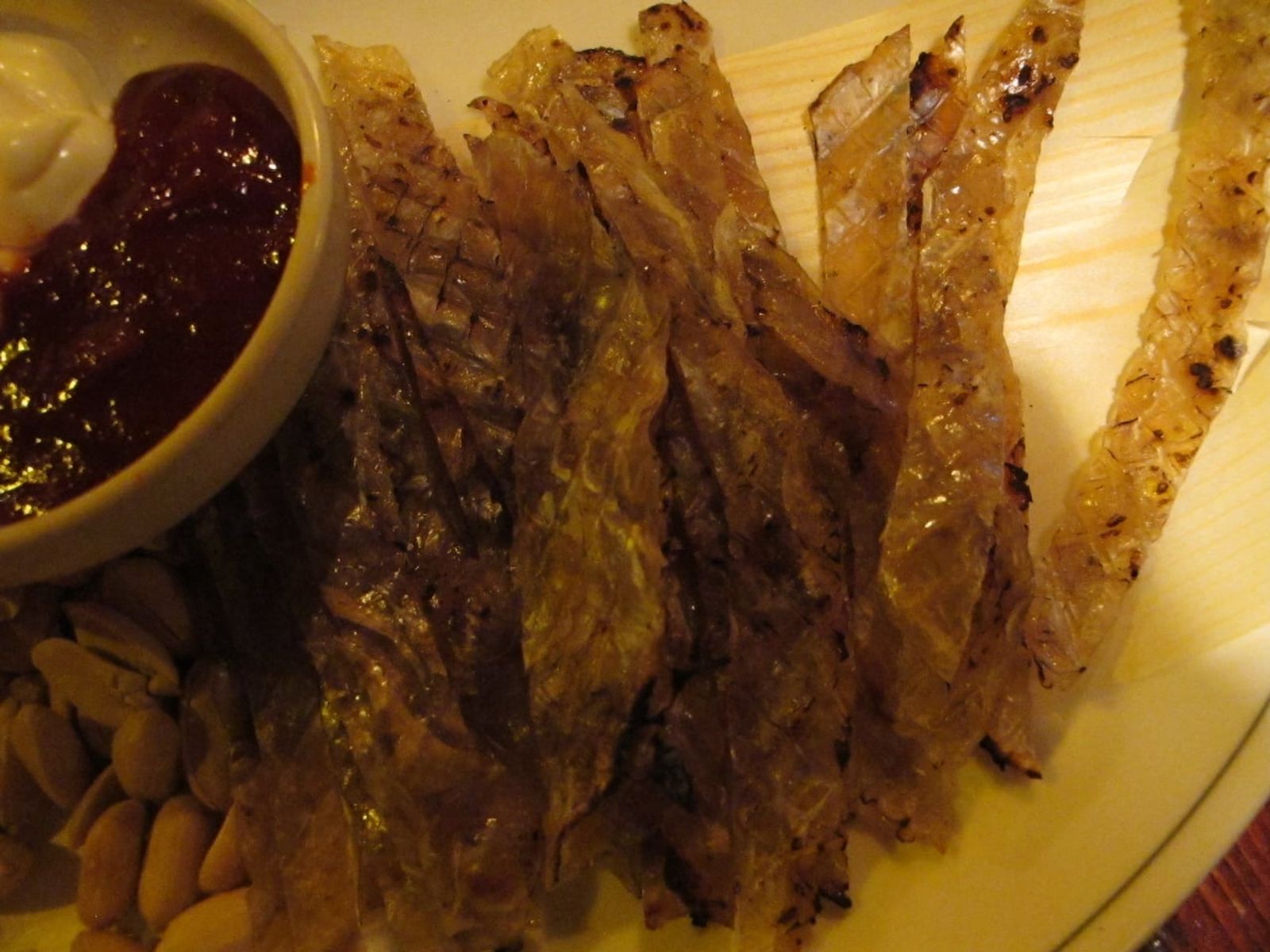
Grilled jwipo with a dipping sauce · Photo: Lisa Risager / CC BY-SA 2.0 (Wikimedia Commons)
 KoreaSouth Gyeongsang · Sacheon
Samcheonpo Jwipo: The Port Behind Korea's Favorite Dried-Fish Snack
A sheet of grilled jwipo is a nostalgic snack for many Koreans, and its best-known home was Samcheonpo port in Sacheon, South Gyeongsang. Here is how processing skills passed from flower-shaped hwaeo to jwipo, the filefish boom of the 1970s and its decline, and how to pick and grill domestic jwipo.
What Is Jwipo?
Jwipo is filefish, mostly black scraper, sliced into thin fillets, seasoned and dried, then lightly grilled before eating. It is one of Korea's classic snacks and a favorite with drinks. Pressed flat, sweet and salty, and more savory the longer you chew, it was once a staple at stationery shops by schools, cinemas and highway rest stops. According to Korean Wikipedia, jwipo is thought to have started in Busan in the 1960s and spread to Samcheonpo, Yeosu and elsewhere, and Koreans began eating it in the late 1960s. When filefish were caught in huge numbers off the south coast, people adopted the method of turning fish into dried fillets, and jwipo spread nationwide. The place where the jwipo industry bloomed biggest was Samcheonpo port, now part of Sacheon City.
Skills Rooted in Hwaeo, the Flower-Shaped Fish Snack
Samcheonpo became the home of jwipo partly because it already had fish-processing skills. According to a report citing Sacheon City, Japanese settlers who came to Samcheonpo during the colonial period made dried anchovies and a dried fish snack called sakuraboshi for export to Japan, and this is described as the forerunner of Samcheonpo's hwaeo, or "flower fish." Hwaeo is a premium dried fish snack: the fish is boned, seasoned, dried and then shaped into flowers such as chrysanthemums, sunflowers and roses. It was named a Samcheonpo specialty in 1967, and the city says hwaeo directly influenced the birth of filefish jwipo, the classic snack of the 1970s to 1990s. Few places still make hwaeo and few people know it today, but the skill of spreading fish thin, seasoning and drying it lived on in jwipo.
The 1970s: When Filefish Flooded the Port
The jwipo boom peaked in the late 1970s. According to press reports, black scraper was Samcheonpo's signature fish in the 1970s, and as demand for jwipo soared, filefish from all over the country flowed into Samcheonpo. In 1978 alone, 160,000 tonnes of black scraper were caught, making it the top species by catch (the report does not say what area that figure covers), and the Samcheonpo area had more than 200 jwipo factories. Research backs this up. A 1987 study of Korea's national set-net fishery statistics for 1971-1985 found that catches rose sharply from 1978 to a peak of 99,475 tonnes in 1979, with filefish making up 64% of that total, though it also pointed to a change in how catches were counted after a 1976 revision of fisheries law. The jwipo industry is said to have fueled Samcheonpo's whole economy, from dried-fish processing to feed mills, fuel supply, port logistics, restaurants and bars.
The Fish Disappeared, the Craft Remained
The boom did not last. According to a 2013 article, filefish were the main income for Samcheonpo fishers until the late 1980s, but catches collapsed in the 1990s and the port lost its energy. Another report says overfishing exhausted the stock, factories closed one after another, and jwipo makers came to rely on fish from China. Today jwipo made from domestic filefish is very rare, and only a few small factories carry on. Still, thanks to a small domestic catch and long-accumulated skills, the name Samcheonpo jwipo lives on. The 2013 article showed how wide the price gap was: jwichi alpo, whole filefish lightly salted and dried, cost 38,000 to 40,000 won, regular seasoned jwipo 10,000 to 20,000 won, and Vietnamese or Chinese products around 5,000 won.
How to Grill It and How to Buy at Samcheonpo
The trick to jwipo is to grill it gently over low heat. Seasoned jwipo contains sugar and burns quickly over high heat, so turn it until the edges curl and turn golden. At home people also use a microwave or frying pan. In Korea it is usually dipped in mayonnaise or gochujang, and it is a common beer snack alongside dried squid. At Samcheonpo port, auctions start around 5 a.m., and a market sets up next to the auction hall afterward. Behind the port, shops selling live fish, dried seafood and shellfish are grouped by section, so you can choose jwipo in the dried-seafood area. Domestic and imported products differ greatly in price, so always check the origin label. Add a drive across the Changseon-Samcheonpo Bridge, which links Samcheonpo with Changseondo island in Namhae, for some sea views.