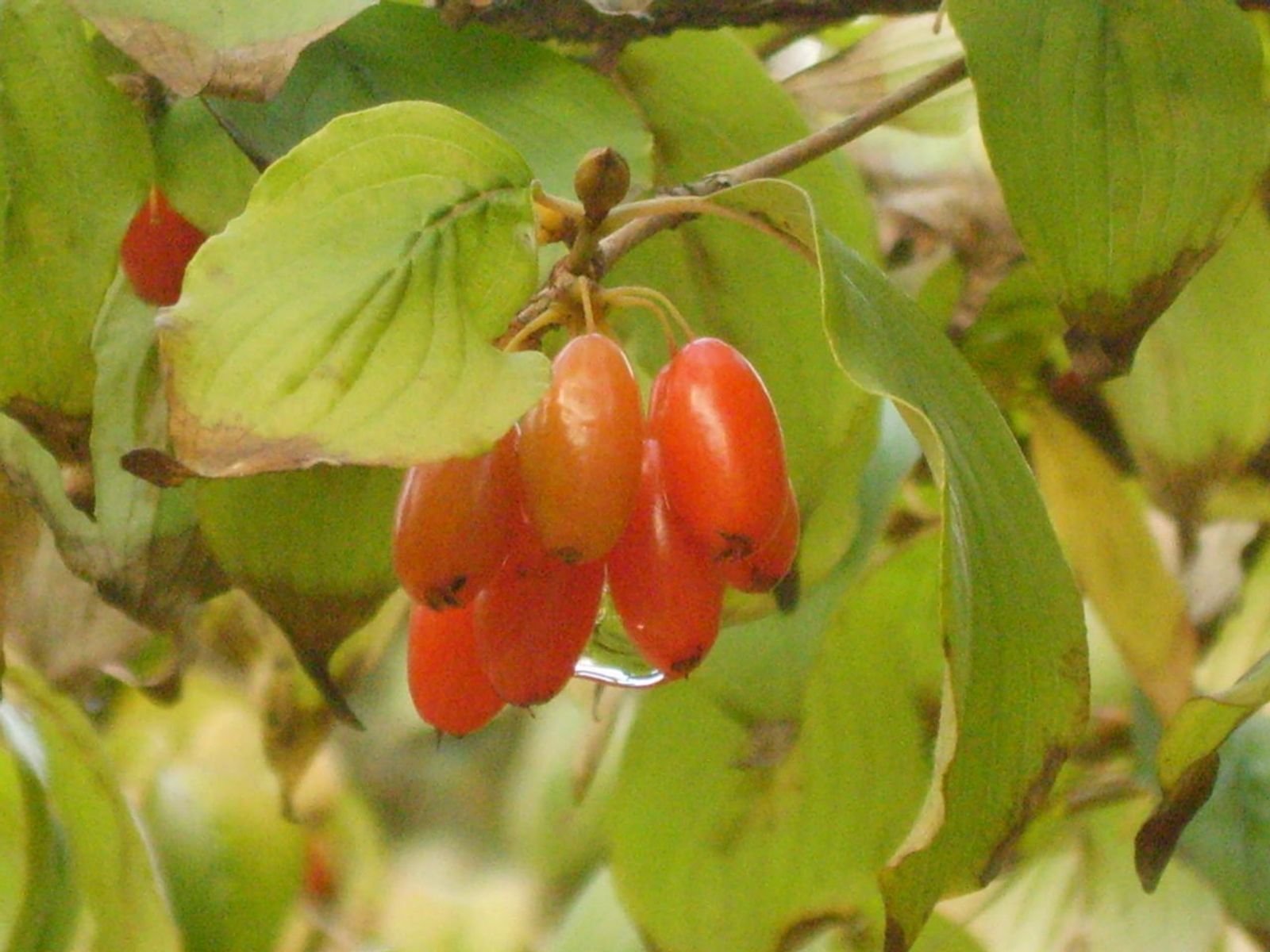
Ripe red sansuyu berries on the branch · Photo: Dalgial / CC BY-SA 3.0 (Wikimedia Commons)
 KoreaSouth Jeolla · Gurye
Gurye Sansuyu: Yellow Spring Blossoms, Red Autumn Berries and the Tree That Fed Jirisan's Villages
Every March the villages of Sandong-myeon in Gurye turn completely yellow. The blossoms draw the crowds, but what actually fed these villages was the red sansuyu (cornelian cherry) fruit that ripens in autumn. Here is the legend of the bride from Shandong, the thousand-year-old "grandmother tree," the days of pitting berries by mouth, and how to enjoy them as tea and liquor.
More Than Flowers: The Fruit That Paid the Bills
Sansuyu, the Korean name for Asiatic cornelian cherry (Cornus officinalis), blooms yellow in early spring before its leaves appear and bears long red berries in autumn. Sandong-myeon in Gurye County, South Jeolla, is regarded as Korea's largest sansuyu grove and is a well-known spring flower destination. For these villages, though, sansuyu was a livelihood before it was scenery. A 2023 report explains that Sandong is mostly mountain with little farmland, and that mountain residents planting sansuyu to make a living was how today's vast groves began. A 2003 article quotes the idea that sansuyu is what put rice on villagers' tables and sent their children to school. The berries were dried and sold as herbal medicine and health food, and herbal dealers across the country still seek out Gurye sansuyu today.
The Bride From Shandong and the "Grandmother Tree"
Gurye has a legend about how sansuyu came to this valley. About a thousand years ago, a young woman from Shandong in China married into a family at the foot of Jirisan and brought sansuyu seedlings with her, and the local name Sandong ("mountain east," written with the same characters as Shandong) is said to come from her. A 2010 Seoul Shinmun article added that this origin story has weak grounds, so enjoy it as a legend. Gyecheok Village in Sandong-myeon has a tree known as the sinok, the "first tree." It is said to be close to a thousand years old and is called the "grandmother tree"; though it now leans on supports, it still blooms every year. Nearby Daljeon Village has its partner, the "grandfather tree." Sangwi Village is said to have started planting trees about 200 years ago.
Pitting by Mouth, and a Painful History
Sansuyu berries must be pitted and only the flesh dried before they can be sold as medicine. A 2003 Kyunghyang Shinmun article says that in the past village women pitted them one by one with their mouths every night, which gave rise to the saying that "the girls of the sansuyu villages have lips as red as flowers." Today the seeds are removed by machine. Harvesting is still slow, hands-on work that takes a great deal of time and labor. These villages also carry painful memories. A 2010 article noted that the trees in Hyeoncheon Village have trunks over 300 years old, yet their flowering branches are under 60 years old, because counter-insurgency troops cut the trees down during the 1948 Yeosu-Suncheon incident. A song about the tragedy of that time, "Sandong Aega" (Sandong Elegy), is still remembered in the area.
Dried, Simmered, Steeped: How Sansuyu Is Eaten
Sansuyu berries are sour and astringent, so rather than eating them fresh, people dry them. The most common use is sansuyu tea, made by simmering the dried berries in water. It is tart with a gentle sweetness, and many people stir in a little honey. The berries are also steeped in liquor to make sansuyu-ju. In Gurye today the range of uses is much wider. According to a 2023 report, besides dried berries there are sansuyu syrup, makgeolli and other liquors, jam, fermented tea, juice, snacks and breads, and even chocolate, and the fruit is used for ades in cafés. It has long been used in traditional Korean medicine, but treat health claims as traditional usage and simply enjoy it in a way that suits you.
When and Where to Go
The flowers reportedly start opening in early to mid-March and last close to a month. The Gurye Sansuyu Flower Festival has been held around this time near the Jirisan hot springs area in Sandong-myeon, so check Gurye County's information each year for exact dates. Sangwi and Bangok villages are known for the densest blooms, and Hyeoncheon Village, with trees packed between its stone walls, is a popular photo spot. To see the red berries, go in autumn. As of 2023, Gurye had about 120,000 sansuyu trees on roughly 284 hectares; Gurye sansuyu was registered as a geographical indication in 2008 and designated a National Important Agricultural Heritage in 2014. Dried berries, sansuyu tea and syrup are sold around Sandong-myeon and at specialty shops in Gurye town.