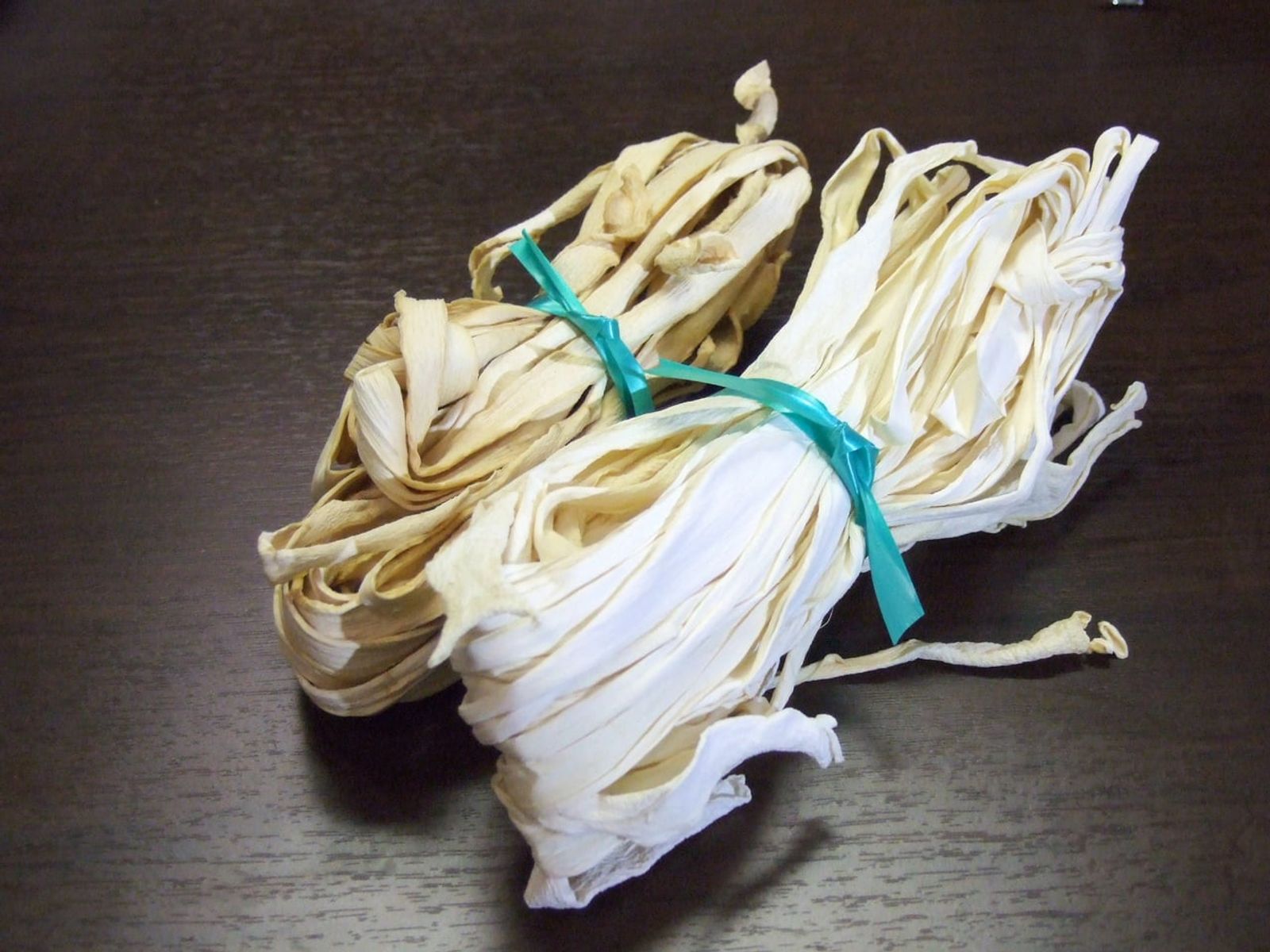
Dried kanpyo (gourd ribbons) · Photo: Sakurai Midori / CC BY-SA 3.0 (Wikimedia Commons)
 JapanNikko
Tochigi Kanpyo: The White Ribbons of Dried Gourd Behind 99 Percent of Japan's Domestic Supply
That sweet brown strip inside Japanese rolled sushi is kanpyo, dried gourd, and nearly all of Japan's domestic supply comes from Tochigi, the prefecture that is home to Nikko. Here is its history, said to date to a lord's transfer in 1712, the summer dawn work of shaving and drying the gourds, and how Tochigi eats it beyond sushi rolls.
What Is Kanpyo?
Kanpyo (干瓢) is made by shaving the flesh of the yugao, a type of bottle gourd, into long thin ribbons and drying them. Dried, it is white and brittle, but once soaked and simmered sweetly in soy sauce and sugar, it turns soft and pleasantly chewy. In Japan it is most familiar as a filling for rolled sushi. Almost all of Japan's domestic kanpyo comes from a single prefecture. According to Tochigi Prefecture, more than 99 percent of Japan's domestic kanpyo is grown there. Southern Tochigi has been the main growing area since the 20th century, so the Tochigi plain you cross on the way to Nikko is effectively the home of Japanese kanpyo. Even with imports now common, "domestic kanpyo" essentially means Tochigi kanpyo.
1712: A Lord Sends for Seeds From His Old Domain
Tochigi kanpyo is said to have started in 1712. When Torii Tadateru, lord of the Minakuchi domain in Omi Province (today's Koka, Shiga), was transferred to the Mibu domain in Shimotsuke Province (today's Mibu, Tochigi), he had yugao seeds brought from Minakuchi, and this is said to be the beginning of kanpyo production in Tochigi. Minakuchi was already famous for kanpyo. Utagawa Hiroshige's woodblock print of Minakuchi in his Fifty-three Stations of the Tokaido series even shows people making the town's famous kanpyo. The Mibu domain encouraged cultivation, and a menu record survives showing that the lord Torii Tadaaki ate kanpyo dishes. Today, Mibu draws on this history to promote kanpyo cooking as a local specialty, along with sweets made from yugao.
Shaved Before Sunrise, Dried for Two Days
Making kanpyo is midsummer work. Seedlings are planted in mid-April, and in May straw is spread over the fields to prevent drying and disease. The gourds are harvested in summer when they reach around 7 to 8 kilograms and processed right away, usually in the early morning before sunrise while it is still cool. Traditionally the gourd was cut into rings, the core scooped out and the flesh shaved from the inside with a hand plane, but major growing areas such as Tochigi use machines. The gourd is spun while the hard outer skin is removed first, then the white flesh is peeled off in a long continuous ribbon. The ribbons are traditionally dried over two days: hung on bamboo poles on the first day, then cut to length and spread on straw mats on the second. If rain stretches drying to three days or more, the kanpyo turns brown, so it is a race against the summer weather.
Kanpyo in Sushi Rolls, and the "Teppo-maki"
Kanpyo's most common use is sushi. The thin kanpyo-maki, rolled with nothing but sweetly simmered kanpyo, is a long-standing staple of Japanese sushi shops, and kanpyo is also a regular in thick futomaki rolls with many fillings. A thin roll made with half a sheet of nori and filled with kanpyo is also called teppo-maki, "gun roll", because its long, slim black shape resembles a gun barrel. In sushi-shop slang, kanpyo-maki is also called kizu-maki. There are several theories about the name, one being that it comes from Kizu, a kanpyo-growing area within the Minakuchi domain. Since Tochigi kanpyo has its roots in Minakuchi, even sushi slang hides a trace of kanpyo's long journey.
In Tochigi, It Goes in Soups and Stir-Fries Too
In Tochigi, kanpyo is not just for sushi. It shows up across everyday cooking: simmered dishes, stir-fries, kinpira-style sauté, kanpyo soup with beaten egg and vinegared salads. Kanpyo simmered with egg (tamagotoji), said to have started as a way for farm families to use up leftovers from kanpyo making, is counted among the local dishes, and kanpyo soup appears on school lunch menus too. There is also something useful to know if you buy kanpyo to take home. Commercial kanpyo comes either bleached, fumigated with sulfur dioxide, or unbleached. Japan's Food Sanitation Act limits residual sulfite to less than 5.0 grams per kilogram of dried product. Look for kanpyo labeled as Tochigi-grown at souvenir shops and farm stands in Nikko and around the prefecture. It is light and keeps well, so it makes a good gift.