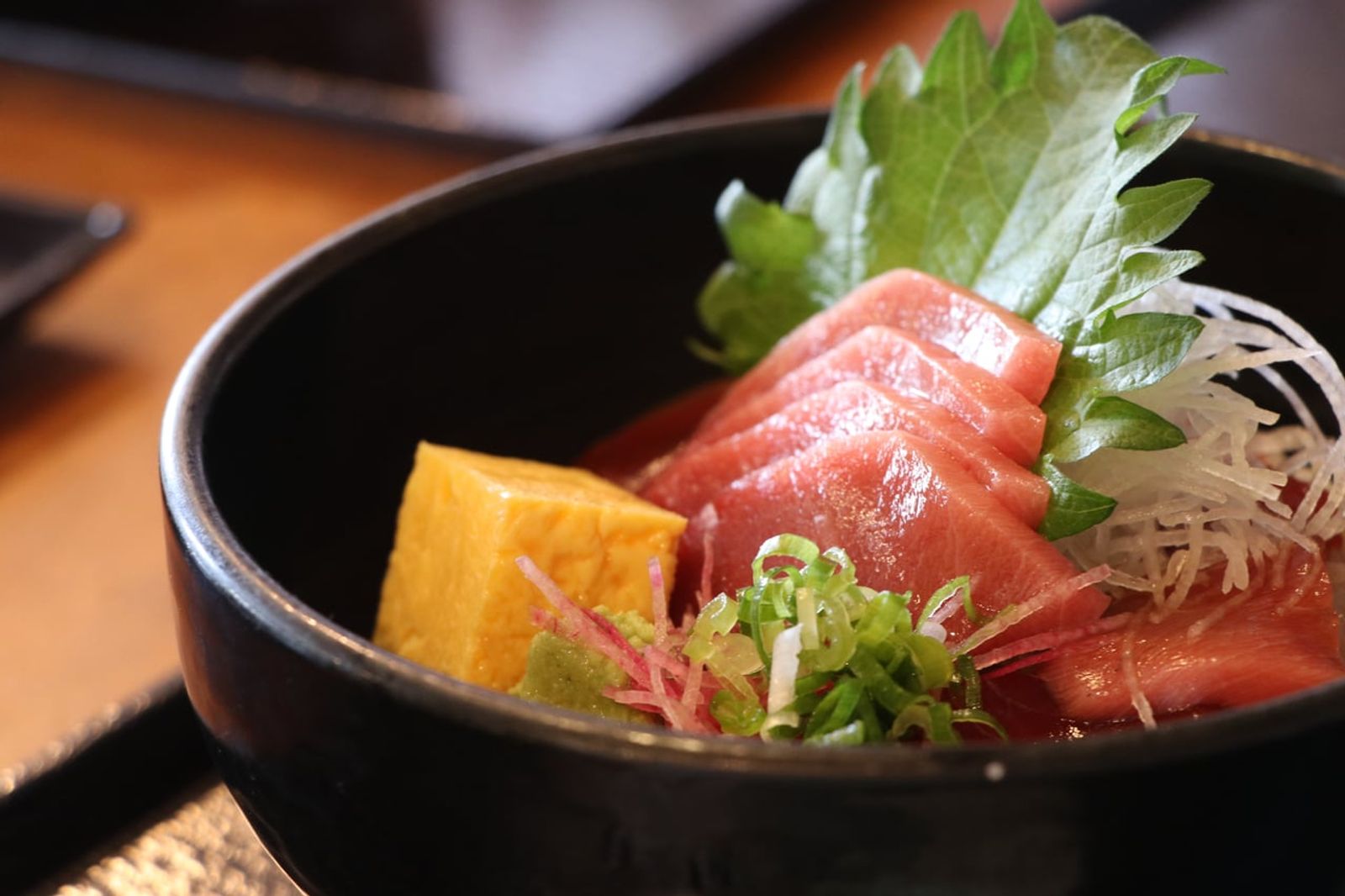
Tuna zuke-don at a Misaki Port eatery, topped with chutoro · Photo: Osumi Akari / CC BY-SA 4.0 (Wikimedia Commons)
 JapanKamakura
Misaki Tuna and Kabuto-yaki: Why a Miura Peninsula Port Roasts Whole Tuna Heads
At the tip of the Miura Peninsula south of Kamakura, Misaki was once Japan's biggest tuna port. Here is the story of kabuto-yaki, a whole roasted tuna head said to have started on fishing boat chimneys, how to eat it and how to enjoy tuna in Misaki.
Once Japan's Biggest Tuna Port
Misaki is a fishing port in Miura City, Kanagawa, at the southern tip of the Miura Peninsula. Head south from Kamakura and this is where you end up, a port that grew into a base for distant-water tuna fishing. A town-run fish market opened in 1922, and in 1938 and 1939 Misaki boats were the first in Japan to head for the South Seas fishing grounds. From about 1946 to 1954 it was the country's largest tuna port. As boats grew bigger, many stopped coming home to unload and landed their catch directly in countries on the Atlantic, so Misaki fell behind Yaizu in 1955 and Shimizu in 1961, both in Shizuoka. Even so, "tuna means Misaki" remains a common image in Japan.
Misaki Today: A Port of Frozen Tuna
Tuna caught on the high seas is frozen on board and brought back to port. The Kanagawa tourism association notes that Misaki's tuna is traded at Japan's first market dedicated to frozen tuna, under strict hygiene controls. Most of it is bigeye tuna, along with tuna gathered from fishing grounds around the world. Volumes have fallen sharply since the 2000s, partly because of international limits on tuna fishing, but the Misaki market still handles roughly 20,000 tonnes of seafood a year, most of it bigeye and other tunas. The streets around the port are lined with restaurants serving tuna, and Misaki is a popular day trip from Tokyo. Besides sashimi and tuna rice bowls, you can try dishes such as zuke-don, tuna marinated in soy sauce over rice, and taste many different cuts of the fish.
How Kabuto-yaki Began: A Fishing Boat's Chimney
Misaki's signature local dish is kabuto-yaki, a whole roasted tuna head. It is listed in the Ministry of Agriculture's "Our Regional Cuisines" database as a dish of the Misaki area of Miura City. Kabuto means a samurai helmet, a fitting image for a huge tuna head. According to the ministry, it began with Misaki fishermen on distant-water boats, who hung tuna heads that could not be sold on the ship's chimney and ate them steam-roasted. Back in port, it was also a favorite drinking snack among young fishermen. Restaurants near Misaki Port started serving it to ordinary customers about 40 years ago. It is a true tuna-port dish, turning a part once thrown away into a delicacy.
How to Eat It: From Behind the Eyes to the Cheeks
Restaurants today roast the tuna head in an oven over low heat for three to four hours. Because it takes so long and the portion is so large, most places require a reservation in advance, and it is best thought of as a dish to share with a group. The fun is in comparing the different parts. The ministry lists the meat behind the eyeballs, the meat of the head, the cheeks (hoho-niku) and the flesh inside the jaw. You pick the meat from between the bones with chopsticks, and some parts are rich and fatty while others are lean. Standard condiments are grated daikon with soy sauce, ponzu and tosa-zu, a vinegar sauce flavored with bonito. The tangy ponzu and daikon balance the rich tuna fat well.
Getting to Misaki and Tuna Trip Tips
To reach Misaki Port, take the Keikyu Kurihama Line to its last stop, Misakiguchi, then a Keihin Kyuko bus to the Misakiko stop, right by the port. You can combine it with Kamakura and Yokosuka for a loop around the Miura Peninsula. Since 2009 Keikyu has sold the "Misaki Maguro Kippu," a discount ticket for visitors. Tuna is so central to local identity that the Misakiguchi station sign has been redesigned as a pun reading "Misaki Maguro (tuna) Station." In 2007 the old "Misaki maguro ramen" was revived as well. One more tip: many restaurants around the port are open mainly during the day and close early in the evening. If you want kabuto-yaki, book ahead and plan to arrive around lunchtime.