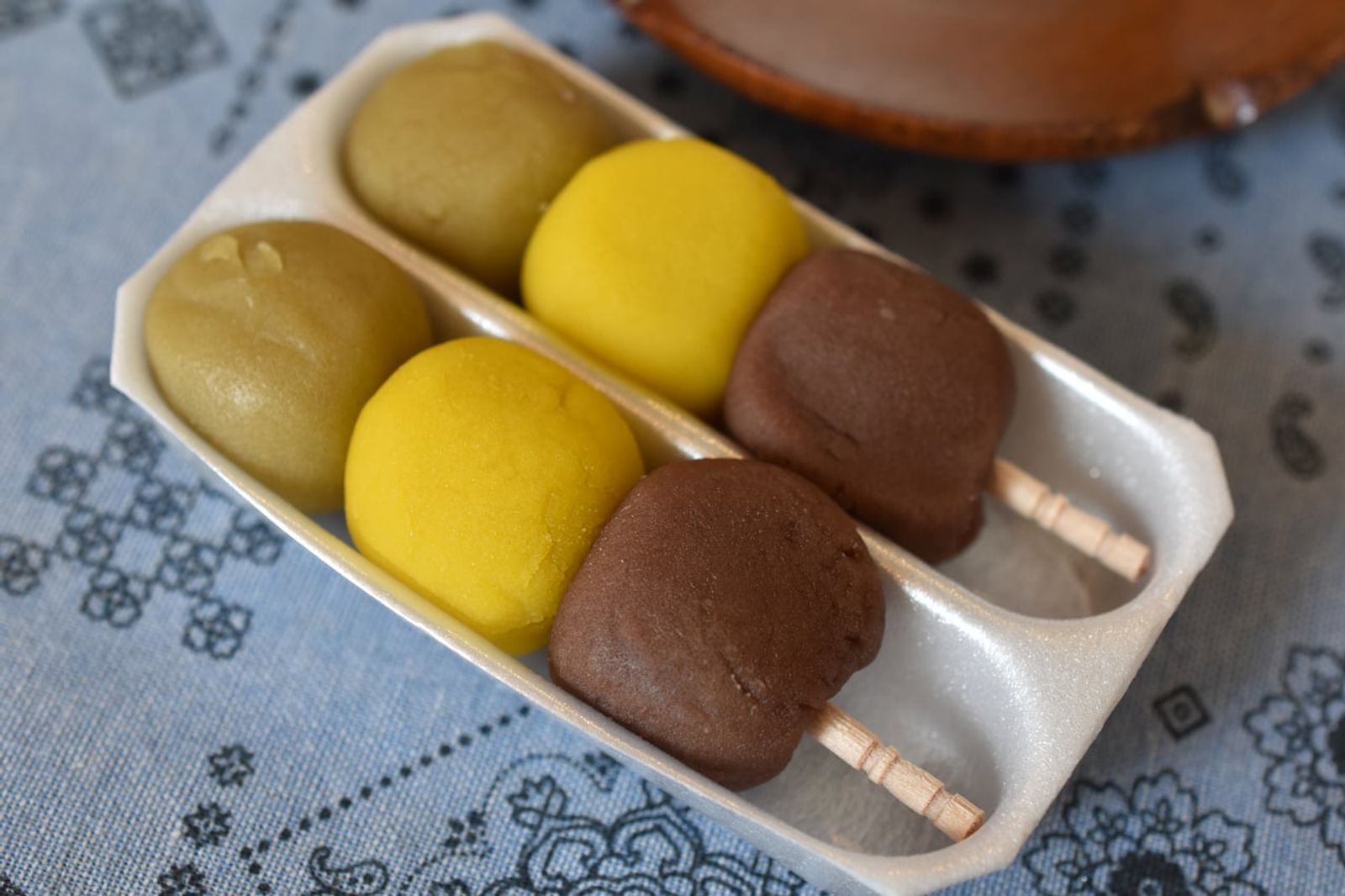
Botchan dango (green tea, egg and red bean) · Photo: Fred Cherrygarden / CC BY-SA 4.0 (Wikimedia Commons)
 JapanMatsuyama
Botchan Dango: How a Dumpling in Natsume Soseki's Novel Became Matsuyama's Signature Sweet
Three dumplings in green, yellow and brown on one skewer, Botchan dango is Matsuyama's best-known sweet. Here is the scene in Soseki's novel that inspired it, what the dumplings in the book really were, and tips for buying and eating them.
Three Colors on a Skewer
Botchan dango (坊っちゃん団子) is Matsuyama's signature sweet: three dumplings of different colors on a single skewer. The most common version today runs green tea, egg and red bean from top to bottom, a cheerful row of green, yellow and brown. Most are coated in sweet bean paste, so each bite combines chewy rice dough with soft, smooth filling. You can buy it in the Dogo Onsen shopping street, souvenir shops across Matsuyama, hotels and inns, and kiosks at the station, port and airport, so almost every visitor comes across it. Several confectioners make their own version, and size, sweetness and shelf life vary a little from shop to shop.
The Novel Botchan and Matsuyama
The name comes from Natsume Soseki's novel Botchan. Soseki was posted to a middle school in Matsuyama as an English teacher in 1895 and stayed about a year; drawing on that experience, he published Botchan in 1906. It follows a hot-headed young teacher from Tokyo who clashes with everyone at a country school, and it remains one of the most widely read novels in Japan. The novel never names Matsuyama, but the hot-spring town of Sumita the hero visits is understood to be modeled on Dogo Onsen, and the school on the one where Soseki taught. That is why Matsuyama has a Botchan train, a Botchan clock tower and many other things named after the book, and Botchan dango is one of them.
The Dumpling Scene in the Novel
On his fourth night in town, the hero goes to a place called Sumita and eats dango. The novel says the dumpling shop stood at the entrance to the pleasure quarter and was said to be very good, so he tried some on his way back from the hot spring. He assumed no one would know, but the next day the classroom blackboard read 'Dango, two plates, 7 sen', and in the second period someone had written 'Pleasure-quarter dango, yummy yummy'. The scene follows an earlier one in which he eats four bowls of tempura soba and finds himself mocked as 'Mr. Tempura' on the blackboard. Together they comically show how, in a small town, the students hear about everything he does. More than a century later, this short episode lives on as Matsuyama's most famous sweet.
The Novel's Dumplings vs. Today's Botchan Dango
In fact, the dumplings in the novel were not today's three-color Botchan dango. What Dogo sold then was yuzarashi dango (湯晒団子): skewers of three dumplings with red and white bean paste. Records say they were sold for 5 sen a skewer at a teahouse on the hill east of the Dogo Onsen main building. The Botchan dango we know was developed in 1921 by the owner of a Dogo confectioner, and the name is said to date from around then. That confectioner is said to be a shop Soseki frequented during his Matsuyama days. There is no dumpling shop today at the spot the novel describes, but in the Dogo shopping street you can still try the original yuzarashi dango.
Tips for Buying and Eating
Botchan dango is a rice-cake sweet, so it is best freshly made. Some shops in the Dogo Onsen shopping street sell single skewers, and eating one with green tea after a soak lets you enjoy dango after the bath just like the novel's hero. The green tea dumpling tends to be slightly bitter, while egg and red bean taste sweeter. If you are buying gifts, check the best-before date on the box. Depending on the maker, some must be eaten within a few days while others keep much longer. If the dough has firmed up, leave it at room temperature for a while to soften. Refrigeration tends to harden rice cake, so store it somewhere cool but not in the fridge.