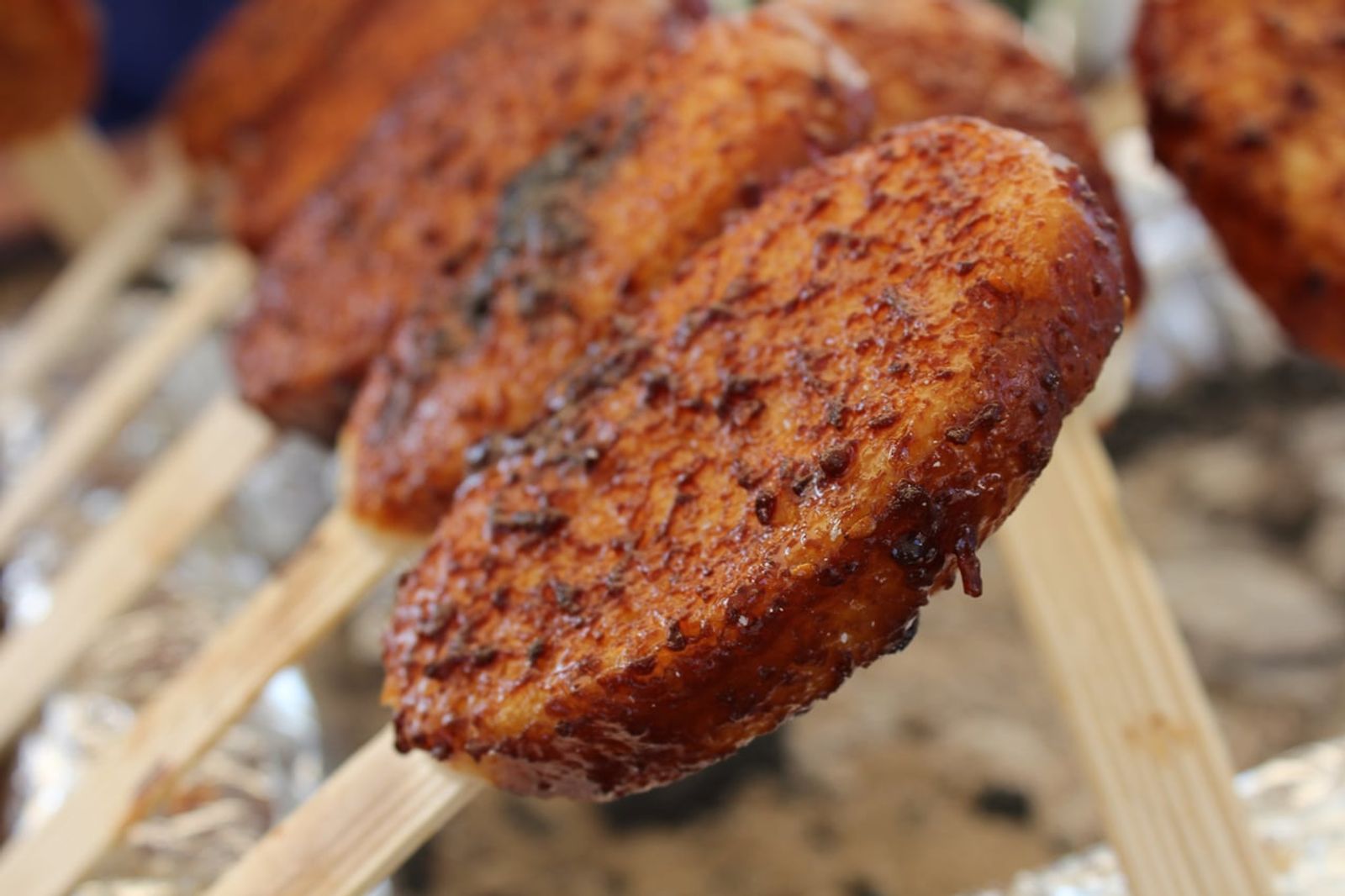
Sandal-shaped gohei mochi grilled with sauce · Photo: Kunmap / CC BY-SA 4.0 (Wikimedia Commons)
 JapanTakayama
Gohei Mochi in Hida: Skewered Rice Cakes for the Gods and Perilla "Aburae" Sauce
Gohei mochi, half-pounded rice shaped onto a skewer, brushed with sauce and grilled, is a local food of central Japan's mountains. Here is the woodcutter origin story, theories about the name, regional shapes and sauces, and the perilla (egoma) sauce loved in Hida.
Skewered Rice Cakes of the Central Mountains
Gohei mochi is a local dish of mashed rice pressed onto a skewer, brushed with sauce and grilled. According to Japanese Wikipedia, non-glutinous rice is pounded just enough to leave some grains intact, shaped flat on a skewer, coated with sauce and grilled. Because it is made from cooked rice rather than sticky rice cake, it is chewy yet keeps the texture of the grains. It is eaten in the mountain areas of central Japan: Kiso and Ina in Nagano, Tono and Hida in Gifu, southern Toyama, Okumikawa in Aichi and parts of Shizuoka. Nagano has selected it, under the name written 御幣餅, as an intangible folk cultural asset ("cultural asset of taste"). When rice was precious, it was food for festivals and celebrations.
From a Woodcutter's Campfire to an Offering for the Gods
The Ministry of Agriculture's local cuisine guide tells how gohei mochi began. In the mid-Edo period, woodcutters in the Kiso area of Nagano pressed rice onto scraps of wood left from felling, grilled it over a campfire and ate it spread with miso. Soon it was offered to the gods with prayers for safety in mountain work. In Gifu, after the autumn harvest, people made gohei mochi from new rice and offered it at shrines in thanks for the harvest and in prayer for the next, and it was also a favorite meal in busy farming seasons. In Ena and Nakatsugawa in eastern Gifu, it was a treat served to guests. Today it is a casual snack, but its roots hold the prayers of mountain people.
The Mystery of the Name "Gohei"
There are several theories about the name, too. According to the Ministry of Agriculture, the most common explanation is that it resembles a gohei, the wand with paper streamers used at Shinto shrines as an offering to the gods. A flat cake on a stick does look like one. Another theory says it began when a man named Gohei from Mino (today's southern Gifu) handed it out to soldiers at the Battles of Kawanakajima in the mid-16th century, fought between Takeda Shingen and Uesugi Kenshin. Japanese Wikipedia adds that many places have legends of a woodcutter, hunter or other figure called Gohei or Gobei who first made it. That is why it is written two ways, 五平餅 and 御幣餅.
A Map of Shapes and Sauces
Gohei mochi's shape varies by region and household. The Ministry of Agriculture mentions sandal shapes, flattened dumplings and round dumplings, and Japanese Wikipedia adds gohei-wand, gourd and leaf shapes. The sandal shape in the main photo is the most familiar, and there are also round dumplings threaded on a skewer. Sauces have strong local character too. According to the ministry, the basics are miso, soy sauce or a blend of the two; north of the old Nakasendo highway soy sauce dominates, and to the south, miso. Walnuts and peanuts are common secret ingredients, and parts of the Tono area in eastern Gifu even use "hebo," the larvae of ground-nesting wasps. Cross one mountain pass and the flavor changes.
The Taste of Hida: Perilla "Aburae" Sauce
No talk of Hida gohei mochi is complete without egoma, the plant Koreans know as perilla (deulkkae), which in Hida is also called "aburae." In a reply to a resident's comment, Takayama City stated that "in the Hida region, gohei mochi made with egoma (aburae) has long been familiar, and many shops in the city serve gohei mochi with aburae sauce." The reply answered a plea to protect the culture, since egoma gohei mochi seemed to be giving way to plain sweet miso. The city explained that it supports aburae production through a regional council. If you buy gohei mochi in Takayama, look for "egoma" or "aburae" on the shop sign.