Kaga Bocha
 JapanKanazawa
Kaga Bocha: Kanazawa's Everyday Tea Made From Roasted Stems
The amber tea that quietly arrives at your table in Kanazawa is often Kaga bocha. Here is how a roasted tea made from leftover stems became Ishikawa's everyday brew, what makes it taste different and how to make it well at home.
What Kaga Bocha Is: Tea From the 'Sticks'
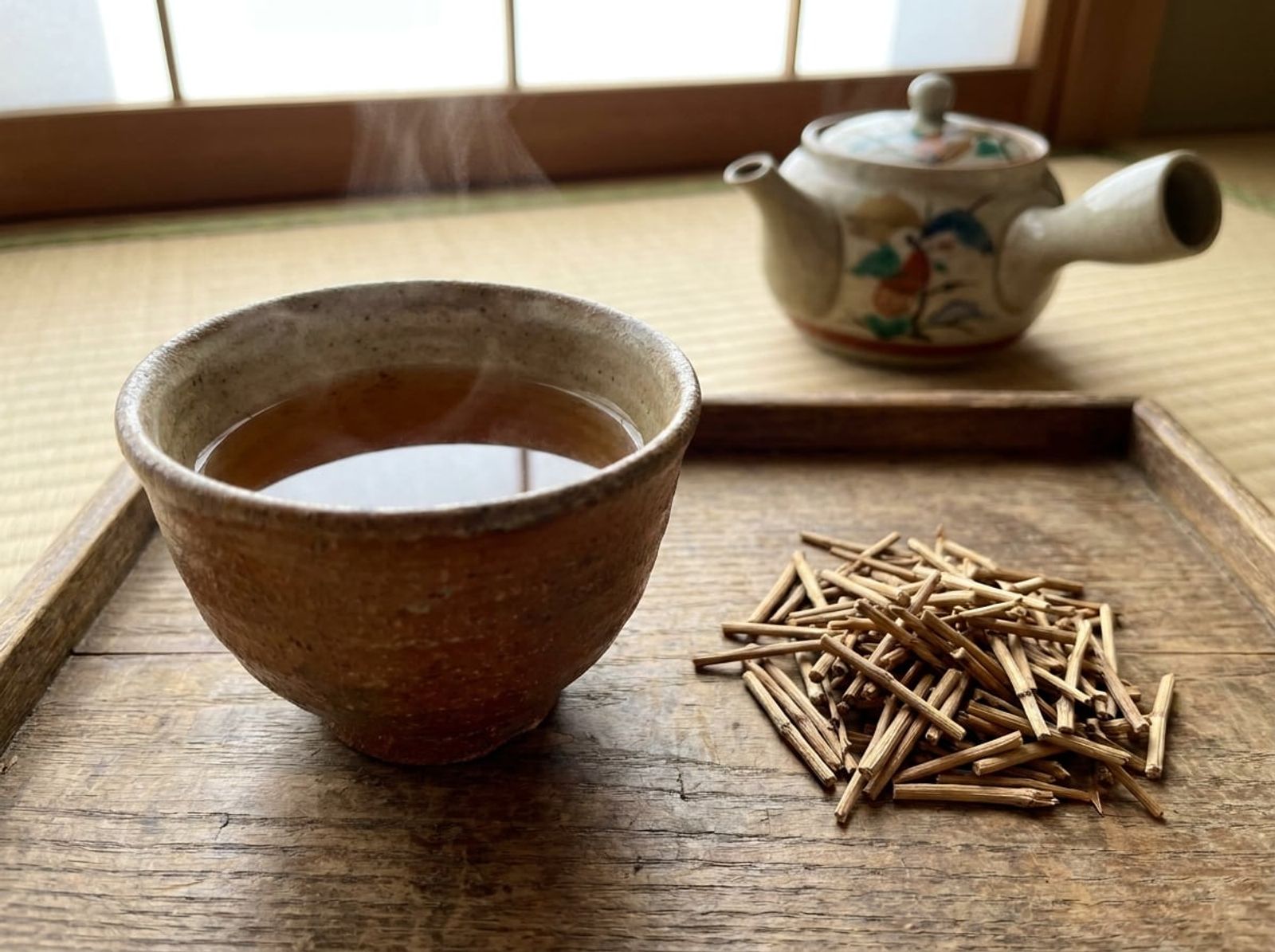
Kaga bocha is a hojicha (roasted green tea) from Ishikawa Prefecture, made by roasting the stems of the tea plant rather than its leaves. Bo means "stick," a nod to the long, thin shape of the stems. Japan's Ministry of Agriculture, Forestry and Fisheries (MAFF) also lists it among Ishikawa's traditional foods. Ordinary hojicha is mostly roasted leaves, but in Kaga bocha the stems are the star. Stems are said to hold more theanine, the compound behind tea's savory sweetness, than leaves, so the brew is toasty with a gentle sweet aroma. It has little bitterness or astringency, which makes it an easy match for meals. That is why it became an everyday tea in Ishikawa homes and restaurants. In Kanazawa, the tea a restaurant pours without being asked may well be this one.
A Domain That Loved Tea, and Tea Ordinary People Could Not Afford
Behind Kaga bocha lies the tea culture of the Kaga domain. According to the Ministry of Agriculture, Maeda Toshitsune, the third lord of Kaga in the Edo period, retired to Komatsu Castle, invited a master of the tea ceremony and supported tea culture, while also encouraging tea planting across the domain. Tea production spread through the Ishikawa area as a result. By the Meiji era, Ishikawa had become one of Japan's leading tea-growing regions. But at the time, about 80 percent of Japan's tea was exported, so good tea was a luxury that local ordinary people could rarely get. That is where attention turned to a byproduct: the stems left over when tea leaves were dried. The leaves were sold at a good price, and the stems were roasted into a cheap, fragrant tea. That was the starting point of Kaga bocha.
Born in Kanazawa in 1902, Known Nationwide After 1983
According to MAFF, Kaga bocha began in 1902 (Meiji 35), when a Kanazawa tea merchant developed and started selling a tea made from roasted stems. Its distinctive aroma and low price won fans, and it gradually spread across the prefecture. In 1983 (Showa 58) Kaga bocha was presented to Emperor Showa, which is said to have made it known nationwide. Today dozens of companies in the prefecture roast their own in their own way, so the aroma and taste differ a little from maker to maker. What is interesting is that it started as a way to use a by-product. A tea made to be cheap is now one of Ishikawa's signature gifts, easy to find in the souvenir shops around Kanazawa Station.
Fire, Sand or Infrared: How It Is Roasted
Kaga bocha starts with aracha, crude tea that has been steamed, rolled and dried; only the stems are picked out and then roasted. MAFF describes three roasting methods: direct-fire roasting in a rotating drum, sand roasting in heated sand that warms the stems evenly to the core, and far-infrared roasting with ceramic heaters that cooks them quickly from the inside. Direct fire is said to lock in a rich flavor, while sand roasting brings out a fuller aroma. There are also three roast levels: light (asairi), medium (nakairi) and deep (fukahoji). A lighter roast keeps more of the stems' natural savoriness; a deeper one brings more sweetness and toasty aroma. When buying a pack as a souvenir, check the roast level on the label to find your style.
How to Brew It and Enjoy It in Kanazawa
MAFF gives this basic method: put 2 tablespoons of Kaga bocha in a teapot, pour in about 300 ml of boiling water, and serve after about 25 seconds. In summer, try a cold brew: 4 tablespoons and about 1 liter of water in a glass pot, chilled in the fridge for about 3 hours. For a big batch, bring 2 liters of water to a boil, add 2 tablespoons, turn off the heat, cover and leave for at least 20 minutes. Heat 3 tablespoons in 200 ml of milk and strain it for a hojicha milk tea. In Kanazawa, taste it first in the cup a restaurant serves, and if you like it, buy a few roast levels at a tea shop in town or the souvenir shops around the station. Light tea-bag packs travel well, too.