Goshiki Namagashi
 JapanKanazawa
Goshiki Namagashi: Kanazawa's Five Wedding Sweets for Sun, Moon, Mountain, Sea and Village
Five fresh sweets said to have been created in 1601 for a wedding in the Maeda family, rulers of the Kaga domain, each one standing for the sun, moon, mountains, sea or village. Here is the story and the customs behind Kanazawa's celebration sweets, goshiki namagashi.
Celebration Sweets That Come in a Set of Five
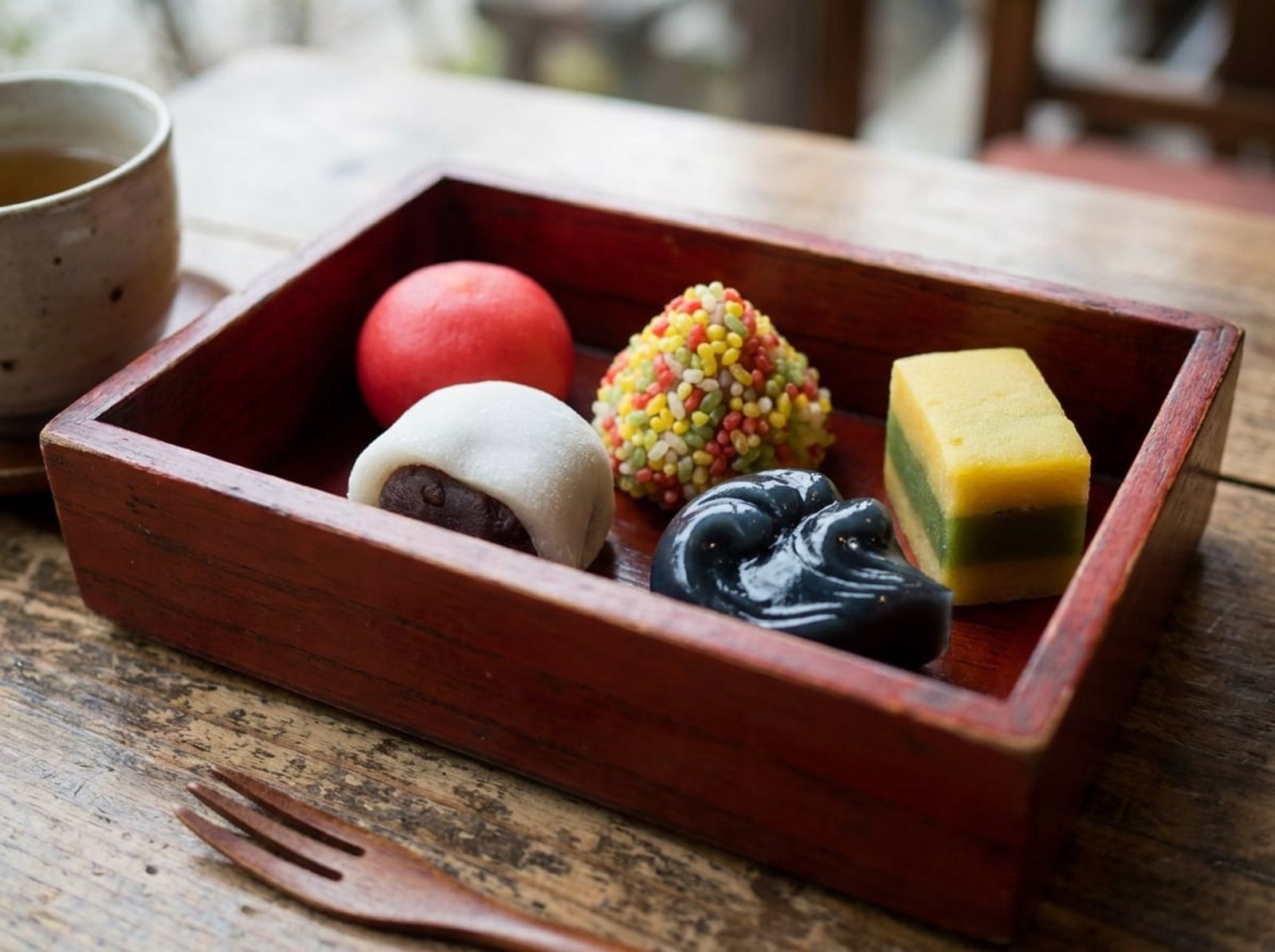
Goshiki namagashi are fresh sweets handed down around Kanazawa, the old castle town of the Kaga domain. Goshiki means five colors, and namagashi means moist sweets that are neither baked nor dried. What makes them special is that they are not eaten one by one on their own. Five kinds are packed together as a set. All of them use sweet red bean paste, and each represents the sun, the moon, the mountains, the sea or the village, together known as nichigetsu sankairi, a way of expressing all of creation. Some explanations add that the five stand for the body's internal organs, carrying a wish for good health. Japan's Ministry of Agriculture describes them as fresh sweets passed down since the Edo period and an auspicious treat that is essential at celebrations such as weddings and the raising of a new house's ridgepole.
1601: A Wedding Between an Eight-Year-Old Groom and a Three-Year-Old Bride
The story behind goshiki namagashi goes back to 1601 (Keicho 6). According to MAFF, that year Tamahime, the three-year-old daughter of Tokugawa Hidetada, later the second shogun, was married to eight-year-old Maeda Toshitsune. Toshitsune's adoptive father, Maeda Toshinaga, the second lord of the Kaga domain, is said to have ordered the domain's official confectioner to create sweets worthy of the wedding. The confectioner paid attention to the vessel too, offering the sweets in a five-tiered container. The tale of capturing all creation in five sweets to celebrate a union between the Kaga domain and the Tokugawa family lives on in Kanazawa's wedding sweets today.
Reading the Five Sweets: Which One Is the Sun, Which the Sea?
Here are the five as described in the Ministry of Agriculture's guide to traditional Japanese foods. The sun is a round rice cake filled with red bean paste, its upper half dusted with red rice flour to suggest a sunrise. It is also called sasara. The moon is a white sake manju, a steamed bun leavened with sake lees. The village is steamed yokan, a bean jelly, and older versions are said to have used ordinary yokan. The sea is a diamond-shaped rice cake representing waves, also known as nagamashi or uzura. The mountain is igara mochi, coated with yellow-dyed domyoji flour, steamed and dried glutinous rice, so that it looks like a spiky chestnut burr. In other words, the colors and shapes let you guess what each one stands for. If you buy a set, it is fun to eat them one by one while guessing: this is the sun, this is the mountain.
Black Lacquered Steamers and Twenty Sweets: The Wedding Custom
The custom of giving goshiki namagashi at weddings is said to have spread to ordinary people in the Meiji era. In the past, the bride's family sent the sweets to the groom's home in tiered boxes set in a five-tier black-lacquered decorative steamer, and one record says twenty sweets in all was the norm. The steamer was displayed at the gate or entrance, and after the wedding the bride handed the sweets out to relatives and neighbors as a greeting. The sweets also had a place at Buddhist rites. From the Edo period to the mid-Showa era, the red powder on the "sun" cake was changed to green for memorial services, and in the Taisho era baked sake buns came to be used instead. For celebration and mourning alike, these sweets have been part of Kanazawa life.
Trying Them Today: Year-Round, and as a Souvenir
As lifestyles have changed, a full set of twenty is now rarely seen at weddings, though sets of five to ten are sometimes used as celebration sweets. The wrapping has changed too: once a Wajima lacquer box covered with a Kaga silk cloth, it is now usually a paper box. Even so, wagashi shops in the Kanazawa area sell goshiki namagashi all year, so anyone can buy them, wedding or not. Locals pick them up out of nostalgia, and they are also popular as souvenirs. Look for them on streets in town lined with confectioners or at souvenir counters around the station. As fresh sweets they do not keep long, so it is best to eat them the day you buy them or the next day. Pair them with a cup of Kaga bocha for a very Kanazawa afternoon tea break.