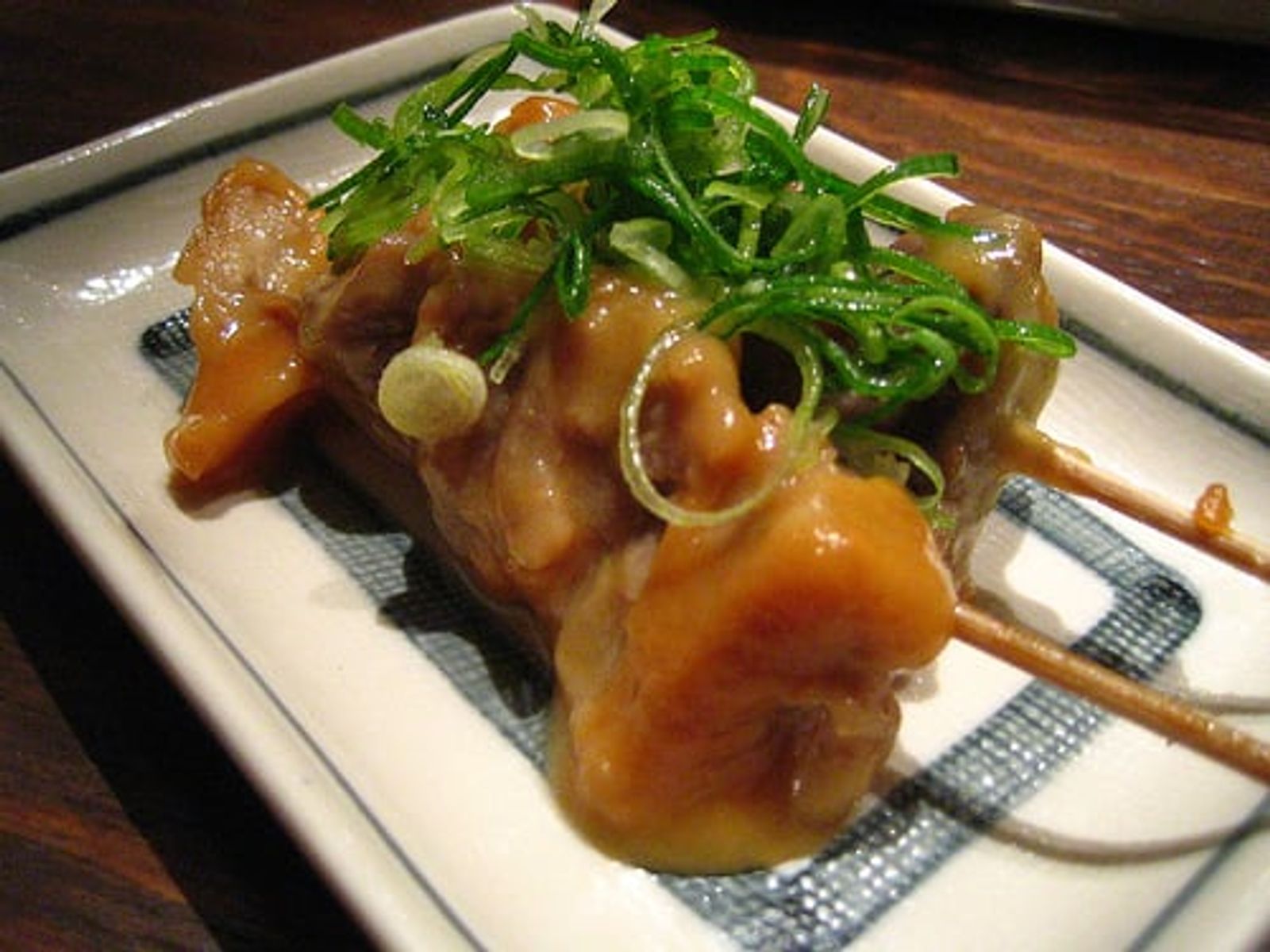
Doteyaki skewers topped with green onion · Photo: ayustety from Tokyo, JAPAN / CC BY-SA 2.0 (Wikimedia Commons)
 JapanOsaka
Osaka Doteyaki: Beef Tendon Simmered Inside a Wall of Miso
The glossy brown skewers you see next to kushikatsu all over Shinsekai are doteyaki. Here is why the name means "embankment", how it differs from Nagoya's doteni, and how to order it at a standing bar.
The Name: An "Embankment" Made of Miso
Doteyaki is an Osaka home-grown dish of beef tendon simmered for a long time in miso and mirin, and it appears in the Osaka list of the Ministry of Agriculture's "Our Regional Cuisines" database. "Dote" means a riverbank or embankment. The classic method is to spread miso in a ring around the inside rim of an iron pot like a levee, sear the ingredients in the middle, and let the miso that melts down from the rim slowly braise them. So one dish is both "grilled" (yaki) and stewed. Today most places simply simmer it in a pot and serve it on skewers or in a small dish, but that deep, sweet-salty glaze of reduced miso comes straight from the old technique.
A Cheap, Hearty Bar Snack for Working People
Beef tendon is tough and fiddly to prepare, but after long simmering its collagen breaks down until it almost melts. Turning a cheap cut into something delicious with nothing but time and seasoning is exactly why doteyaki has long been known as an inexpensive food of Osaka's old working-class neighborhoods. The ministry's write-up describes its rich, sweet flavor as a natural match for sake and calls it a much-loved everyday food. Oda Sakunosuke's 1940 novel Meoto Zenzai even has a hero so fond of "two-sen doteyaki from the night stalls" that he is nicknamed "Mr. Doteyaki". In the novel, though, doteyaki is described as pork skin simmered in miso, not the beef tendon used today. Today it is mostly served as a drinking snack at izakaya and kushikatsu bars, and some families still make it at home.
How It Differs From Nagoya's Doteni
The Tokai region, including Aichi and western Shizuoka, has a closely related dish, usually called doteni or just "dote". The biggest difference is the miso. Nagoya-style versions mostly use dark soybean miso such as Hatcho miso, and many places use pork offal as well as beef tendon. Spooned over rice it becomes dote-meshi, another Nagoya specialty. Osaka doteyaki, by contrast, is all about beef tendon, and it usually leans sweeter with mirin and sugar. The ministry's recipe simmers tendon with konnyaku, leek and ginger in country-style miso, sugar, mirin and sake. Still, the type and blend of miso varies from shop to shop, so tasting both cities' versions side by side is half the fun.
Where to Eat It: Shinsekai and Kushikatsu Bars
The easiest place to find doteyaki is Shinsekai, the neighborhood below Tsutenkaku tower. The ministry's write-up itself notes that Shinsekai is lined with shops serving it, and on menus there doteyaki and kushikatsu practically come as a pair. If you see a big tray or pot out front with skewers bubbling away in miso, that is doteyaki. Beyond Shinsekai, you can find it at izakaya in the city's nightlife lanes, especially those with plenty of standing bars (tachinomi). It usually comes a few skewers or a small dish at a time, so it is an easy thing to try. Each shop adds its own touch to the seasoning, so hopping between two or three bars is a good plan.
How to Eat It and Ordering Tips
Doteyaki usually arrives buried under chopped green onion. The sharp onion cuts through the rich miso, so eat them together; a shake of shichimi pepper is also nice. Some shops simmer konnyaku alongside, and alternating chewy tendon with bouncy konnyaku is part of the pleasure. To order, look for doteyaki, or simply dote, on the menu (usually written in hiragana) and say how many. At kushikatsu bars many people order it first, before the fried skewers, because it is already simmering and comes out right away. It goes well with beer, a highball or warm sake. One note: unlike kushikatsu with its "no double-dipping" sauce rule, doteyaki is already sauced, so it never goes into the shared sauce pot.