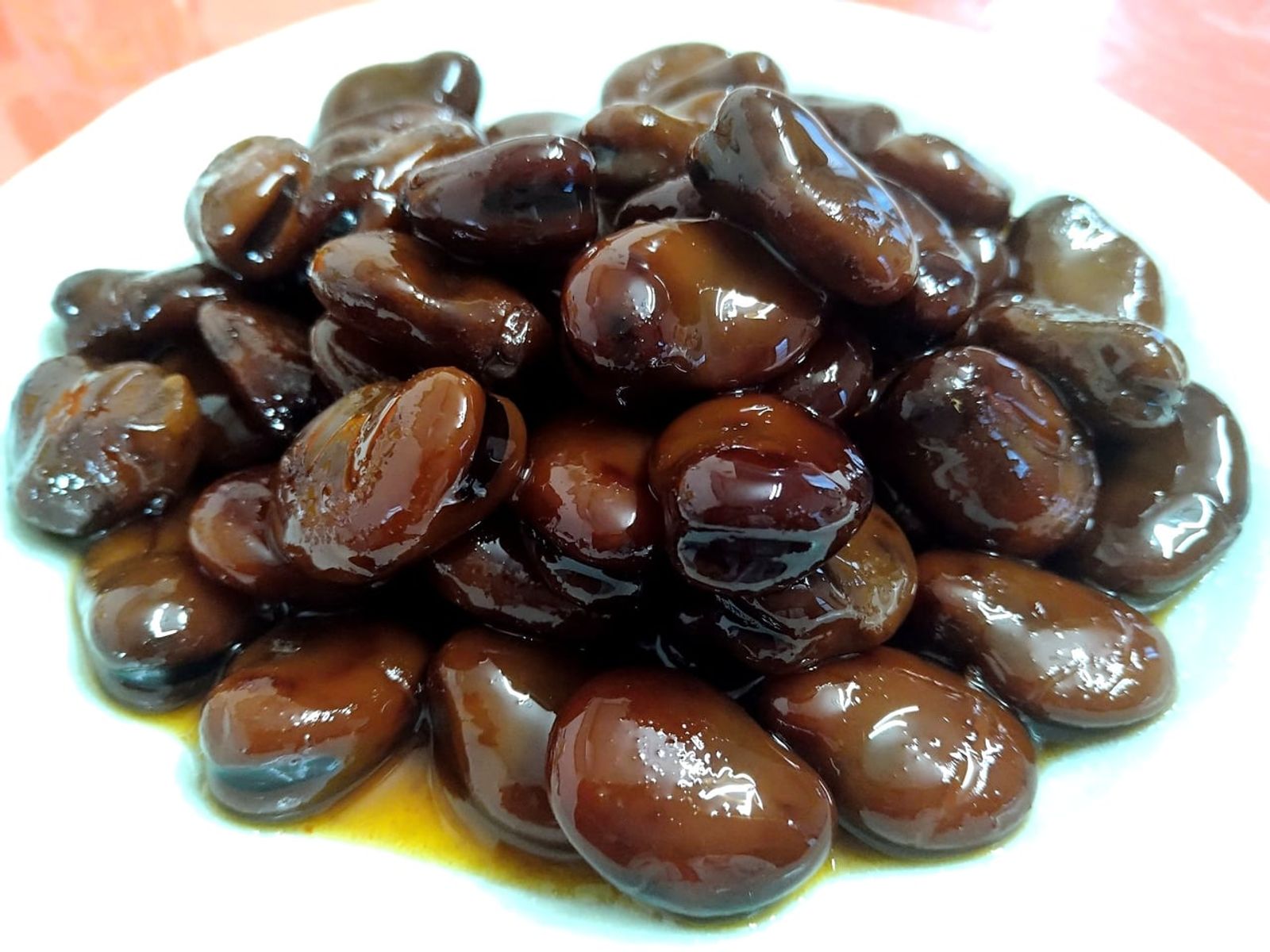
Shoyu mame soaked in soy sauce marinade · Photo: Dokudami / CC BY-SA 4.0 (Wikimedia Commons)
 JapanTakamatsu
Shoyu Mame: Kagawa's Roasted Broad Beans Soaked in Soy Sauce, From Pilgrim Legend to Table
Those glossy brown beans you see in every Kagawa supermarket and airport shop are shoyu mame: dried broad beans roasted and dropped, still hot, into a soy sauce marinade overnight. Here are the two origin stories, how they are made and how locals eat them.
What Shoyu Mame Is
Shoyu mame (しょうゆ豆) is a Kagawa specialty made by roasting dried broad beans and plunging them, still hot, into a simmered mix of soy sauce, sugar and water. The agriculture ministry's regional food archive lists the whole prefecture as the area where it is handed down, so you will find it well beyond Takamatsu. What sets it apart from ordinary simmered beans is the roasting. The toasty aroma blends with the soy sauce, and the beans break apart pleasantly when you bite them. They are normally eaten skin and all. Sweetness varies from home to home: some versions lean savory and go with rice, others are closer to a sweet snack.
Two Origin Stories
According to the agriculture ministry, shoyu mame is thought to have begun in Sanuki, today's Kagawa, during the Edo period. Nobody knows exactly when or who started it, but two stories are told. One links it to Shodoshima, the island where soy sauce brewing is said to have begun in the Bunroku era at the end of the 16th century: with soy sauce close at hand, the dish followed. The other is a legend about pilgrims on the Shikoku 88-temple route. Broad beans being roasted for passing pilgrims rolled into a nearby jar of soy sauce, and the result turned out to be delicious. Both are best enjoyed as local lore rather than documented fact.
Kagawa and the Broad Bean
Broad bean cultivation is said to have spread across Japan after the Meiji era. Kagawa's mild, dry climate suited the crop, and farmers grew broad beans as a second crop in rice paddies after the harvest. The beans were dried and stored, and shoyu mame became a handy preserved side dish for the busy farming months. Kagawa even had its own traditional variety, Sanuki Nagasaya, named for its long pods. According to the agriculture ministry, however, most of the dried broad beans used for shoyu mame today are imported. The recipe has carried on, while the source of the beans has changed with the times. If you are curious about the bean itself, early summer is the season for fresh broad beans.
How It Is Made: Roast, Then Soak While Hot
The home method published by the agriculture ministry is simple. Roast dried broad beans in a horoku (an earthenware roasting pan) or a heavy pan over low heat for 20 to 30 minutes. Meanwhile, bring water, soy sauce and sugar to a boil, adding sliced chili if you like. Drop the hot beans into the sauce and leave them overnight so they absorb it. If they are still hard, simmer them gently for another 20 to 30 minutes. Some households soak the roasted beans in water for two or three hours first, which makes them softer, and some add ginger juice. The key is that the beans must be hot when they hit the sauce so the flavor soaks in, which is why roasting and making the sauce happen at the same time.
When and Where to Eat It
Shoyu mame is eaten year-round. At home it goes with rice or with drinks, and local eateries serve it as a side. It used to be a preserved dish for the farming season and a regular at village events, and some families still serve it at New Year in place of the usual black beans. For travelers, the easiest way to meet it is as a souvenir. Vacuum-packed versions are now common in supermarkets, at the airport and in tourist shops, so check around Takamatsu Station or the airport. The ingredient list on the pack gives a hint of how sweet it is. Have a few with beer or sake at your hotel, or put them on hot rice, which is closest to how local families eat them.