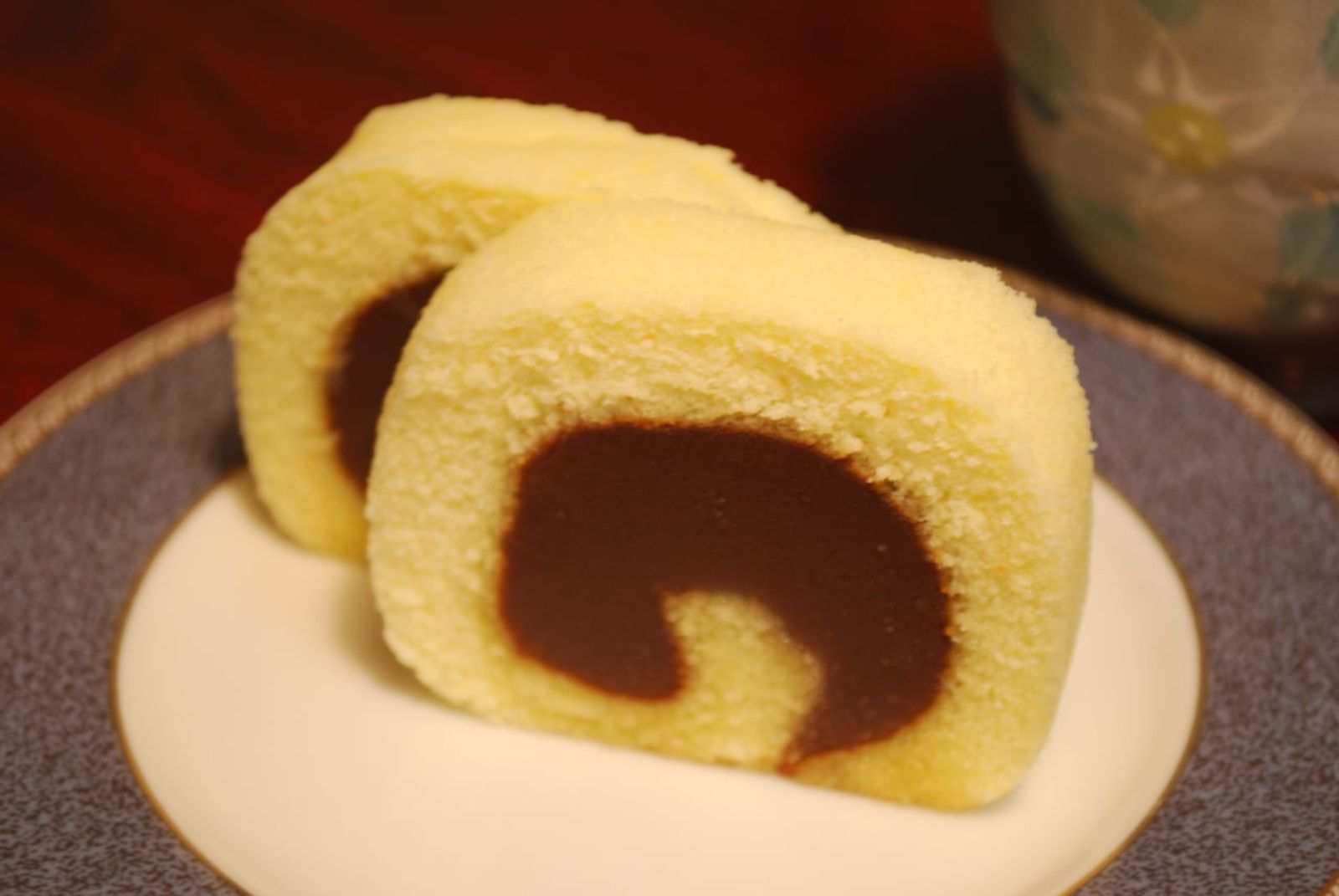
Sliced Matsuyama taruto · Photo: katorisi / CC BY-SA 3.0 (Wikimedia Commons)
 JapanMatsuyama
Matsuyama's 'Taruto': Not a Tart but a Yuzu Bean-Paste Roll, a Story That Began in Nagasaki in 1647
Ask for 'taruto' in Matsuyama and you get not a crisp pastry but a soft sponge rolled around yuzu-scented red bean paste. Here is how a Nanban sweet a feudal lord tasted in Nagasaki became Matsuyama's signature confection.
Called a Tart, Shaped Like a Roll Cake
In Matsuyama, Ehime, 'taruto' (タルト) is nothing like the fruit tart most travelers imagine. It is a roll: a soft, castella-like sponge spread with smooth red bean paste (koshian) flavored with yuzu and rolled up. Slice it and the paste swirls across the cut face like the hiragana character の. The agriculture ministry's regional food archive introduces taruto as a confection that represents Matsuyama City. Today it is made and sold by confectioners all over Ehime and also appears in department stores and some highway service areas around Japan. It is a sweet people buy rather than bake at home, usually served with tea or given as a gift.
1647: A Feudal Lord Goes to Nagasaki
According to the agriculture ministry, taruto's story goes back to the early Edo period. In 1647 (Shoho 4), word came that a Portuguese ship had arrived at Nagasaki, and Matsudaira Sadayuki, first Matsuyama lord of the Hisamatsu line, went to Nagasaki to guard the coast. Japan was then barring Portuguese ships, so the arrival was a serious matter. Yet what Sadayuki met in Nagasaki was not only a military problem. There he is said to have tasted a Nanban sweet, castella rolled around jam, and grown fond of it. 'Nanban' sweets were confections that came from Portugal and other European countries; castella belongs to the same family.
Bean Paste Instead of Jam, Plus Yuzu
Sadayuki is said to have brought the method back to Matsuyama, where it was given a Japanese character and became today's taruto. The agriculture ministry explains that because the original jam was citrus-based, yuzu was added. Bean paste took the jam's place, and the yuzu aroma ties the two together. Interestingly, the sweet stayed hidden for a long time. The recipe was handed down as a secret of the Hisamatsu family and only spread to Matsuyama confectioners after the Meiji era. As for the name, one theory traces it to the Dutch 'taart' and another to the Portuguese 'torta', both meaning cake. Either way, a word for a European baked sweet became the name of something entirely different in Matsuyama.
How It Is Made
The basic ingredients in the agriculture ministry's recipe are eggs, flour and koshian, plus sugar, yuzu zest and water. Eggs are beaten with sifted sugar while warmed to about 40°C until the batter is smooth and the streaks barely disappear. Sifted flour is folded in without lumps, the batter is poured into a paper-lined pan, and it is baked at 180°C for about seven or eight minutes until golden. The bean paste is warmed with a little water, taken off the heat once it bubbles, and mixed with grated yuzu peel. It is spread over the top of the sponge, which is then rolled so the cut face forms a の. The sponge is thin and the paste generous, so each slice tastes more of bean paste than of cake. Seasonal versions use cherry blossom, amanatsu citrus or chestnut in the filling.
Enjoying Taruto as a Traveler
Taruto is sold year-round, which makes it one of the safest souvenirs from Matsuyama. At Matsuyama Station, around Dogo Onsen and at the airport you can compare versions from several confectioners. It comes as whole rolls or pre-sliced, individually wrapped pieces; the latter are handy for sharing. It is usually sliced thin and served with tea. To enjoy the yuzu aroma, let it sit at room temperature for a while instead of eating it straight from the fridge. Under the same name, each confectioner's sweetness, yuzu intensity and sponge moistness differ, so buying two or three to compare is part of the fun. If a seasonal flavor is out, it is worth trying while it lasts.