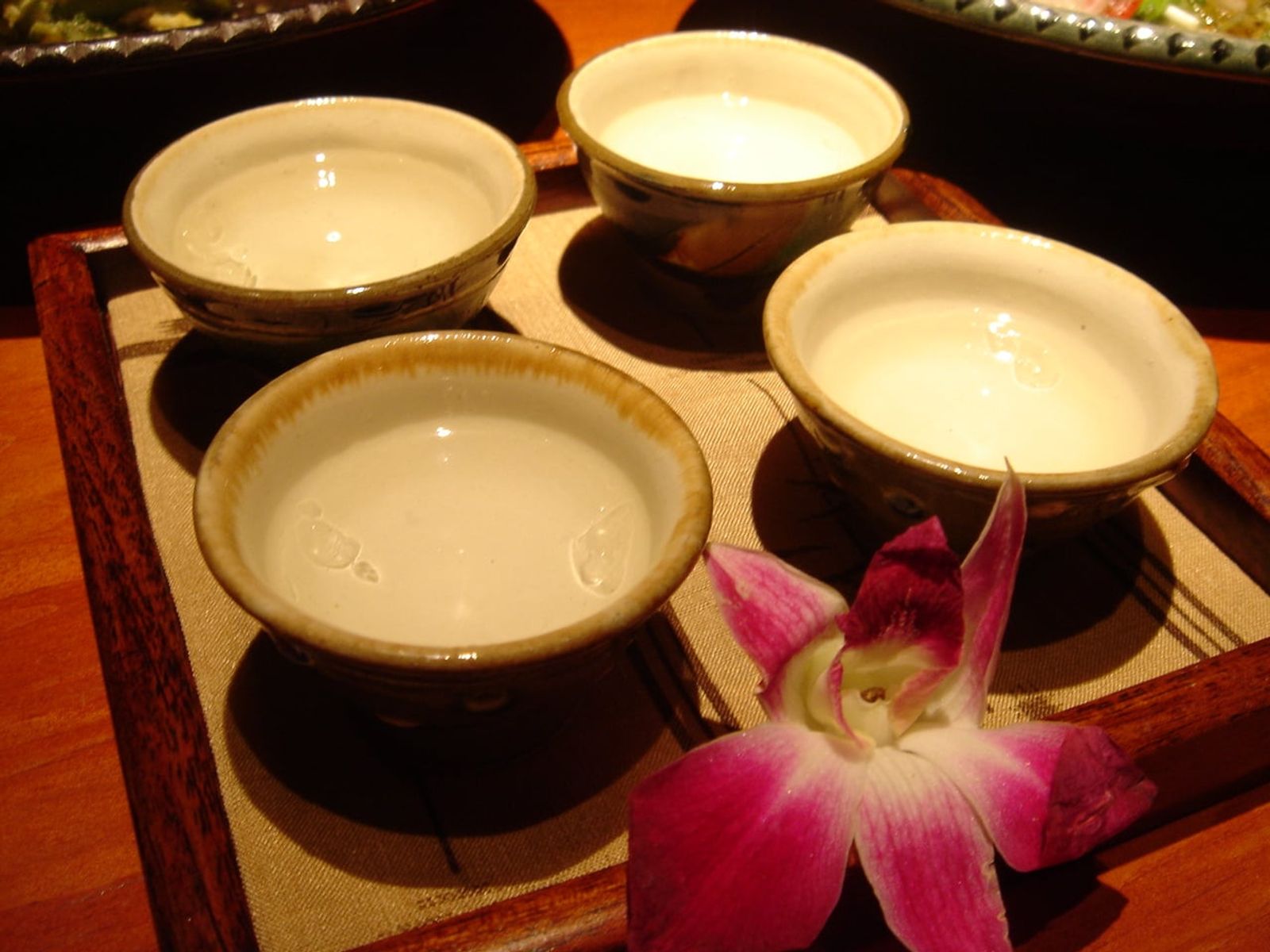
Four kinds of awamori for a tasting · Photo: yajico from Tokyo / CC BY 2.0 (Wikimedia Commons)
 JapanOkinawa
Awamori: Japan's Oldest Distilled Spirit, Guarded by the Ryukyu Court — Black Koji, Thai Rice and Kusu
Okinawa's awamori, made from Thai rice with black koji, is called Japan's oldest distilled spirit. Here is the history of royal control over its production, its revival after the war, aged kusu and the shitsugi tradition, and how to drink it.
Japan's Oldest Distilled Spirit
Awamori (泡盛) is Okinawa's traditional distilled spirit and is often called Japan's oldest. It is described as having some 600 years of history, with techniques that arrived through exchange with Southeast Asia adapting to Okinawa's climate. JETRO notes records of liquor being made in Ryukyu in the 15th century. The name 'awamori' first appears in writing in 1671, in a list of gifts the Ryukyu king sent to the shogun in Edo. There are several theories about the name, including one linking it to the foam (awa) during distillation, but none is settled. There is also an anecdote that Commodore Perry's party, visiting Ryukyu in 1853, compared awamori to a French liqueur.
Shuri's Spirit, Guarded by the Court
In the Ryukyu Kingdom, awamori was not something just anyone could make. According to multilingual explanations from the Japan Tourism Agency, in the 17th and 18th centuries production was limited to three villages in Shuri, Sakiyama, Akata and Torihori, known together as Shuri Sanka. Only 40 makers (48 by another account) were licensed, and apart from a small share kept as payment, everything they made went to the royal government. Unlicensed brewing was severely punished, sometimes with exile. The awamori was stored in a storehouse (zenigura) within Shuri Castle and used by the king and nobles, for entertaining high-ranking guests, and in rites and court ceremonies. From the early 17th to the mid-19th century it was sent regularly to Edo as gifts for the shogun. Awamori was, in effect, a precious spirit that supported the kingdom's diplomacy.
Black Koji, Thai Rice and Revival After the War
Awamori is made from rice and black koji mold. According to JETRO, most of the rice is long-grain Thai indica, though trials with Okinawan rice have begun. Black koji produces lots of citric acid, which suppresses unwanted microbes, and it tolerates heat and humidity, so brewing can continue year-round even in hot Okinawa. Hallmarks include making all the rice into koji before mashing and distilling just once in a pot still. The Battle of Okinawa in World War II destroyed many distilleries along with aged liquor handed down for generations. Government production resumed in 1946, but black koji was hard to find until surviving koji was discovered in a ruined factory. Private distilleries were permitted again in 1949.
Kusu and the Art of Shitsugi
One of awamori's great charms is that it grows deeper and smoother with age. Awamori stored for three years or more is called kusu (古酒), and according to JETRO, since August 2015 only liquor stored entirely for three years or more may be labeled as such. If vintages are blended, the label shows the youngest. The uniquely Okinawan way to raise kusu is shitsugi. Liquor is kept in several jars by vintage; whatever is drunk from the oldest jar is topped up with the next oldest, which is in turn topped up with the next. This preserves the aroma and flavor of the old liquor while letting it be enjoyed continually. In 1997 a 'hundred-year kusu' project began, with the spirit to be opened in 2097.
Enjoying Awamori as a Traveler
Awamori is fairly strong, so if it is your first time, start with mizuwari, mixed with water. JETRO lists mizuwari along with on the rocks, with soda and with hot water. Okinawan restaurants usually serve it alongside dishes like rafute or champuru, and some let you compare regular awamori and kusu in small pours. By JETRO's count there are 46 distilleries and one cooperative on Okinawa Island, Kumejima, Miyakojima, Ishigakijima, Yonagunijima and elsewhere, so seeking out each island's spirit is part of the fun. In December 2024, Japan's traditional knowledge and skills of sake-making with koji mold were inscribed on UNESCO's Intangible Cultural Heritage list, and awamori is among them. It is strong, so sip slowly, and never drive after drinking.