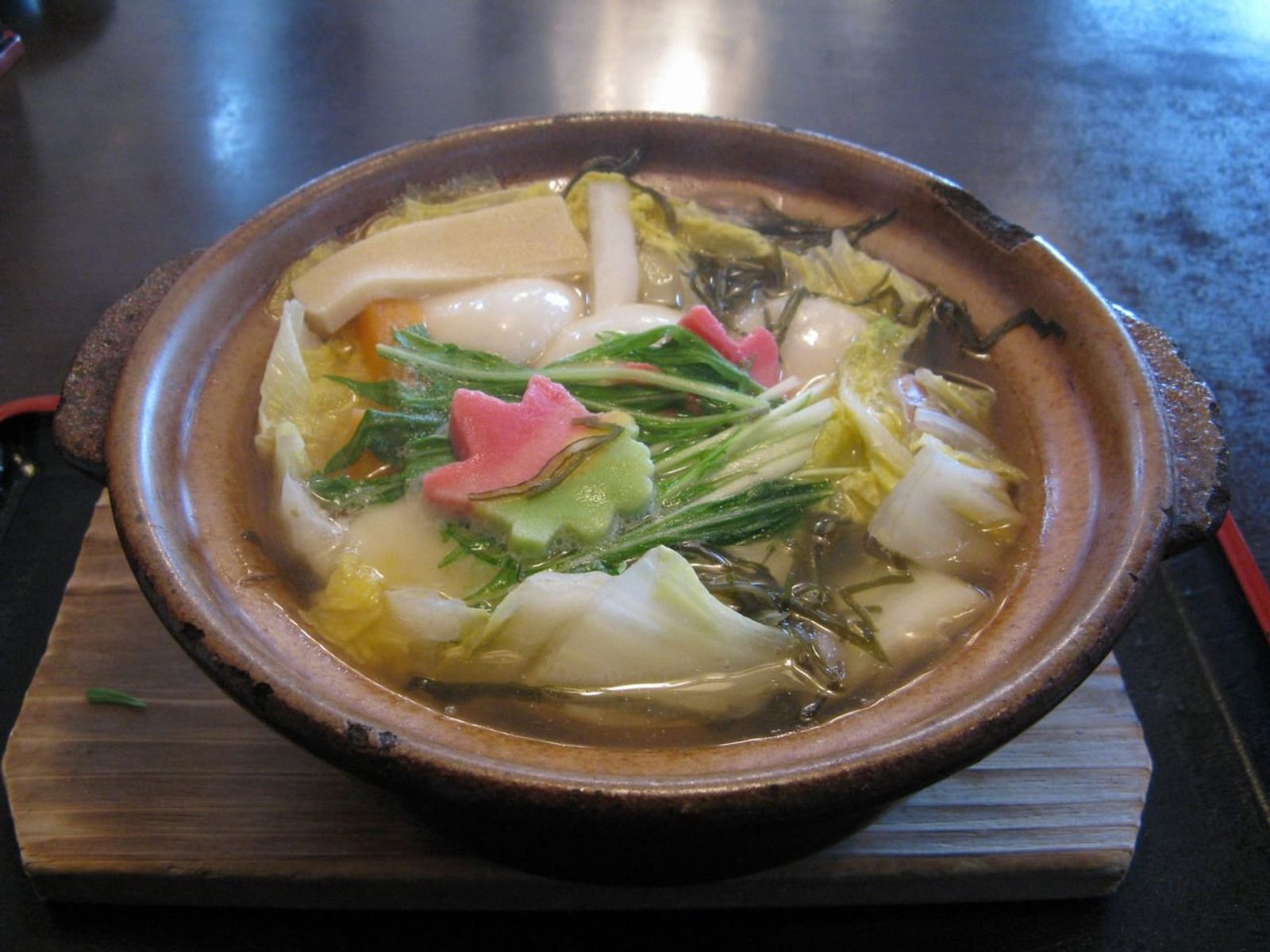
Guzoni in a clay pot (Isahaya) · Photo: Bakkai / CC BY-SA 3.0 (Wikimedia Commons)
 JapanNagasaki
Shimabara Guzoni: The Hearty Mochi Soup Tied to the Legend of the Shimabara Rebellion
Guzoni from the Shimabara Peninsula fills a clay pot with mochi, chicken, vegetables and seafood. Here is the legend linking it to the 1637 Shimabara Rebellion, the rules for its ingredients, and how and where to try it.
From New Year Soup to Local Speciality
Zoni (雑煮) is the mochi soup eaten across Japan at New Year, with broth and mochi shapes that change from region to region. Guzoni (具雑煮) from the Shimabara Peninsula in south-eastern Nagasaki Prefecture is, as the name says, a zoni packed with gu, or fillings: mochi with chicken, napa cabbage, carrot, burdock, shiitake, koya tofu and fish cakes, all simmered and served in the clay pot. Japan's farm ministry lists guzoni as Shimabara's signature local dish. Families eat it at New Year and on festival or celebration days, but it has become such a local speciality that restaurants serve it all year. In 2007 it was chosen as one of the 100 local dishes of Japan's farming, mountain and fishing villages, and many people visit Shimabara just to eat it.
The Shimabara Rebellion and the Mochi
The best-known origin story ties guzoni to the Shimabara Rebellion of 1637. According to the farm ministry, when about 37,000 Christian believers led by Amakusa Shiro were besieged in a castle, they simmered mochi with whatever they could gather from the mountains and the sea to keep up their strength for the long standoff. Japanese Wikipedia adds a tale that Amakusa Shiro had the people store mochi as provisions. This is, however, a legend. Another account holds that the founder of a long-established Shimabara restaurant refined the seasoning in 1813 and created guzoni as it is today, so sources differ on its origin. Either way, it is clearly a dish that has been handed down in this area for a very long time.
An Odd Number of Fillings, Seven or More
Guzoni has some charming rules. According to Japanese Wikipedia, the number of fillings is odd and at least seven, and napa cabbage and strips of kombu always go in. The broth is made from bonito flakes, dried sardines (iriko), dried flying fish (ago) and kombu for a deep savoury flavour. The farm ministry's recipe shows just how varied the fillings are: mochi, chicken, napa cabbage, carrot, burdock, shiitake and koya tofu, plus kamaboko, chikuwa, fried fish cake, lotus root and mizuna, and some households add grilled conger eel or rolled omelette. It is seasoned with light soy sauce, mirin and salt, and the water used to soak the shiitake goes into the broth. Part of its charm is that the fillings vary a little by area and by family.
Cooked in the Clay Pot, Mochi Cooked Separately
The steps in the farm ministry's recipe show how much care goes into guzoni. Koya tofu and shiitake are soaked, a dashi is made from kombu and bonito, and the shiitake soaking water is added. Chicken and root vegetables go in first, then fish cakes, egg and seasonings, followed by cabbage and tofu. The mochi is cooked separately and added with the mizuna for a final simmer. Traditionally it is cooked in a donabe clay pot and eaten straight from it, and restaurants often bring it to the table still bubbling in an individual pot. With so many fillings it is closer to a hot pot than a simple soup, so one order makes a filling lunch on its own. It arrives very hot, so start slowly with the broth.
Trying It in Shimabara
Guzoni is home cooking across the Shimabara Peninsula, but the easiest place for visitors to try it is a restaurant in central Shimabara. It makes a good lunch after seeing sights such as Shimabara Castle and the old samurai residence street. It is also eaten elsewhere in Nagasaki Prefecture, such as Isahaya. The farm ministry notes that frozen gift versions that can be shipped anywhere in Japan have appeared, which is unusual for a zoni. It is sometimes served in school lunches as well, which shows how familiar it is to people in Shimabara. Visit around New Year and you can also sense the season when families everywhere are making their own pot.