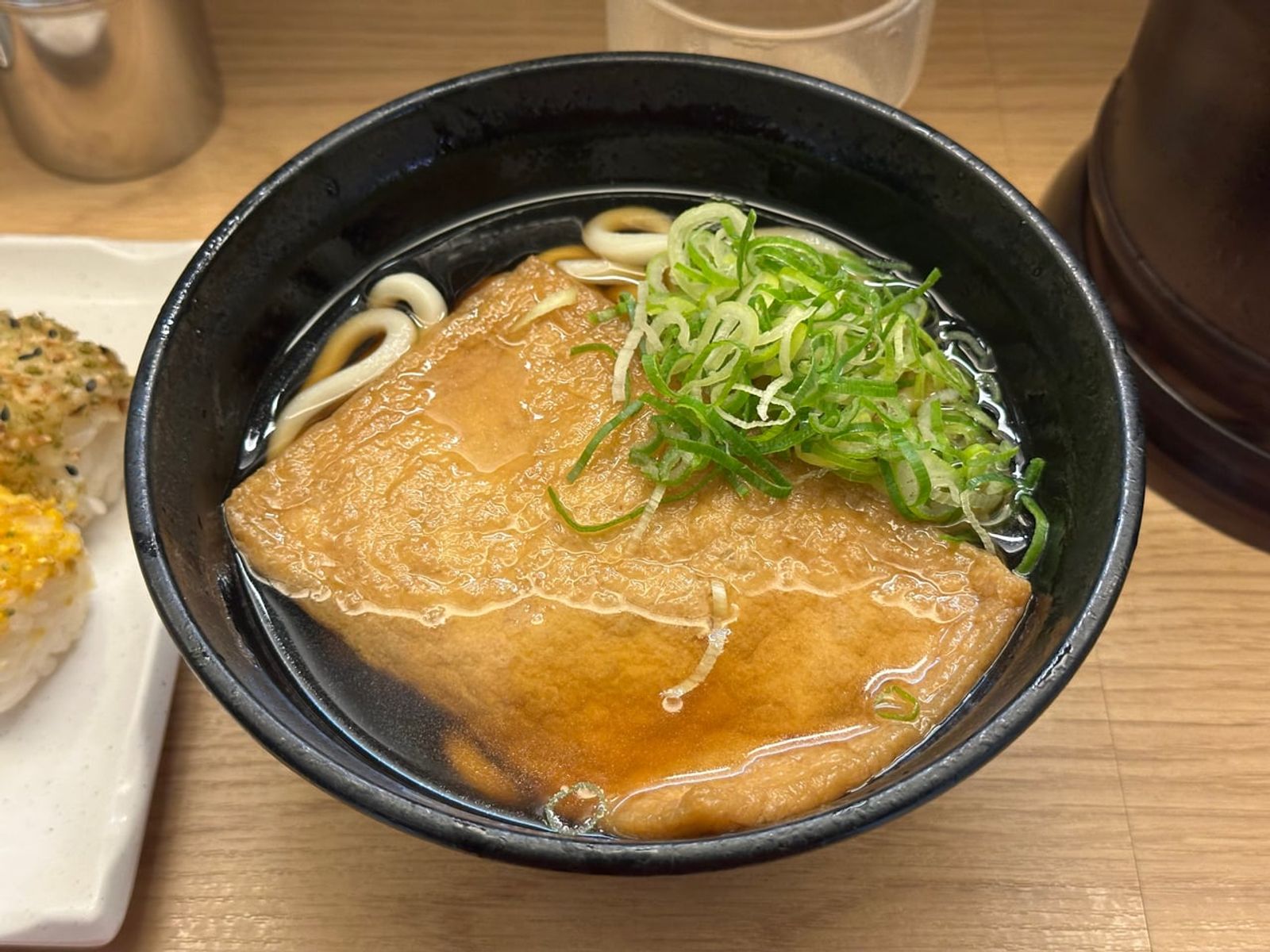
Kitsune udon at Tennoji Station, Osaka · Photo: ノボホショコロトソ / CC BY 4.0 (Wikimedia Commons)
 JapanOsaka
Osaka Kitsune Udon: How a Sheet of Fried Tofu Became Osaka's Soul Udon, and Why 'Tanuki' Means Soba Here
Kitsune udon, a big sheet of sweet-and-savory simmered fried tofu floating on clear broth, is said to be Osaka's favorite udon. Here is how it was born, the secret of its kombu broth, and the confusing name differences between Osaka, Kyoto and Tokyo.
Osaka's 'Most Beloved Udon'
Kitsune udon (きつねうどん) is udon in a clear broth made from kombu and bonito flakes, topped with a large sheet of fried tofu (aburaage) simmered sweet and savory in sugar, soy sauce and mirin. Japan's Ministry of Agriculture lists it as a local dish of Osaka Prefecture, calling it the udon dish Osaka people 'love most' and one that lets you taste both the region's broth culture and its flour-food culture. It is not a special-occasion dish but an everyday meal, eaten year-round at home and in restaurants. From standing noodle counters in train stations to neighborhood udon shops, you will find it near the top of almost every menu in Osaka. Kitsune means 'fox' in Japanese, and the reason is explained below.
Senba, 1893: A Customer Puts the Tofu on the Noodles
Osaka's bond with udon goes back a long way. According to the Ministry of Agriculture, when Toyotomi Hideyoshi built Osaka Castle, udon and soba shops lined an area called Sunaba near today's Shinmachi in Nishi Ward, and udon became widespread around the mid-Edo period. In the early Meiji era noodle factories multiplied, and many shops began buying their noodles from them. Kitsune udon is said to have started in 1893 at an udon shop in Senba, Osaka's merchant district, when a customer took the fried tofu served as a side dish and put it on top of plain udon. However, a book published in 1806 mentions soba with fried tofu in Edo, so some argue the Edo version appears earlier in the written record.
Why 'Fox'?
The best-known explanation is that fried tofu was thought to be the fox's favorite food. In Japan foxes are considered messengers of Inari, the deity of rice and harvests, and that is also said to be why sushi rice wrapped in fried tofu is called inarizushi. Other theories say the golden-brown color of simmered tofu resembles a fox's coat (the color is even called kitsune-iro, 'fox color' in Japanese), or that the shape of the tofu looks like a curled-up fox. In Osaka people sometimes call it 'ketsune' in affectionate dialect, and another nickname, 'shinoda', comes from the Shinoda Forest, the setting of a famous fox legend. If you see 'shinoda' on a menu, it means a dish with fried tofu.
The Secret of the Broth: Kombu and Light Soy Sauce
The other star of kitsune udon is the broth. The Osaka Convention and Tourism Bureau describes the base of Osaka cooking as a combined stock of kombu and bonito flakes. In the Edo period, kitamaebune ships carried kombu from Hokkaido to Osaka, and unlike Kyoto, which favored rishiri kombu, Osaka chose ma-kombu for its rich savoriness. The Ministry of Agriculture adds that the kitamaebune route also brought flour and salt to Osaka, all of which went into udon. The Kansai way is to use usukuchi, a pale soy sauce, so the broth stays a clear golden color. The key is contrast: a clean, light broth against tofu simmered sweet and savory. Dip the tofu briefly in the broth, take a bite, and drink the broth to the last drop as the sweetness from the tofu seeps in. That is how Osaka eats it.
Ordering Tips: The Names Change Between Osaka, Kyoto and Tokyo
Names are the most confusing part of eating noodles in Kansai. In the Kinki region centered on Osaka, udon topped with fried tofu is 'kitsune', and soba with the same tofu is usually called 'tanuki', so you generally will not see 'kitsune soba' or 'tanuki udon' on menus. In Tokyo, tanuki means noodles topped with tempura crumbs (agedama), so you would get a completely different dish. Kyoto is different again. Noodles with simmered tofu are 'ama-gitsune' (sweet fox), those with unseasoned, finely sliced tofu are 'kizami kitsune', and udon with sliced tofu under a thick kudzu-starch sauce (ankake) is called 'tanuki'. In Osaka, if you want the big sheet of sweet tofu, simply order 'kitsune'.