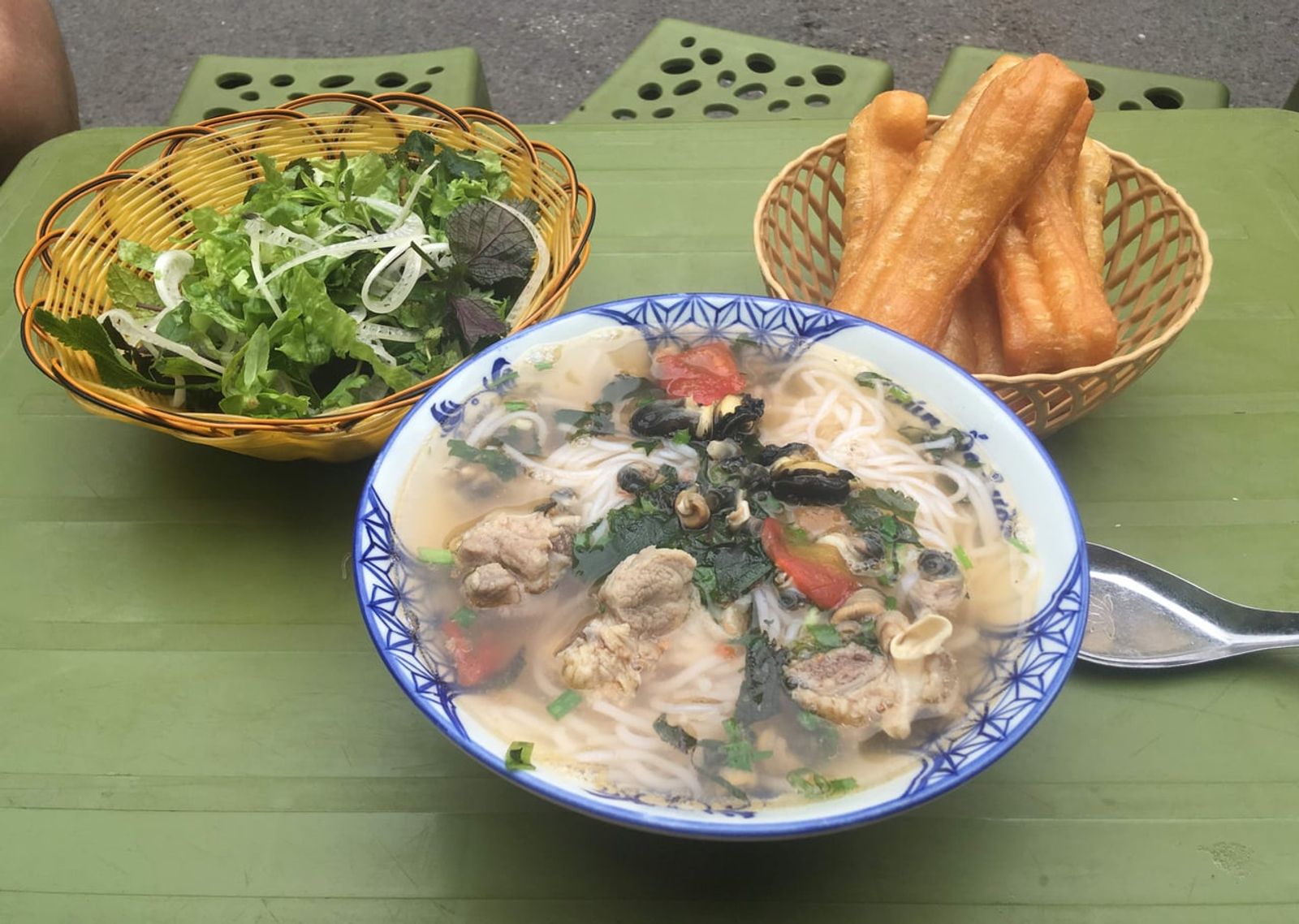
Noodle soup with an herb basket and quẩy at a Hanoi street eatery · Photo: Christophe95 / CC BY-SA 4.0 (Wikimedia Commons)
 Vietnam
How to Eat Out in Vietnam: Low Stools, Herb Baskets, Wet Towels and the Bill
Sitting on a little plastic stool on the pavement over a bowl of noodles is one of the defining images of a trip to Vietnam. Here is how street eateries work, what to do with the herbs and sauces on the table, and what to know about towels, tea and tipping.
A Restaurant on the Pavement
Walk any Vietnamese city and you will pass endless eateries set up on the pavement, with knee-high plastic stools, small tables and a menu of one or two dishes. Locals call these small places quán. According to the Vietnamese outlet Vietcetera, sitting low on woven mats on the ground was a long-standing habit, but the plastic stool only became common in the early 1990s, after the 1986 Đổi Mới reforms boosted plastic manufacturing. The stools are light, waterproof and stackable, so a vendor can carry dozens on one motorbike and open or close a shop in minutes. Sharing a table with strangers is normal, so if you see a free seat, give a nod and sit down.
The Herb Basket and the Condiments
Order noodles and many places bring a separate basket or plate of lettuce, mint, coriander and other fresh greens. Raw vegetables are called rau sống and aromatic herbs rau thơm, and the idea is that you tear in as much as you like rather than eating a set portion. The table usually holds lime wedges, fresh chillies or chilli sauce, fish sauce and sometimes garlic pickled in vinegar. Locals taste the broth first and then adjust it with lime and chilli. In Hanoi you may also get quẩy, long fried dough sticks for dipping into the soup, which some places charge for separately. If coriander is not for you, try saying "không rau" (no greens) or "không ngò" (no coriander) when you order.
Wet Towels and Iced Tea: Free or Not?
When you sit down you may find a sealed wet towel or a chilled towel on the table, or a glass of iced tea (trà đá) may arrive without you asking. Vietcetera notes that these "free-looking" extras are common in Vietnamese restaurants, but none is guaranteed to be free. Some restaurants do charge for towels, and the outlet mentions a foreign reviewer in Ho Chi Minh City who was surprised to see iced tea on the bill. The amounts are usually small, but if it bothers you, simply leave the sealed towel unopened, and it is perfectly polite to ask whether the tea costs extra before drinking it. Snacks such as peanuts set out in advance at seafood places and beer spots may be charged at some places too, so think of them the same way: you can ask for anything you did not touch to be taken off the bill.
Ordering and Paying: All at the End
Street eateries often have a menu on the wall, or none at all. The dish written on the sign or wall is the house speciality, so pointing at it, or at another diner's bowl, works perfectly well. For dishes like pho where you choose the cut of meat, just point to the line listing the cut you want. At most places you pay at the end. Before you get up, signal to the owner or staff that you want to pay, and they will count up your bowls, drinks and extras such as quẩy or towels and tell you the total. Small places are easiest with cash, so carry plenty of small notes. Where no prices are posted, it is easier to ask before you order.
Tipping Is Optional, Plus a Few Small Courtesies
Tipping is not obligatory in Vietnam. A column by a foreign resident in Tuoi Tre's English edition says tipping is not customary at quán serving everyday food such as rice, pho and bún bò. Upscale and hotel restaurants, however, may add a service charge (phí phục vụ) and VAT to the bill, so check the total. If you want to thank friendly staff, leaving the small change is plenty. Table manners are much like elsewhere in East Asia. Standing chopsticks upright in a bowl is widely said to be avoided because it recalls incense sticks at an altar, so rest them across the top of the bowl instead. Using a spoon and chopsticks together for noodles is perfectly natural. Above all, at a busy lunchtime street stall, the welcome guest is the one who does not linger long after finishing.