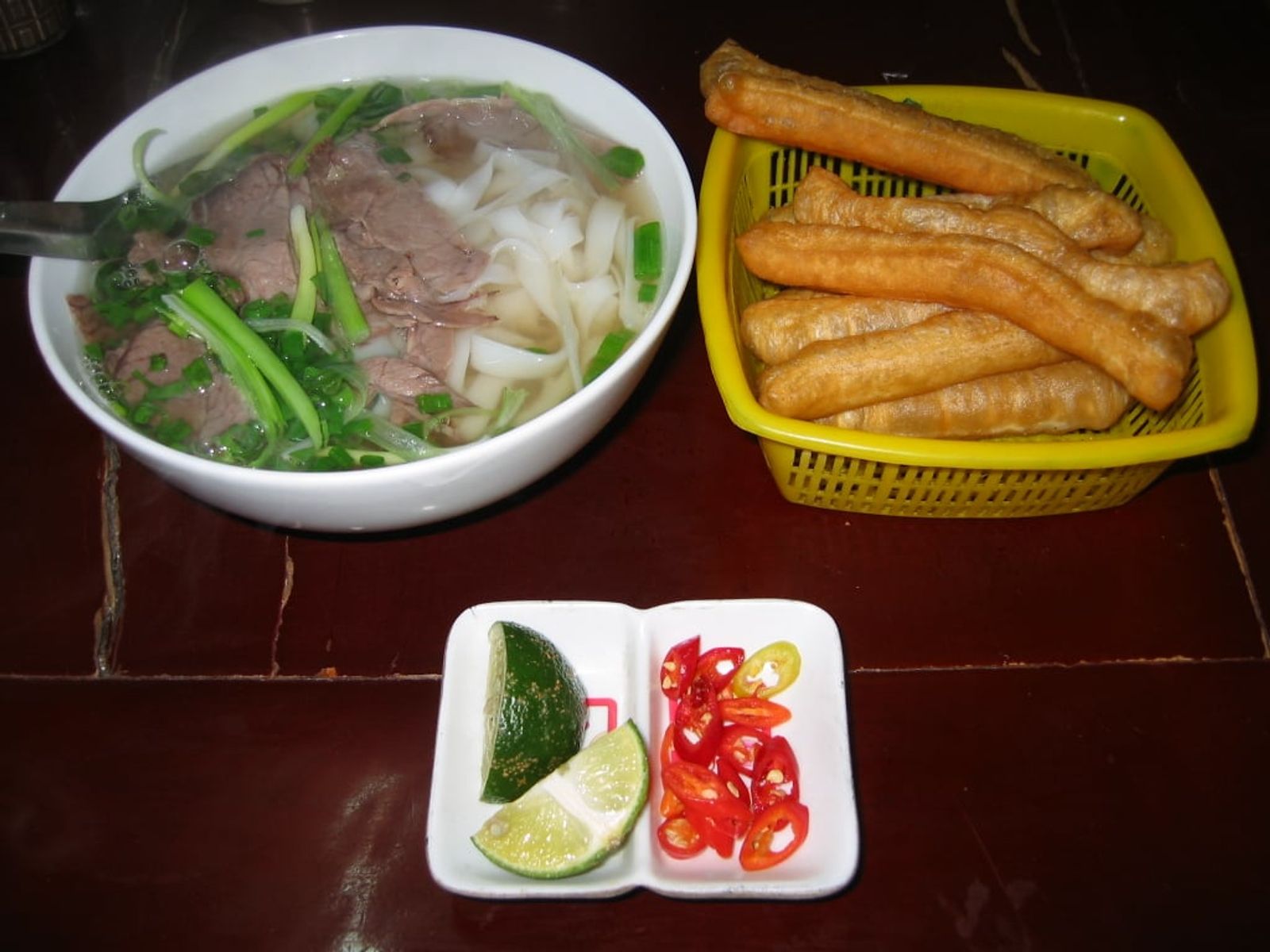
Beef pho (phở bò chín) served with quẩy · Photo: Binh Giang / Public domain (Wikimedia Commons)
 Vietnam
The Pho Family Tree: Born in Nam Định, Raised in Hanoi, Reinvented in Saigon
Pho is a surprisingly young dish, born in northern Vietnam a little over a century ago. Here are the competing origin theories, how it spread to Hanoi and the South, how the clear northern bowl differs from the herb-laden southern one, and a few words that help when ordering.
Early 1900s, Near the Textile Markets of Nam Định
Pho, the noodle soup that stands for Vietnam, is younger than most people think. Research summarised on English Wikipedia places the emergence of modern pho between 1900 and 1907 in Nam Định, southeast of Hanoi, then home to a major textile market. Villages such as Vân Cù are named as its traditional home (since a 2025 administrative merger, the former Nam Định Province has been part of Ninh Bình Province). Early pho was not sold in shops but from gánh phở, mobile kitchens of pots and bowls hung from a shoulder pole, at dawn and dusk. Written records are thin: the word appears in a 1907 short story, and the writer Nguyễn Công Hoan recalled seeing pho vendors in 1913. The first dictionary to define phở as a soup only appeared in 1931.
Where Did the Name Come From? Three Theories
Sources disagree on where pho comes from. The first theory points to France: beef became widely available under French rule (1887–1954), and some link the name to the French beef stew pot-au-feu, though many scholars reject this because the two dishes are so different. The second theory points to China. It holds that phở comes from the fen (粉) in ngưu nhục phấn (牛肉粉), a beef noodle dish that Chinese workers in Hanoi made from beef bones, and that labourers from Yunnan and Guangdong drove early demand for it. A third view says pho grew out of xáo trâu, an older northern dish of water buffalo, once cooks switched to cheaper beef. None has won out, and most writers assume a mix of influences.
Becoming Hanoi's Noodle, Then Heading South
Pho soon reached Hanoi. Fixed pho stands appeared there around 1918, and around 1925 a native of Vân Cù is said to have opened Hanoi's first "Nam Định-style" stand. Phở tái, with beef cooked rare in the hot broth, had arrived by 1930, and phở gà, made with chicken, by 1939. The great turning point was the partition of 1954, when more than a million people moved from North to South and pho put down roots in Saigon, now Ho Chi Minh City. In the lean post-war subsidy years, state eateries served a meatless bowl of seasoned broth jokingly nicknamed "pilotless pho". After the war, emigrants carried pho around the world; the first pho restaurant in California's Little Saigon opened in 1980, and hundreds followed.
Clear in the North, Abundant in the South
Pho differs quite a bit between North and South. A Hanoi bowl has a clear, deep broth from long-simmered beef bones, with whole blanched spring onions, and the extras are restrained: sliced spring onion, coriander, pickled garlic, chilli sauce and quẩy. It is a bowl for appreciating the broth itself. The southern version has a slightly sweeter, cloudier broth and comes with a heaped plate of bean sprouts, Thai basil, culantro, lime and fresh chilli, with hoisin and chilli sauce on the table. Wikipedia describes many of these additions as southern innovations. The original Nam Định style is noted for wider noodles and more fish sauce. The bean sprouts and sauces you see at most pho restaurants abroad are, in fact, closer to the southern style.
Pho as National Heritage, and Words for Ordering
In August 2024, Vietnam's Ministry of Culture, Sports and Tourism added the cooking knowledge of Hanoi pho and Nam Định pho to the national intangible cultural heritage list. When ordering, you usually choose the meat and how it is cooked. Phở bò is beef, phở gà is chicken; with beef, tái means raw slices cooked by the hot broth, and chín means meat that has been boiled and sliced in advance. Many people order tái chín, a mix of both. There are broth-free versions too: phở cuốn, beef and herbs rolled in sheets of fresh rice noodle, is a relatively new favourite in Hanoi, and phở xào is the noodles stir-fried with beef and vegetables. Pho is traditionally a breakfast dish, but most places now serve it all day.