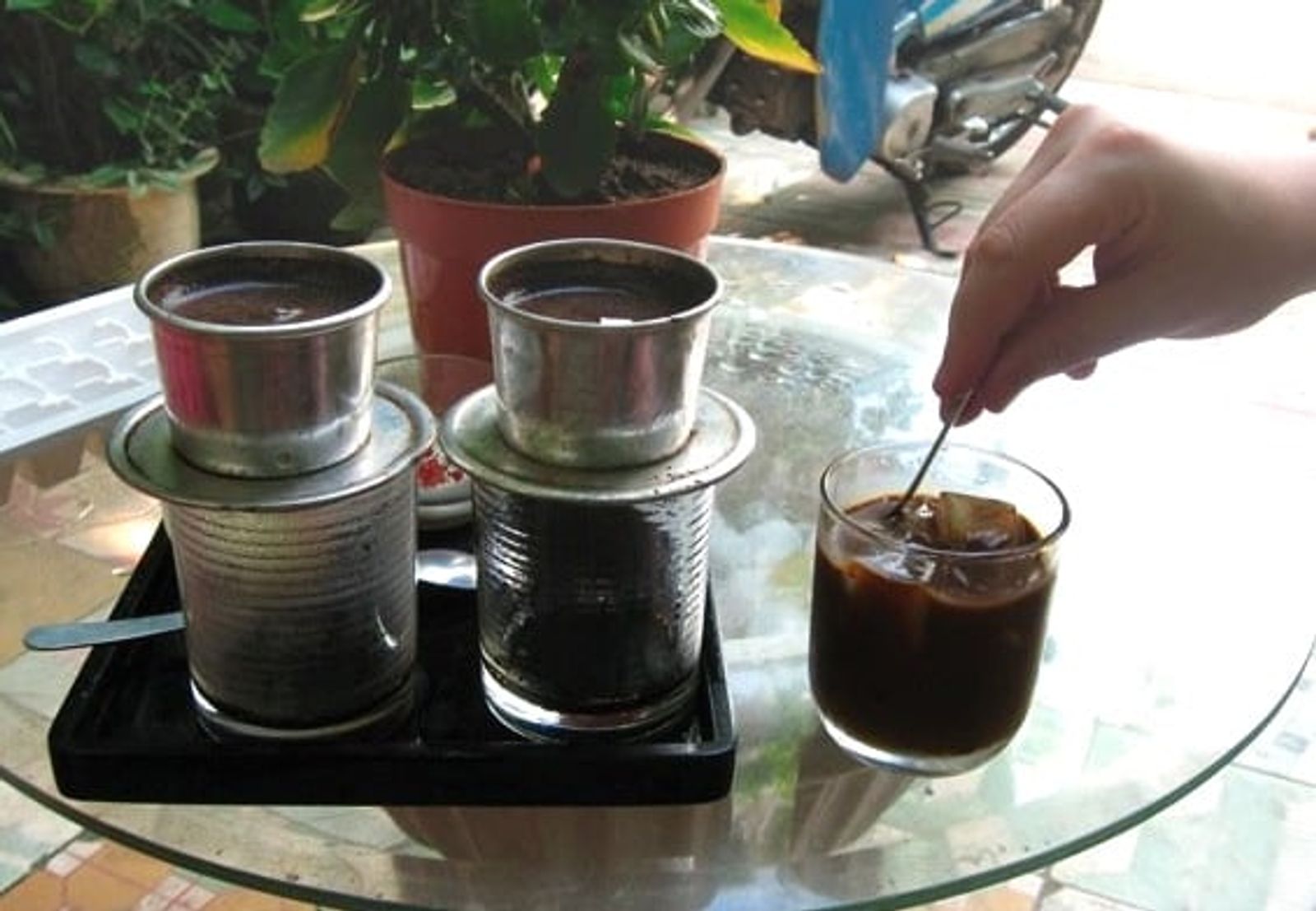
Coffee dripping through phin filters, with an iced coffee (Đà Nẵng) · Photo: Dragfyre / CC BY-SA 3.0 (Wikimedia Commons)
 Vietnam
ese Coffee Explained: The Phin, Condensed Milk, Egg Coffee and Beyond
Vietnam is the world's second-largest coffee producer after Brazil, with a coffee culture all its own: strong, bitter robusta dripped through a small metal filter and finished with condensed milk and ice. Here is the history, how to use a phin, how egg coffee was born and how to order.
From Missionaries' Plants to the World's No. 2 Producer
Coffee is believed to have arrived in Vietnam in 1857, when French missionaries brought in the plants. The first plantations were set up in 1888 in Ninh Bình in the north and Quảng Bình in central Vietnam, and in the 1920s the French opened growing areas in the Central Highlands, mainly in Đắk Lắk Province, making the Buôn Ma Thuột plateau the heart of the industry. After stalling through war and collectivisation, the industry surged once the 1986 Đổi Mới reforms allowed private enterprise again. Vietnam is now the world's second-largest coffee producer after Brazil, and about 97 percent of its output is robusta. Robusta tends to be more bitter and higher in caffeine than arabica, and that strong, bitter taste is what gives Vietnamese coffee its character.
The Phin: A Metal Filter That Drips One Cup at a Time
The image of Vietnamese coffee is the phin, a small metal filter sitting on top of a cup. Coarsely ground coffee goes into the cup-shaped filter with tiny holes in the base, a press plate goes on top, hot water is poured in and the lid is closed, and the coffee drips into the cup below, drop by drop. The usual method is to pour in a little water first to let the grounds bloom, then add the rest. Cafés often bring the phin to your table still brewing. Wait a few minutes until it stops dripping, turn the lid upside down to use as a tray, set the phin on it, then stir the coffee into the condensed milk waiting at the bottom. Vietnamese coffee is not something to gulp down; enjoying the wait is part of it.
Why Condensed Milk? The Birth of Cà Phê Sữa Đá
There is a reason Vietnamese milk coffee uses sweetened condensed milk. Under French rule fresh milk was scarce and spoiled quickly in the heat, so people relied on imported, shelf-stable condensed milk. The bitterness of dark-roast robusta balanced the sweetness of the milk, and ice was added to cope with the hot climate, giving us today's iced condensed-milk coffee. This is cà phê sữa đá: cà phê is coffee, sữa is milk and đá is ice. Without milk it is cà phê đen (black coffee), and with ice cà phê đen đá. At the other end is bạc xỉu, lots of condensed and fresh milk with just a splash of coffee, which is said to have originated in the 1950s in Chợ Lớn, Saigon's Chinese quarter.
Egg Instead of Milk: Hanoi's Egg Coffee
Egg coffee (cà phê trứng) is egg yolk whipped with sugar and condensed milk until it turns into a fluffy cream, then spooned over strong coffee. According to Vietnam's national tourism site and other sources, it began in 1946 (some say simply the 1940s), when milk was scarce in wartime and a hotel bartender in Hanoi used whipped egg yolk in its place. He later opened his own café, and his family is said to still serve egg coffee made the same way in Hanoi. Accounts differ slightly on exactly what was mixed with the yolk. The cup often arrives sitting in a bowl of hot water to keep it warm. Try the egg cream on top with a spoon first, then stir it into the coffee below. It started in Hanoi but is now easy to find in Ho Chi Minh City and elsewhere, and there is an iced version too.
Coconut Coffee, Salt Coffee and How to Order
Newer Vietnamese coffee drinks keep appearing. Coconut coffee (cà phê dừa), strong coffee poured over a slush of coconut milk, condensed milk and ice, began in Hanoi and was popularised by a café chain. Salt coffee (cà phê muối), topped with a lightly salted cream, was created in Huế in 2010; the idea is that the salt brings out the sweetness of the condensed milk. To order, "cà phê sữa đá" (iced coffee with condensed milk) and "cà phê đen đá" (iced black coffee) will get you most of the way. Vietnamese coffee tends to be quite sweet, so add "ít đường" (less sugar) if you prefer it less so. Robusta is high in caffeine, so if coffee affects you, go easy late in the afternoon.