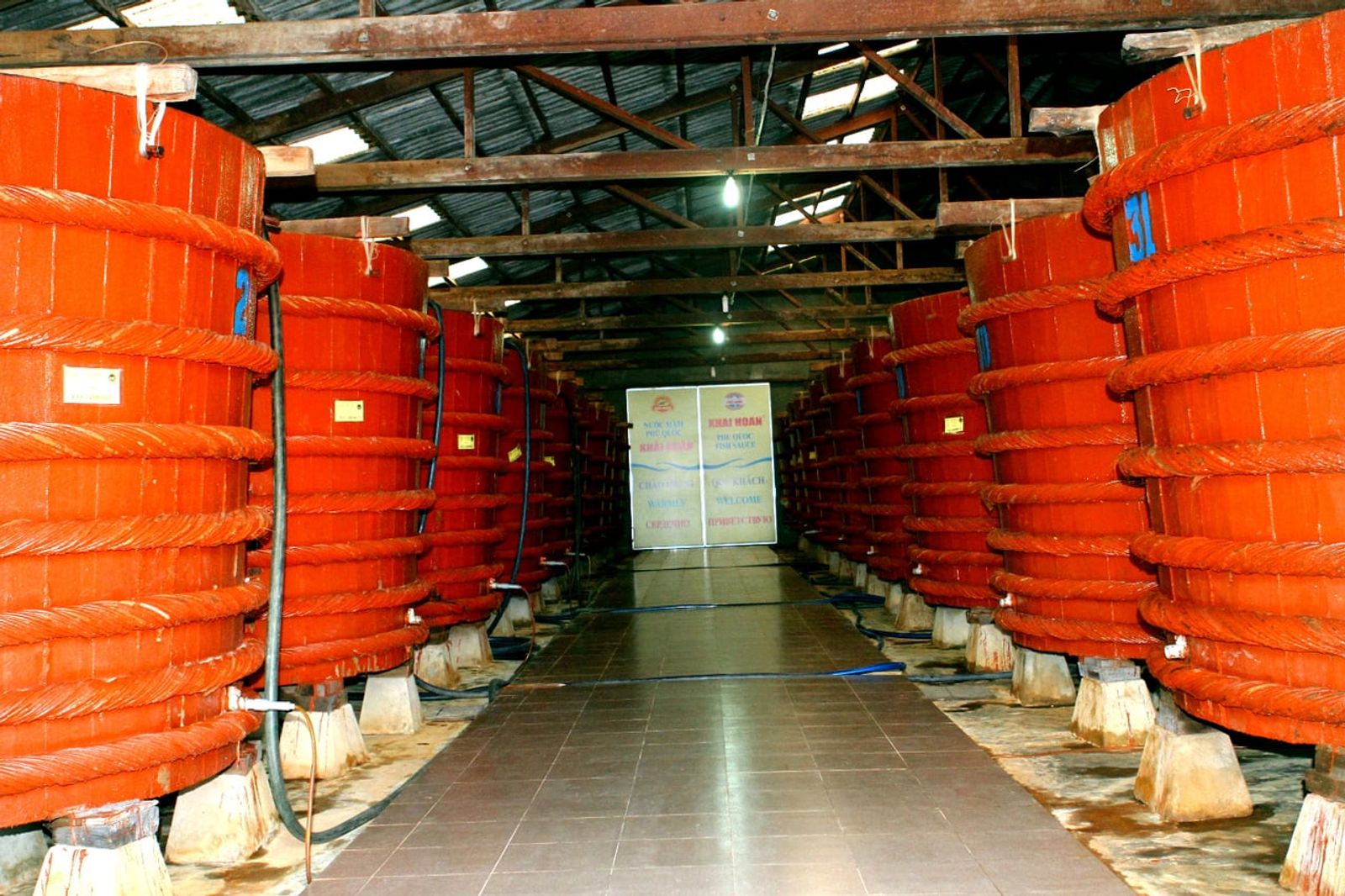
Fermentation vats at a fish sauce factory on Phú Quốc Island · Photo: Frank Fox / CC BY-SA 4.0 (Wikimedia Commons)
 Vietnam
Nước Mắm: Fish Sauce, the Root of Vietnamese Flavour, and the Art of Dipping
The savoury backbone of Vietnamese food is nước mắm, fish sauce made from little more than anchovies and salt. Here is how it is made, how to read the nitrogen degree that marks a good bottle, how to use nước chấm, the dipping sauce that comes with almost everything, and a few other ferments.
Anchovies, Salt and Time
Nước mắm, fish sauce, plays a role in Vietnamese cooking much like soy sauce does in other East Asian kitchens. It goes into stir-fries, braises, soups and salads alike, and at the table it becomes a dipping sauce. The ingredients are remarkably simple. Small fish, mostly anchovies (cá cơm), are mixed with salt, packed into large vats and left for a long time; as the proteins break down, a clear amber liquid is drawn off. Vietnamese producers sometimes use other fish such as mackerel or scabbard fish. Traditionally made Vietnamese fish sauce is noted for having no added sugar or preservatives. The smell can be startling at first, but in cooking it turns into deep savouriness and salt rather than fishiness. That mysterious depth in Vietnamese food is, more often than not, nước mắm.
Aged in Wooden Vats, the Traditional Way
Traditionally, anchovies are mixed with salt at roughly three parts fish to one part salt and packed into large wooden vats; in other climates the ratio may be four to one. Done the old way, fermentation takes a year or more, while modern producers usually allow six to twelve months, as the fish proteins slowly break down and the savoury depth builds. The rich first run is called nước mắm nhĩ and is considered the finest; producers often keep it for their own use or as gifts rather than selling it. As for where it comes from, Phan Thiết on the south-central coast is often named as the birthplace of Vietnamese fish sauce, and the southwestern island of Phú Quốc is another famous source. In October 2012 Phú Quốc fish sauce became the first product from an ASEAN country to be registered under the EU's Protected Designation of Origin.
Reading the Number on the Label: Degrees of Nitrogen
Look at fish sauce bottles in a Vietnamese supermarket and you will see large numbers such as 25°N, 35°N or 40°N. This is độ đạm, the nitrogen content, meaning grams of nitrogen per litre of sauce. Nitrogen reflects the amino acids released from fish protein, so a higher number generally means more fish and a richer savoury taste. Most everyday sauces sit in the mid-20s; over 30°N is considered high-grade and around 40°N premium. If you are buying a bottle to take home, check the degree and also the ingredients list for just anchovies and salt. Since it is a liquid, mind cabin baggage rules and pack it carefully for the flight.
Nước Chấm: The Dipping Sauce for Nearly Everything
The sweet-and-sour sauce that comes in a little bowl at most meals is nước chấm. The base is fish sauce mixed with water, sugar and lime juice (or vinegar), with minced garlic and bird's eye chilli floating on top; one simple ratio is one part fish sauce, one part sugar and two parts water. Salty, sweet, sour and hot all meet in one bowl. Nước chấm is essential with chả giò (fried spring rolls), gỏi cuốn (fresh rolls), bánh xèo, bánh cuốn, cơm tấm (broken rice) and all kinds of bún noodle dishes. It changes by region: northern cooks may add meat or shrimp broth, central versions are less diluted and stronger, and in the south palm sugar or coconut water is often used for sweetness.
Shrimp Paste and Fish Pastes: Deeper Into Fermentation
If nước mắm is the clear, filtered liquid, mắm is the general name for thicker pastes of fish or shrimp fermented whole. Mắm ferments for a shorter time than fish sauce and is kept together with its liquid. The one travellers meet most is mắm tôm, a purple paste of fermented tiny shrimp. Its smell is powerful and divides opinion, but with dishes such as Hanoi's bún đậu (rice noodles with fried tofu), the classic way is to dip into mắm tôm stirred with lime and sugar until it foams. In central Vietnam, many dishes come with mắm nêm, a fermented fish dip. You can ask whether nước chấm is available instead, but it is worth trying the local way at least once; if you like salted ferments, you may be pleasantly surprised.