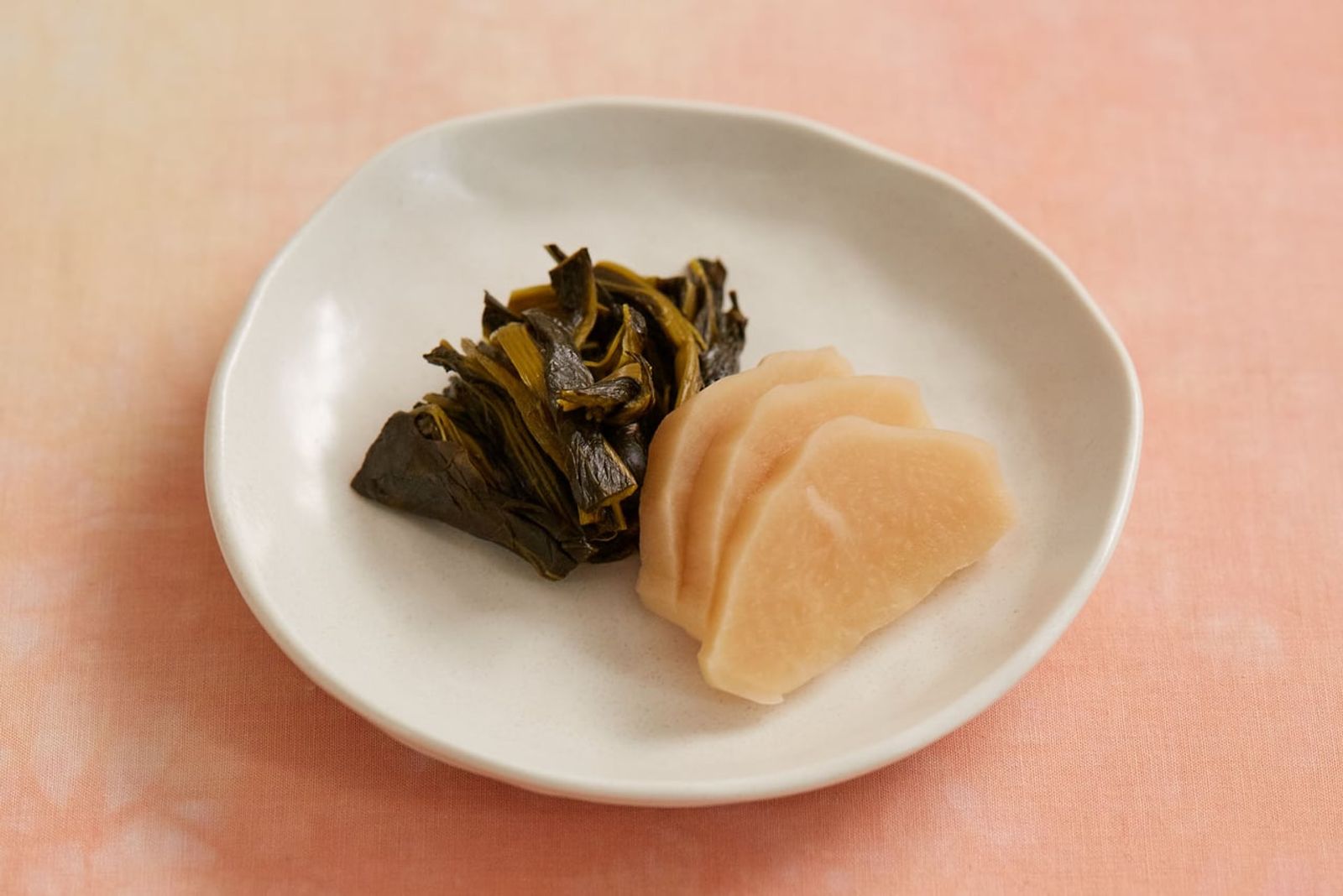
Suguki, one of Kyoto's three great pickles · Photo: 農林水産省 (Ministry of Agriculture, Forestry and Fisheries) / CC BY 4.0 (Wikimedia Commons)
 JapanKyoto
Kyoto's Three Great Pickles: The Stories Behind Senmaizuke, Shibazuke and Suguki
Far from the sea, the old capital of Kyoto developed a deep tradition of pickling vegetables. From a turnip pickle created by an imperial palace cook, to a shiso pickle tied to the legend of a tragic empress, to a fermented pickle once guarded by a shrine village, here are the origins of Kyoto's three great pickles and how to enjoy them.
Why Kyoto Became a City of Pickles
Kyo-tsukemono is the collective name for pickles made in Kyoto from Kyoto-grown vegetables, and they are considered a symbol of the city's food culture alongside Kyoto cuisine itself. The Kyoto Prefecture pickle cooperative has even registered the name as a regional collective trademark. Several things helped pickling flourish here. Kyoto sits in a basin far from the sea, so seafood was hard to get and growing and preserving vegetables became essential. The meat-free cooking of Buddhist temples encouraged pickles too. The bone-chilling, humid Kyoto winter is said to be ideal, keeping unwanted bacteria in check while allowing fermentation to continue. Of all Kyoto's pickles, senmaizuke, shibazuke and suguki are known as the big three.
Senmaizuke: A Winter Turnip Pickle Created by a Palace Cook
Senmaizuke is the pickle of the Kyoto winter. Large Shogoin turnips, a traditional Kyoto vegetable, are sliced paper-thin and pickled in sweet vinegar with kombu and chili. The name, meaning a thousand slices, is said to come from cutting the turnip so thin that a single tub held more than a thousand pieces. Its origin is unusually clear: it is credited to Daikokuya Tozaburo, a cook who worked for the Kyoto Imperial Palace, in 1865. Originally the slices were lactic-fermented and turned a yellowish color, but because the color faded and the smell grew strong, most senmaizuke today is seasoned with kombu and vinegar instead. It is made and sold only from roughly November to March, following the turnip harvest.
Shibazuke: Ohara's Red Shiso and the Legend of a Tragic Empress
Shibazuke is a vivid purple pickle of eggplant and other vegetables salted with red shiso and left to lactic-ferment. Its original name was shiyozuke, meaning shiso-leaf pickle, and Ohara, a mountain village north of Kyoto, was famous for its red shiso. A legend surrounds it. After the fall of the Taira clan at the end of the Heian period, Kenreimon-in, the Taira empress Tokuko, retired to Jakko-in temple in Ohara. She loved a pickle the villagers brought her and is said to have named it after its purple leaves. Traditionally eggplant was the main ingredient, but much of what is sold today is seasoned shibazuke, based on cucumber with ginger and myoga, steeped in seasoned vinegar.
Suguki: The Tangy Fermented Pickle Guarded by the Kamigamo Shrine Village
Suguki is made from suguki-na, a variety of turnip, salted and lactic-fermented, and it is produced only in Kyoto. Cultivation is said to have begun around the Azuchi-Momoyama period, and one theory credits the shrine-priest families of Kamigamo Shrine with spreading it. It was guarded so closely that in 1804 taking the seeds out of the area was banned, and it became widely known only after it went on sale around Midorogaike Pond in the Meiji era. The tubs are pressed with tenbin-oshi, a long wooden beam weighted at one end, then fermented for about eight days in a heated room. Its sharp sourness divides opinion, but the lactic acid bacterium found in it, known as Labre, has drawn attention to suguki as a health food.
Tasting and Buying: Nishiki Market and the Seasons
Kyoto pickles are, above all, something to eat with plain white rice. Senmaizuke is good on its own as a palate refresher. For suguki, the root is usually cut into half-moons and the leaves chopped finely, then drizzled with a little soy sauce and eaten over rice or in ochazuke. They also go well with sake. If you want to compare several kinds, the area around Nishiki Market in central Kyoto is the easiest place, with many stalls displaying pickles in wooden tubs where you can taste before you buy. To see the home of shibazuke, take a trip to Ohara, where Jakko-in stands. Senmaizuke and suguki are winter pickles, so after late November you have the best chance of finding a fresh batch. Many are vacuum-packed now but still need refrigeration, so time your shopping for the end of your trip.