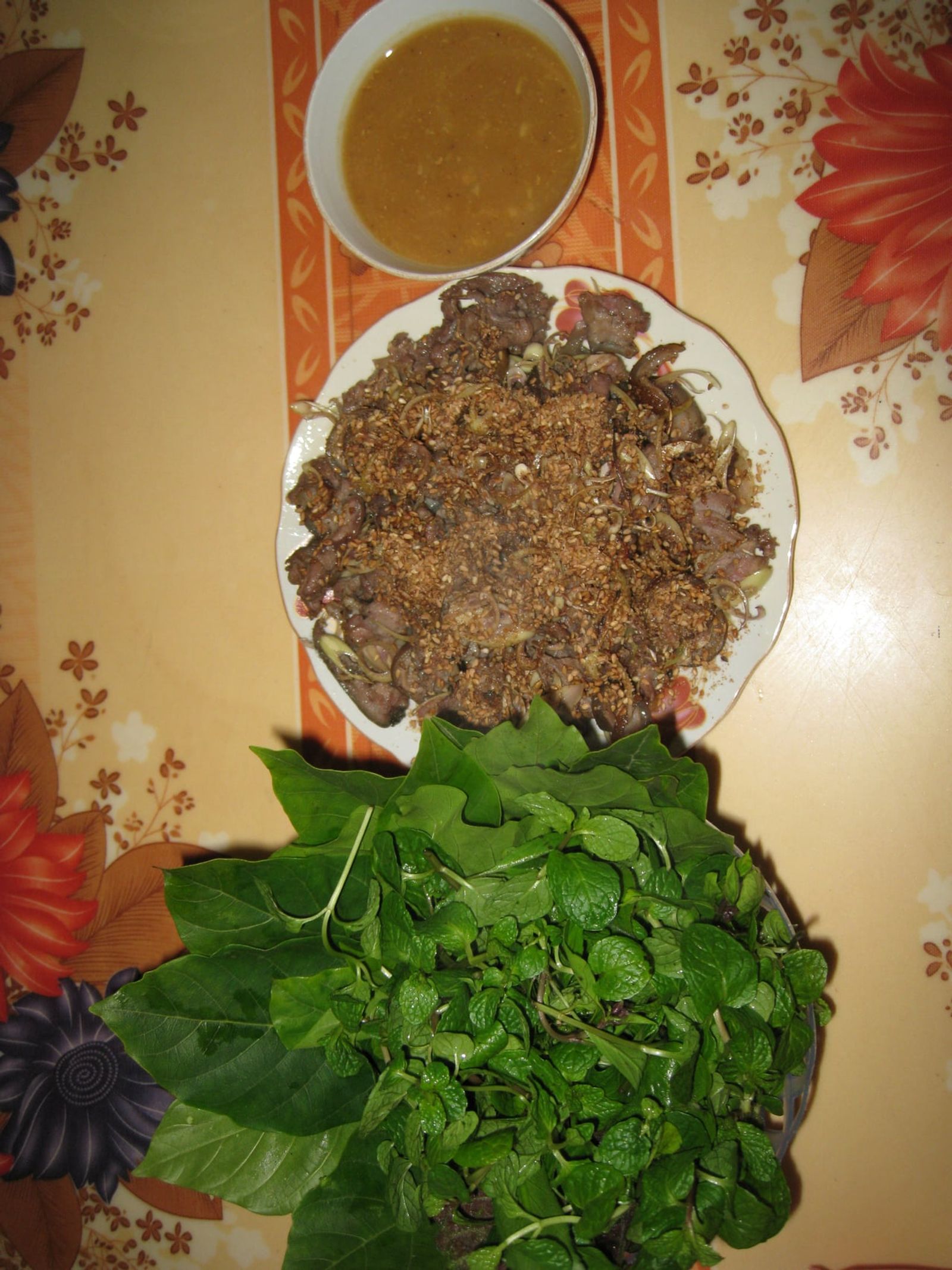
Ninh Bình goat with a plate of fresh leaves · Photo: Nguyễn Thanh Quang / CC BY-SA 3.0 (Wikimedia Commons)
 Vietnam
Ninh Bình Mountain Goat: Limestone-Climbing Goats and How to Eat Tái Dê
Goats raised among the limestone peaks of Tràng An and Tam Cốc are one of Ninh Bình's signature foods. Here is why the local goat is famous, the dishes it goes into and what to know when ordering.
Goats Raised by Limestone Mountains
Ninh Bình's scenery is defined by karst limestone peaks rising from the rice fields, and those rocky hills are said to shape the flavour of its goats too. According to Vietnamese Wikipedia, Ninh Bình mountain goats climb and roam the steep limestone terrain far more than goats on grassy hills, which is why their meat is valued as firm, lean and fragrant. They browse on many plants that grow on the karst, including bách bộ, ô rô and cà gai leo. On a boat trip through Tràng An or Tam Cốc you may spot goats grazing high on the cliffs. In Ninh Bình, the words dê núi, mountain goat, call up that landscape itself and work as a local brand.
A Goat That Became a Regional Brand
Ninh Bình mountain goat has official recognition too. According to Vietnamese Wikipedia, in 2012 the Vietnam Record Organisation listed it among the "Top 50 Vietnamese specialty dishes." Geographical-indication protection was also pursued. In 2014 the province issued Decision No. 71 allowing the place name "Ninh Bình" to be used for its mountain goat products, and on 4 July 2018 Vietnam's Intellectual Property Office granted Ninh Bình goat meat geographical indication certificate No. 00067. From 2014 the provincial science and technology department also ran a breeding project to maintain and develop the local goat. Interestingly, restaurants in Hanoi, Ho Chi Minh City, Hạ Long and Đồng Nai also put "dê núi Ninh Bình" on their signs. The name has become a byword for quality, but if you want the real thing, Ninh Bình itself is the surest bet.
The Signature Dish: Tái Dê, Goat "Cooked" With Lime
Of all Ninh Bình goat dishes, the one Vietnamese Wikipedia singles out as the most delicious is tái dê. Tái means rare: thinly sliced goat is cooked only on the surface and tossed with lime juice. Travel media describe it as "rare goat mixed with lime" (dê tái chanh). It is wrapped in the generous plate of fresh leaves and herbs served alongside, then dipped in sauce. A plate of meat with a basket of greens, as in the photo, is the typical spread. Other dishes include goat stir-fried with lemongrass and chilli, goat with lemongrass and coconut, steamed goat (dê hấp), grilled goat (dê nướng), goat nem (nem dê) and nhựa mận, so people often order several for the table.
What Goes With It: Cơm Cháy and Local Liquor
Certain things always come with a Ninh Bình goat meal. The most important is cơm cháy, which is why the Ninh Bình–style cơm cháy sauce is made with goat broth. A local meal means crisp rice crust topped with sauce, eaten between bites of goat. Vietnamese Wikipedia says mountain goat and cơm cháy with Kim Sơn rice liquor make a meal that is rustic yet refined. Rượu cần, the jar wine of Nho Quan, is also introduced as a local drink. Rượu cần is drunk by several people at once through long bamboo straws pushed into a jar. There is also an old folk belief in Vietnam that goat meat is restorative. That is a traditional idea, not a proven medical benefit, so it is enough to enjoy it simply as a delicious regional dish.
Ordering Tips for Travellers
First, tái dê is rare meat. If something close to raw is not for you, choose fully cooked dishes such as grilled goat (dê nướng), steamed goat (dê hấp) or a stir-fry. For a group, a plate of tái dê with one or two cooked dishes plus cơm cháy is a safe order. Second, the leafy greens are not garnish; they are for wrapping. Put meat and herbs on a leaf, roll it up and dip it in the sauce. The slightly bitter leaves balance the richness of the meat. Third, goat restaurants cluster around sights such as Tràng An, Tam Cốc and Bái Đính and along the main roads, so they are handy for lunch after a boat tour or temple visit. Prices vary with the restaurant and portion size, so check before ordering.