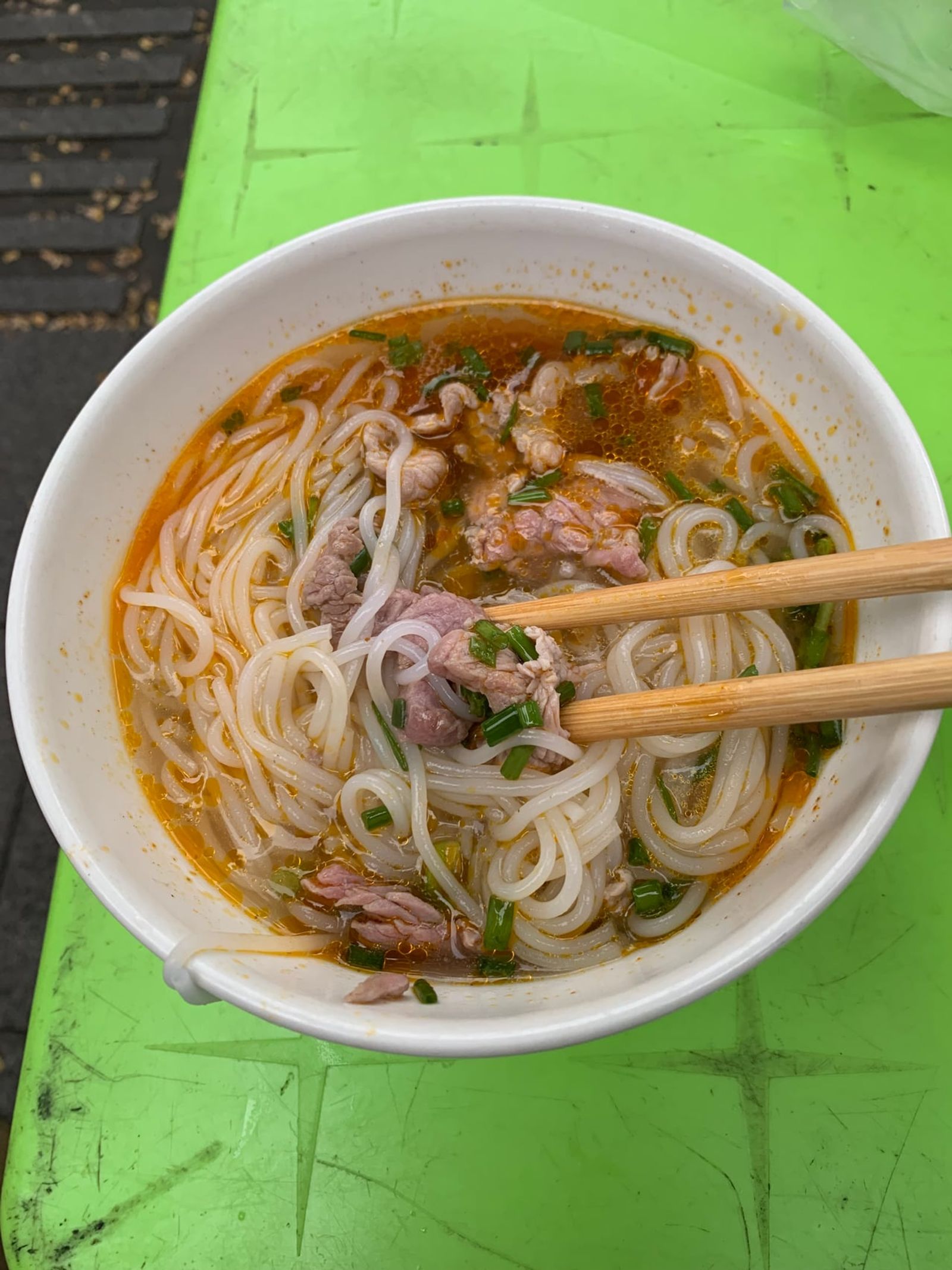
Bún bò Huế at Đông Ba Market, Huế · Photo: Chainwit. / CC BY 4.0 (Wikimedia Commons)
 VietnamHue
Bún Bò Huế: The Red Lemongrass Broth That Became National Heritage
In Huế people simply call it bún bò: thick round rice noodles, a red broth and the scent of lemongrass. Here are the origin theories, the original toppings, how locals eat it and its 2025 listing as national intangible heritage.
In Huế, It's Just "Bún Bò"
Bún bò Huế is the signature noodle soup of Huế, the old royal capital of central Vietnam. You will now find it all over Vietnam and in Vietnamese communities abroad, yet in Huế itself people just call it bún bò, or more precisely bún bò giò heo, beef and pork-knuckle noodles. The "Huế" tag was added elsewhere. Vietnamese Wikipedia explains that outside Huế it is called bún bò Huế or "bún bò from Huế" to make its origin clear, and English Wikipedia notes that the name distinguishes it from Saigon- and Hanoi-style versions. So if a menu in Huế says only bún bò, this is the dish.
Palace Noodles or Village Noodles?
There is no firm record of exactly when or how bún bò Huế began, only several stories. English Wikipedia says it developed in the late 16th and early 17th centuries, when the Nguyễn lords ruled Huế, and gives two accounts. One is that it was court food, first made for the royal family and high officials before spreading to street stalls and homes. The other credits a legendary woman, Cô Bún, from Vân Cù, a village known for its noodles. Vân Cù is said to have made rice noodles for more than 400 years, and its noodles are praised as white and springy, soaking up broth while holding their shape. Whichever story is true, the dish can be seen as the product of both the capital's refined food culture and the skill of village noodle makers.
Red Broth, Thick Noodles and the Original Toppings
The broth is made by simmering beef bones and shank with lemongrass, seasoning it with mắm ruốc (fermented shrimp paste) and sugar, and adding chilli oil as it cooks. English Wikipedia names lemongrass and shrimp paste as the dominant flavours, with spicy, sour, sweet, salty and savoury notes all in balance. The noodles are thicker and rounder in cross-section than those used in phở or bún riêu. On toppings, Vietnamese Wikipedia states that "original bún bò has no rare beef, blood or chả lụa (Vietnamese ham), but has pork knuckle, beef shank and beef tendon." Today, though, many shops add blood cubes or crab cakes (chả cua), and English Wikipedia lists blood among the common ingredients.
How Huế Eats It
According to Vietnamese Wikipedia, bún bò Huế comes with thinly sliced spring onion and onion, lime, fish sauce with chilli and Huế-style chilli paste. Interestingly, it says that "people in old Huế did not eat bún bò with raw vegetables." If greens were added, they were limited to thinly sliced banana blossom, a little mint (húng lủi) and rau răm. Today many shops pile on basil, perilla, ngò gai and bean sprouts, but if you want a more Huế-like bowl, try adding just banana blossom and lime and tasting the broth first. Timing differs too. English Wikipedia says that in Huế bún bò is mainly eaten in the morning as a hearty main meal. Elsewhere it is eaten at any time of day, but in Huế, make it your breakfast.
From Certification Mark to National Heritage
Both the name and the know-how of bún bò Huế now have official protection. According to Vietnamese Wikipedia, Vietnam's Intellectual Property Office issued a certification mark registration for "Bún Bò Huế" on 25 November 2016. In 2025 it went a step further. The Minister of Culture, Sports and Tourism signed Decision No. 2203 adding "folk knowledge of bún bò Huế" to the national intangible cultural heritage list under the folk knowledge category. The decision was signed on 27 June 2025, and the Huế city culture and sports department announced it on 5 July. Coverage cited knowledge passed down over generations, from choosing ingredients to cooking technique and how to eat it. If you are looking for a bowl in Huế, wander around markets where locals eat breakfast, such as the area around Đông Ba Market.