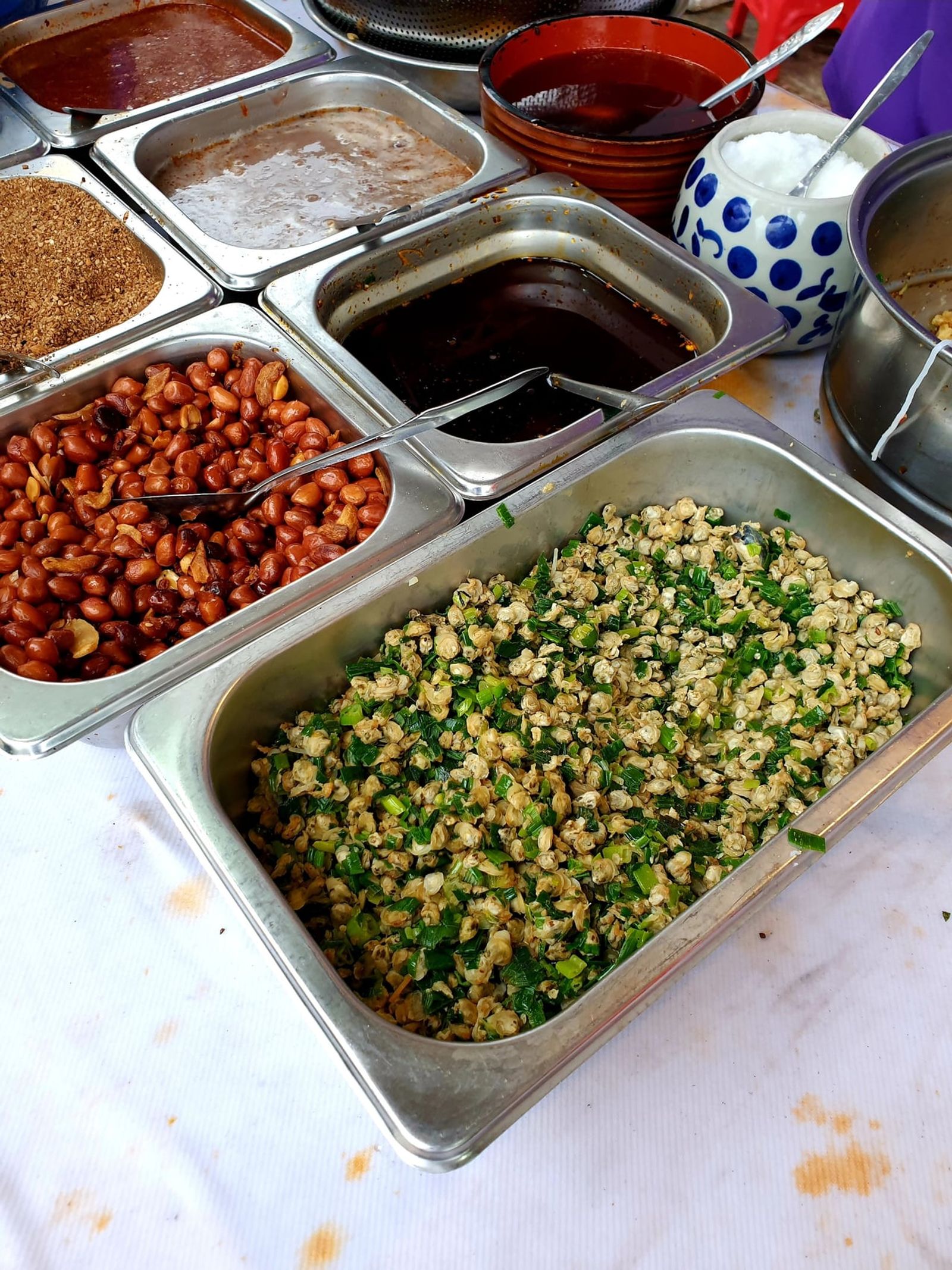
Stir-fried hến clams, peanuts and other cơm hến toppings · Photo: Phương Huy / CC BY-SA 4.0 (Wikimedia Commons)
 VietnamHue
Cơm Hến: Huế's Clam Rice From a Perfume River Islet, Cold Rice and Boiling Broth
Huế's humble cơm hến puts tiny river clams (hến) and more than ten toppings on cold rice, with piping-hot clam broth on the side. Here is what goes into this dish from Cồn Hến islet in the Perfume River and how to eat it.
Cồn Hến, the Islet in the Perfume River
The Perfume River (Sông Hương), which runs through Huế, is split in two by a small islet called Cồn Hến, "the sandbank of hến." Hến are tiny freshwater clams about the size of a fingernail, often called basket clams in English. A 2014 VietNamNet article says Cồn Hến has long supplied the city with hến and other river produce, and that Huế's famous cơm hến, clam rice, comes from this islet. About 600 households lived there at the time. That makes cơm hến unusual in a city known for royal cuisine: it carries the flavour of a riverside village. If palace food is famous for refinement, cơm hến shows the everyday ingenuity of turning a handful of river clams into a meal.
Preparing the Clams and Broth
Vietnamese Wikipedia says that "clam meat and clam broth are the two main flavours of cơm hến," so preparation matters. First the clams are soaked in rice-rinsing water to purge them of mud, rinsed well and boiled until the shells open. The cooking water is left to settle and only the clear top is strained off for broth, while the meat is separated from the shells with a sieve. The tiny clam meat is then stir-fried with oil and seasoning and placed on the rice. VietNamNet describes steaming the clams for a few minutes, removing the meat and serving the broth separately with ginger. Picking meat from clams the size of a fingernail takes time, so this is a dish of cheap ingredients but plenty of labour.
More Than Ten Toppings
A bowl of cơm hến holds more ingredients than you might expect. Combining the lists from Vietnamese Wikipedia and VietNamNet gives the following. Cold white rice, stir-fried clam meat, star fruit (khế) or green mango for sourness, herbs, dọc mùng (a taro-like stem), thinly sliced banana blossom, crisp fried pork fat or puffed pork skin (tóp mỡ), whole roasted peanuts, rice crackers, chilli fried in oil and raw mắm ruốc shrimp paste, all seasoned with fish sauce and pepper. VietNamNet says the combination balances sweet, salty, sour and spicy and has two kinds of crunch, presumably the fried pork fat on one hand and the peanuts and crackers on the other. It is a small bowl layered with flavours and textures.
Cold Rice, Boiling Broth and Very Hot Chilli
What makes cơm hến unique is temperature. Vietnamese Wikipedia writes that "everything is left to cool; only the clam broth is kept boiling hot." Even the rice is cold rather than freshly cooked. Here is how to eat it. Mix everything in the bowl, then pour in a little hot clam broth. Too much and it turns into rice soup, so add just enough to moisten it and sip the rest of the broth on the side. VietNamNet likewise describes pouring hot broth over cooled rice and mixing it with raw vegetables and chilli. And it is meant to be spicy. Wikipedia says cơm hến "must be eaten with really hot chilli to taste right." If you are sensitive to heat, ask for the chilli on the side and add it bit by bit.
From Poor Man's Rice to Huế's Pride
Cơm hến is often described as a humble meal made from cheap river clams, but today it is a Huế specialty enjoyed by locals and visitors alike. VietNamNet notes that it is served at restaurants around Huế city. A few ordering tips: if you are not used to pungent mắm ruốc or mắm nêm, it is fine to ask for it to be left out. VietNamNet also suggests trying it without the sauce if the smell is unfamiliar. You may also see bún hến, clams on rice noodles. Vietnamese Wikipedia, however, says adaptations such as bún hến and mì hến are not Huế specialties, adding that bún hến is probably better eaten dry, without broth.