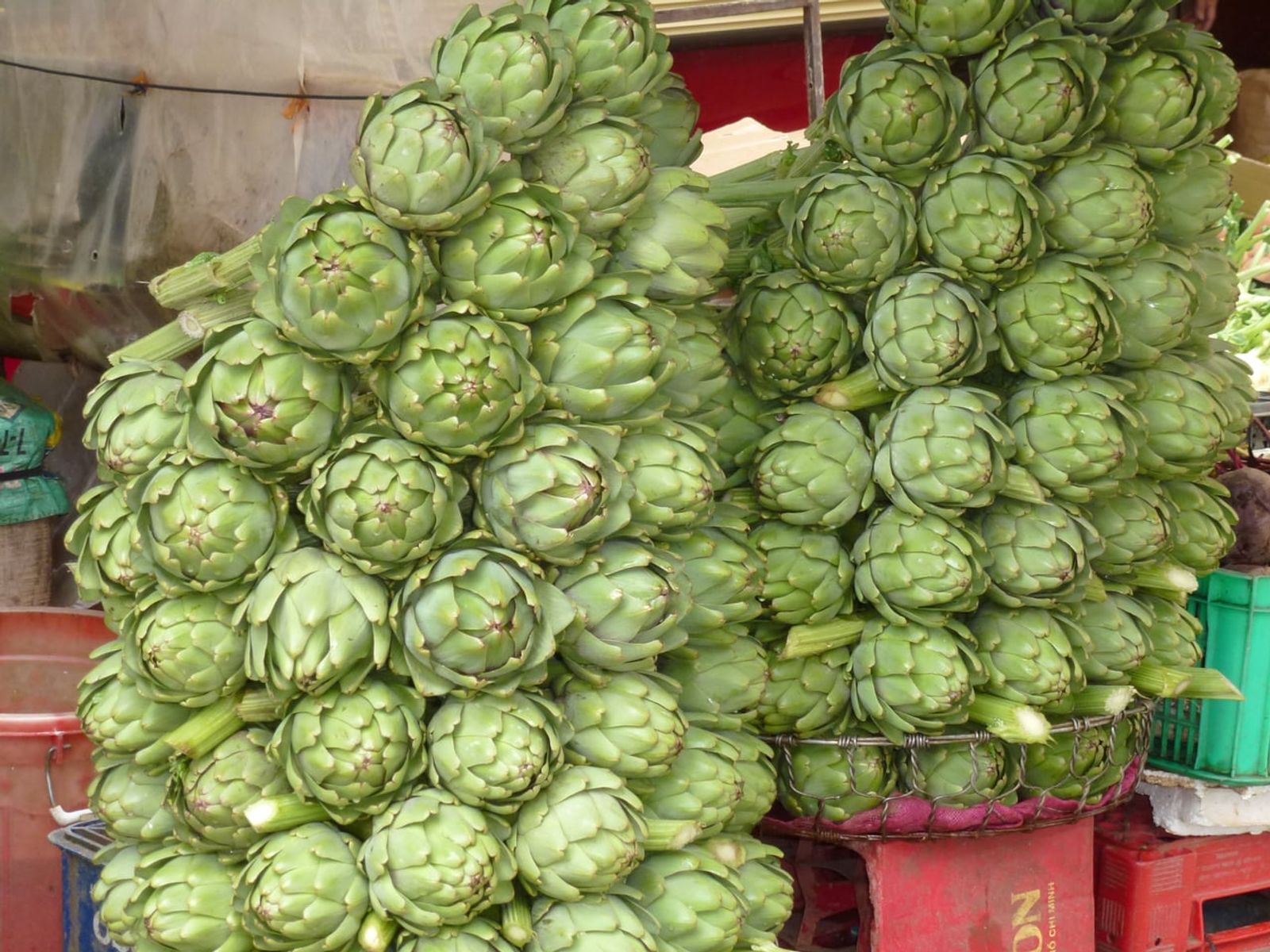
Artichokes piled up at Da Lat Market · Photo: Hungda / CC BY-SA 3.0 (Wikimedia Commons)
 VietnamDa Lat
Da Lat's Artichokes: A French Import the Highlands Turned Into Tea and Soup
The green buds piled high at Da Lat Market are artichokes, a Mediterranean plant that arrived in the French-era hill town. Here is how it became a tea brewed from leaves to roots and a soup simmered with pork hock.
A Hill Town Where European Vegetables Grow
Da Lat became a town after the French-born doctor and explorer Alexandre Yersin surveyed the Lang Biang plateau in 1893 and the colonial authorities developed it as a hill station in the early 20th century. Its cool climate at around 1,500 metres suited European vegetables and flowers that struggle in the hot lowlands. Travel sources say the French era saw the start of temperate crops here such as artichokes, lettuce, strawberries and European flower varieties, and thanks to its year-round cool weather Da Lat is still Vietnam's leading highland vegetable and flower region. Atisô is the Vietnamese name, taken from the French artichaut, for Cynara scolymus, a Mediterranean thistle. Today it counts as one of the city's emblematic local products.
When Did It Arrive? The Exact Year Is Unknown
Exactly when artichokes reached Vietnam is uncertain. Vietnamese Wikipedia says they arrived in the early 20th century and were grown in cool uplands such as Sa Pa and Tam Đảo, but most of all in Da Lat. The same article says the French brought the plant in, but no record pins down the year of the first planting. The exact date is unknown, but the outline is consistent: the French introduced the plant to cool highland areas, and Da Lat became the biggest producer. What is interesting is that a plant introduced in Europe as a bud vegetable was gradually put to completely different uses by Vietnamese cooks, above all as a tea and in a simmered soup.
Artichoke Tea, Brewed From Leaf to Root
In the West, people mostly eat the artichoke's fleshy bud: the base of the bracts and the bottom part known as the heart. The big difference in Vietnam is that the whole plant, leaves, stems, flowers and even roots, is dried and brewed into tea. Artichoke tea (trà atisô) is a common drink in Vietnam and is produced commercially in Da Lat. It tastes gently bitter with a soft sweetness, and local media say many people drink it daily because it is traditionally believed to be good for the liver and digestion. That is folk belief, so enjoy it as part of highland tea culture rather than as medicine. Markets and souvenir shops sell it in many forms: bags of sliced dried root and flower, tea bags and dense concentrated blocks.
Artichoke Flower Simmered With Pork Hock
The signature way to actually eat artichoke in Da Lat is canh hoa atisô hầm giò heo, artichoke buds simmered for a long time with pork hock. The rich, fatty depth of the pork is balanced by the artichoke's mild, clean flavour, and local media report the dish was named among Vietnam's top 50 specialty dishes by an Asian records organisation in 2012. Because the buds go in whole or halved and cook for a long time, you peel off the overlapping bracts one by one, scrape the tender flesh at the base with your teeth, and spoon up the soft centre. It is a warming soup suited to cool highland evenings and can be found on the menus of Vietnamese home-style restaurants in central Da Lat.
Finding Artichokes at the Market
Around Da Lat Market (Chợ Đà Lạt) you will easily spot stalls with green buds stacked into towers. Fresh artichokes are sold for soup, while dried artichoke and tea products are sold as souvenirs. Artichoke tea is light and keeps well, which makes it, alongside coffee, one of the most popular gifts to bring home from Da Lat. The city has also worked to promote the artichoke as its signature crop. In 2023 it announced and showcased 100 dishes made from Da Lat artichokes. On the other hand, local media reported in 2012 that falling prices and difficult sales had led some farmers to uproot artichokes for other crops, a reminder that even a regional emblem rises and falls with the market. Fresh artichokes are heavy and perishable, so for taking home, tea or dried products picked up on your last day are the practical choice.