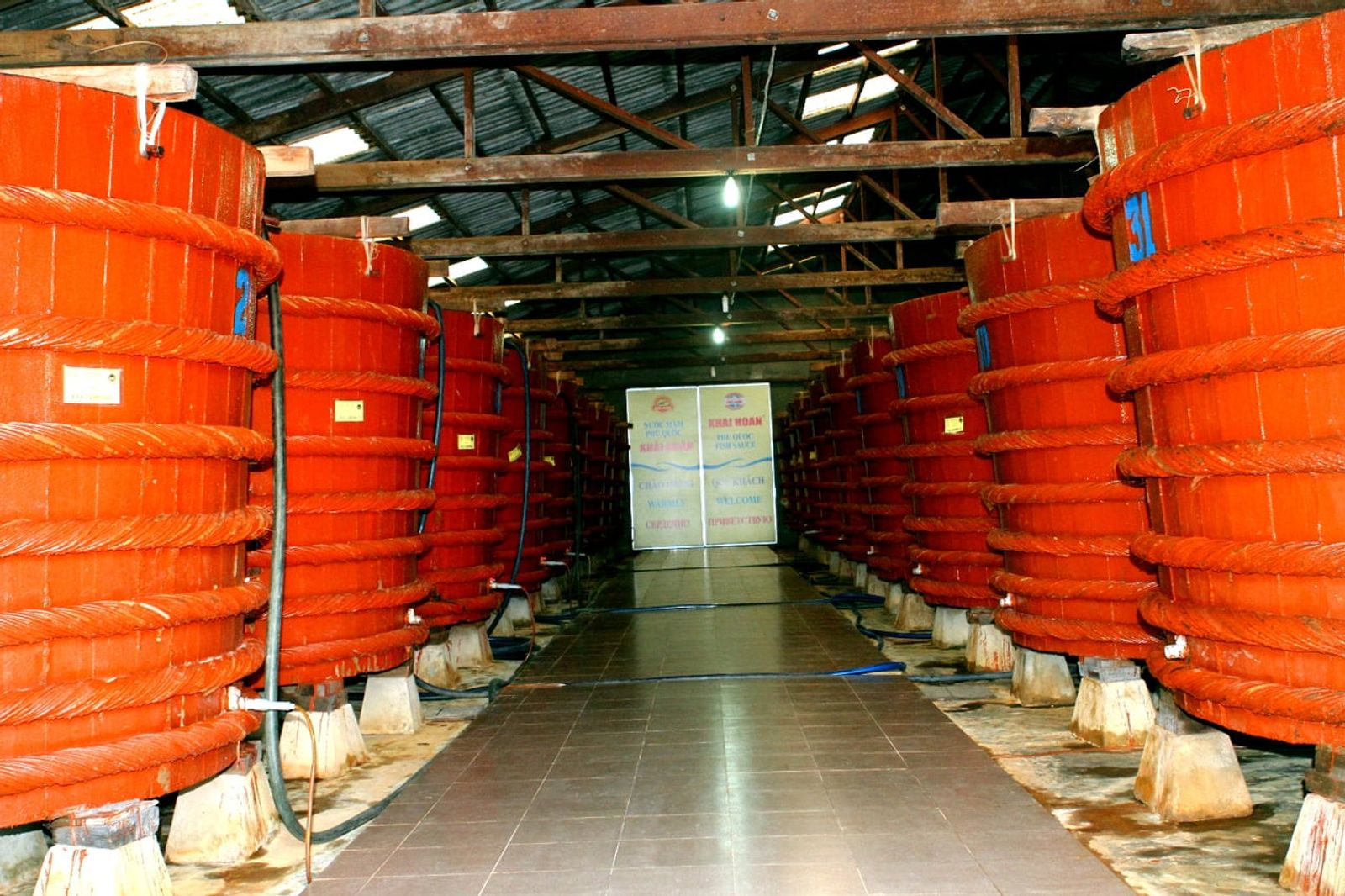
Wooden fermentation vats at a Phú Quốc fish sauce house · Photo: Frank Fox / CC BY-SA 4.0 (Wikimedia Commons)
 VietnamPhu Quoc
Phú Quốc Fish Sauce: Salted at Sea, Aged a Year in Wood, Named for Its Island
Phú Quốc is Vietnam's most famous fish sauce island. From anchovies salted on board the moment they are caught, to more than a year of fermentation in giant wooden vats, to the protected name, here is the island's fish sauce story, plus visiting a barrel house and bringing a bottle home.
An Island Name That Means Quality
Phú Quốc, in the Gulf of Thailand off southwestern Vietnam, is now famous as a resort island, but to Vietnamese it has long been the fish sauce island. Vietnamese press says fish sauce making here has a history of more than 200 years. Until around 1945 it was mostly small-scale and hand-made by natural fermentation, and production grew strongly after that. The island's fish sauce houses, called nhà thùng (barrel houses), are still concentrated around Dương Đông, the main town on the west coast, and An Thới, the southern port. A July 2025 Nhân Dân report says the Phú Quốc Fish Sauce Association has 50 member producers, all vat owners, that the island has more than 7,000 wooden fermentation vats, and that it makes 20 to 30 million liters a year. Under Vietnam's July 2025 administrative reform the island became a special zone (đặc khu) of An Giang province.
Salted on Board the Moment It Is Caught
Phú Quốc fish sauce has just two ingredients: anchovies (cá cơm) and salt. Anchovies are caught around the island all year, and varieties such as the dark cá cơm than, the reddish cá cơm đỏ and the striped cá cơm sọc tiêu are prized as raw material. The key difference is when the salt goes on. On Phú Quốc, anchovies are not taken to port and then salted. They are rinsed and mixed with salt on the boat as soon as the net comes up, sealing in their freshness before the tropical heat can spoil them. Salt is not produced on the island, so it is brought in from Vietnam's central coast. When the salted anchovies are landed, they go straight to the barrel houses and into the vats.
More Than a Year in Bời Lời Wood
Step into a barrel house and you will see rows of wooden vats far taller than an adult. They are mostly made of bời lời wood and bound tight with thick hoops. According to Nhân Dân, each vat holds 12 to 15 tonnes of anchovies. The salted anchovies are packed into the vats and left to ferment naturally for 12 to 15 months (10 to 15 in some sources). Slowly the fish protein breaks down and a clear amber liquid collects. The first draw from the bottom of the vat is the richest, called nước mắm cốt. Vietnamese fish sauce strength is labeled in độ đạm, protein degrees. Phú Quốc first-press sauce is usually described as being in the mid-30s, sometimes above 40, and the higher the number, the deeper the umami and the higher the price.
Protecting the Island's Name
Because the name Phú Quốc became a mark of quality in itself, protecting it became important. In 2001 Phú Quốc fish sauce received geographical indication protection in Vietnam, and in October 2012 Commission Implementing Regulation (EU) No 928/2012 entered it in the EU register as a Protected Designation of Origin (PDO), making it the first Vietnamese product protected in the European Union. The certificate was handed over in Brussels in 2013, which is why some sources give that year. In 2021 Vietnam's Ministry of Culture, Sports and Tourism listed Phú Quốc fish sauce making as national intangible cultural heritage in the field of folk knowledge. Even so, Vietnamese media report a steady stream of fakes that use the Phú Quốc name without permission on sauce made elsewhere. If you want the real thing, buy at a barrel house on the island or choose a product with certification marks.
Visiting a Barrel House and Flying Home With It
Around Dương Đông and An Thới, several barrel houses welcome travelers to see the vats and the process. The smell of fermentation is intense, but you can walk between the vats, taste sauces of different strengths and buy on the spot. The main thing to watch is the flight. Each airline sets its own cabin and checked baggage rules for strong-smelling liquids like fish sauce, including quantity, containers and packing, and these rules change often. Check your airline's latest rules before you buy and again before you fly. In general, a plastic bottle with the lid taped tightly is safer than glass, and it should be packed carefully in something like a foam box so it cannot leak. Some barrel houses will pack bottles for travelers. If your trip involves connecting to another airline, some do not accept odorous baggage, so check every leg.