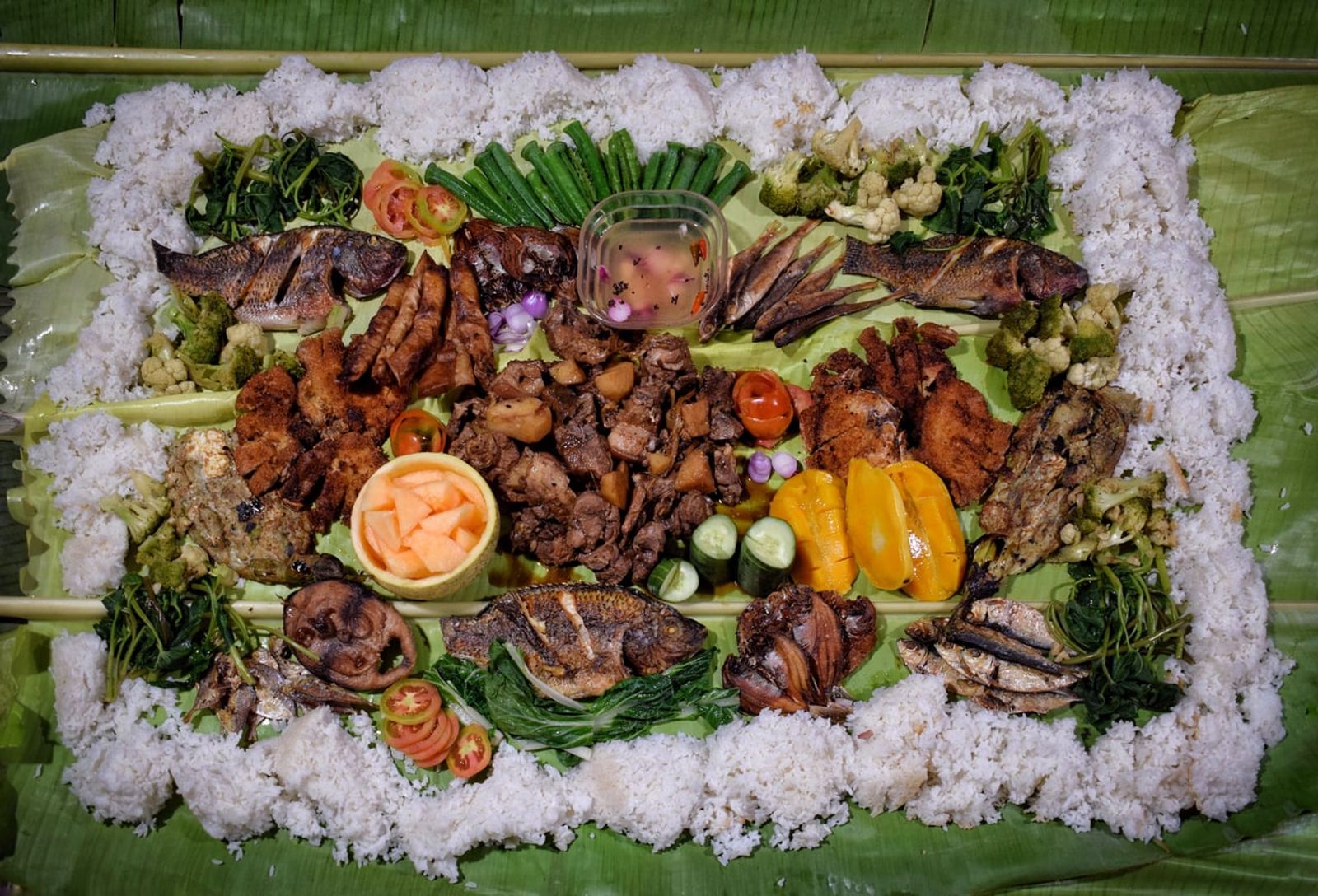
A boodle fight: rice and dishes laid out on banana leaves · Photo: Ej Afable / CC BY-SA 4.0 (Wikimedia Commons)
 Philippines
How Filipinos Eat: Rice and Viands, Point-and-Pick Eateries, Spoon and Fork, Merienda
In the Philippines rice comes with almost every meal, and the table is set with a spoon and fork instead of a knife. From everyday eateries where you point at the pots, to boodle fights eaten by hand off banana leaves, to merienda snack breaks twice a day, here is how to eat like a local from day one.
Rice Is the Star, Dishes Are Viands
Rice sits at the centre of the Filipino table. It goes with almost everything, grilled, stewed or fried, and it often appears at breakfast too. Lunch is typically one or two dishes with rice, sometimes with a soup. In Filipino, a dish eaten with rice is called ulam, and in Philippine English it is often called a viand. The idea is very close to Korean "rice and side dishes", so it can feel surprisingly familiar. Each dish tends to be boldly seasoned, sour or salty, which is exactly what makes you eat more rice. Many eateries price dishes and rice separately, so check whether rice is included before you order.
Carinderia: The Point-and-Pick Eatery
The most common place to eat on Filipino streets is the carinderia (karinderya). The day's dishes sit in pots and trays on display and you choose by looking, which is why it is also called turo-turo, "point-point". The Spanish scholar Wenceslao Retana linked the name to kari, the Tagalog word for curry, and karihan is used with the same meaning. On display you will find home-style dishes such as adobo, sinigang, tinola and kare-kare, along with vegetable and fish dishes, and the line-up changes with the day's ingredients. You do not need the language: point at a pot and hold up fingers for how many. Rice is either included or served on the side, so one or two dishes plus rice is the classic meal.
Spoon and Fork, Not Knife and Fork
The standard Filipino place setting is not a knife and fork but a spoon and fork. You scoop rice and food into your mouth with the spoon, and use the fork to push food onto it or hold things in place. To cut meat, people usually press down with the side of the spoon, so many eateries do not hand out knives at all. It feels odd at first, but it is very practical for eating rice with saucy dishes, and long-braised meat like adobo comes apart easily with a spoon. It also helps to know about dipping sauces: the table often has vinegar with onions or soy sauce with a squeeze of calamansi, collectively called sawsawan in Filipino.
Kamayan and the Boodle Fight
Eating with your hands is an old Filipino way of eating, known as kamayan. It was largely tolerated in the Spanish era but pushed aside under American colonial rule, when spoon-and-fork table manners were strongly promoted; then, from the 1980s and 1990s it became popular again as a way of celebrating Filipino culture. The best-known form is the boodle fight. Banana leaves are laid along a long table and covered with rice, grilled meats, fried dishes, seafood, vegetables and fruit, and everyone stands side by side and eats with no plates or cutlery. It began as a military tradition among Philippine Military Academy cadets, where rank is set aside to build camaraderie. "Boodle" was West Point slang for smuggled sweets. To eat by hand, use one hand to press a little rice and food into a small mound, then push it into your mouth with your thumb.
Merienda: Snack Time, Twice a Day
A Filipino day has extra breaks between the three meals, called merienda. The word came from the Spanish-speaking world and covers both a light mid-morning snack and an afternoon snack equivalent to tea time. A more substantial early-evening snack, eaten before dinner or instead of it, is called merienda cena. Merienda is smaller than a full meal of rice and viand and usually comes with a hot drink such as coffee or something cold. Bread such as the small rolls called pandesal, pastries, sweets, street food and even noodle dishes can all count. If bakeries and street stalls are busy in the mid-afternoon, it is merienda time. Buying a snack to match that rhythm is an easy way for travellers to step a little closer to everyday local life.