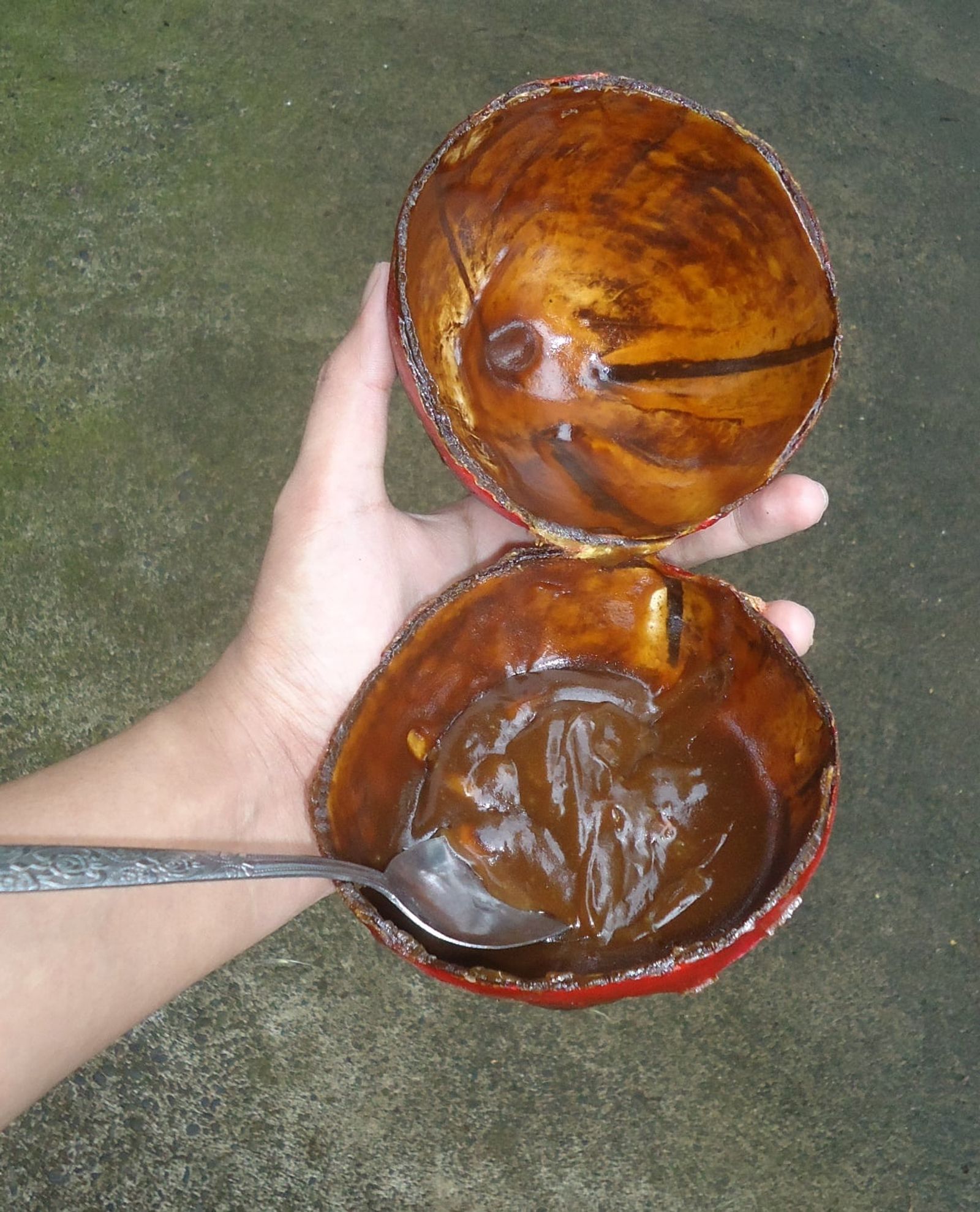
An opened Bohol calamay · Photo: Obsidian Soul / CC BY-SA 3.0 (Wikimedia Commons)
 PhilippinesBohol
Bohol Calamay: Jagna's Sweet, Sealed in a Coconut Shell With Red Paper
A halved coconut shell filled with a sticky brown rice sweet, its mouth sealed with red crepe paper: this is calamay, the pride of Jagna in Bohol. Here is where it comes from, how it is made, and tips for eating it and bringing some home.
What Calamay Is: A Rice Sweet Found All Over the Philippines
Calamay (or kalamay) is a sticky sweet made by slowly cooking a ground glutinous rice paste with coconut milk and brown sugar. Many regions of the Philippines have their own: in Antipolo on Luzon it is spread flat on banana leaves, in Baguio it is packed in small nut shells, and Iloilo and Ilocos have versions famous enough to have festivals. Bohol calamay, though, is recognisable at a glance by its packaging. It is filled into a halved, smooth coconut shell (bagol or paya), and the opening is wrapped and sealed with red crepe paper called papel de japon. Bohol, and especially Jagna on the island's southeast coast, is regarded as its home.
The Parish Priest of Jagna
The story of Jagna calamay is tied to a churchman. According to encyclopaedic and local sources, Father Mariano Gutierrez of the Augustinian Recollects, parish priest of Jagna, deliberately taught residents how to make calamay, especially in the barangay of Can-upao. Some accounts say he worked out the recipe himself. Exactly when he served in Jagna is hard to pin down. Locally, though, Jagna's calamay tradition is said to date from around 1825, and the town's April Calamay Festival celebrates that long history. It is said to have passed from hand to hand in Jagna for close to two centuries.
A Sweet Stirred for Hours: How It's Made
Calamay needs only three things: glutinous rice, coconut milk and brown sugar. Milk is pressed twice from grated coconut. The first pressing is ground with the rice into a paste; the second is boiled with brown sugar for hours into latik, a thick coconut caramel. The rice paste is then poured into the latik and stirred until very thick. It has to be stirred over low heat without stopping for hours so it does not catch, which makes it famously hard work. The finished calamay is filled into coconut shells and sealed with red paper. Today you can also find purple calamay made with ube.
How to Eat and Keep It
Peel off the red paper and the shell is filled to the brim with glossy brown calamay. The easiest way is to eat it with a spoon, and since it is quite sweet, take a little at a time. It can be eaten warm, at room temperature or chilled. It is also good spread on bread, or as a snack with strong coffee. It is sticky and gets on your fingers, so carry wet wipes. Sealed in its shell it travels well, but it is closer to a fresh sweet, so once opened keep it somewhere cool or in the fridge and finish it soon.
Traveller Tips: Where to Buy It and When to Go
Calamay is Bohol's signature souvenir, so it is easy to find in shops and markets in the capital, Tagbilaran, and around the airport. To get a feel for its home, stop in Jagna, along the coastal road southeast of Tagbilaran; it fits neatly into a drive around the island. Jagna is said to hold a Calamay Festival around late April each year, with cooking demonstrations, free tastings and a parade of vehicles decorated with calamay. Dates can change from year to year, so check ahead. If you are flying home with some, pack the shells between clothes so they do not crack, and choose ones whose paper seal is intact.